B2
German level needed before you receive your licence
16
German states, each with its own recognition office
1 licence
valid in all of Germany once granted
B.Sc & GNM
both can apply for recognition
Germany needs nurses, and Indian B.Sc and GNM nurses are in demand. To work here you also need German at B2 level and an Anerkennung, the official recognition that lets you work as a Pflegefachfrau or Pflegefachmann. Our German courses for nurses are planned around that process, so your classes and your paperwork move forward together.
Your path to German Anerkennung
Anerkennung means recognition. A state authority checks whether your Indian training matches the German nursing training. If it does, you receive the Berufsurkunde, your licence to work as a nurse. If the authority finds gaps, you close them first. The route usually looks like this:
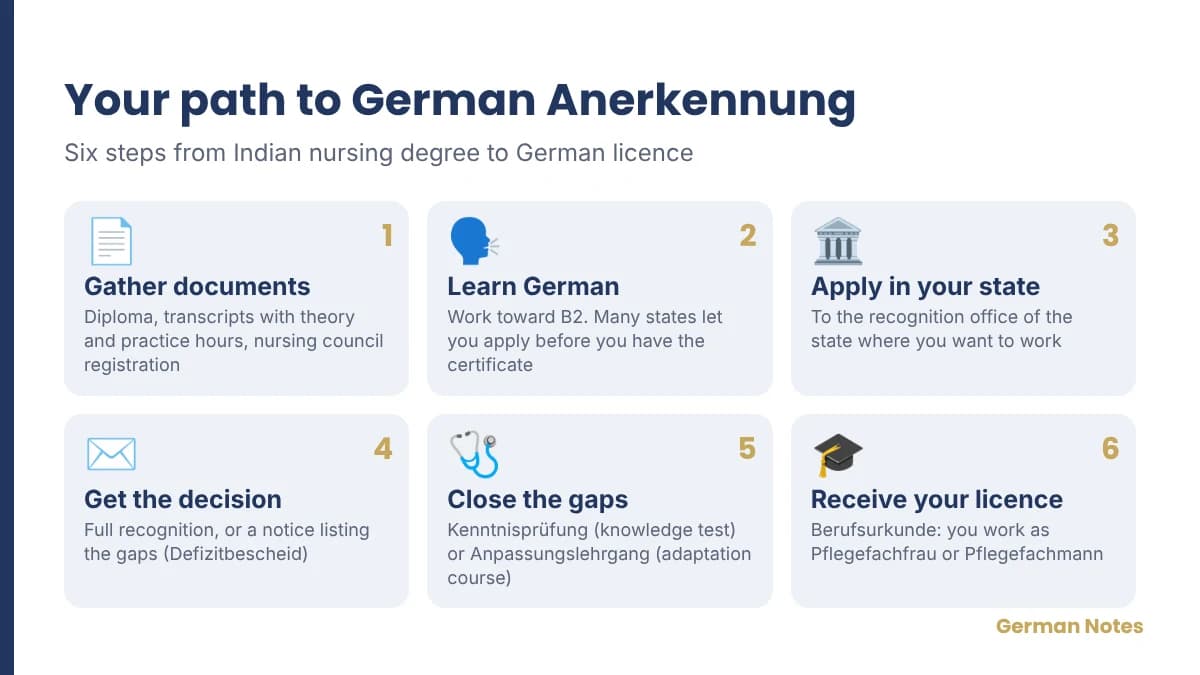
- Gather your documents: degree or diploma, mark sheets and transcripts showing theory and practice hours, internship records, your nursing council registration and experience letters. Most documents need a German translation by a sworn translator.
- Learn German up to B2. You can start your application while you are still learning.
- Send your application to the recognition office of the German state where you plan to work. The recognition is valid in all of Germany.
- Wait for the decision. You get either full recognition or a notice that lists the differences (Defizitbescheid).
- If gaps are found, close them with a knowledge test (Kenntnisprüfung) or an adaptation course (Anpassungslehrgang).
- Once you show B2 German, a medical certificate and a police clearance, you receive your Berufsurkunde.
You can also skip the detailed document check. You waive the equivalence assessment (Verzicht auf die Gleichwertigkeitsprüfung) and go straight to the knowledge test or the adaptation course. This is often faster and needs fewer documents and translations. Your work experience is then not taken into account, and the waiver cannot be withdrawn, so think it through before you tick the box.
हिंदी में समझें
Anerkennung का मतलब है आपकी Indian nursing degree को Germany में मान्यता मिलना। इसके लिए आप उस state के office में apply करते हैं जहाँ आप काम करना चाहते हैं। अगर आपकी training में कुछ कमी (gap) मिलती है, तो आप Kenntnisprüfung (exam) या Anpassungslehrgang (course) से उसे पूरा करते हैं। license (Berufsurkunde) मिलने से पहले B2 German ज़रूरी है।
Nurse recognition in Germany: requirements
The requirements for nurse recognition in Germany come from federal law, so they are the same in every state, even though each office uses its own forms. For the Berufsurkunde you need:
- a nursing qualification that is equal to the German training, or the gaps closed through a test or course
- German at B2 level, shown with an accepted certificate
- a medical certificate that you are fit to work as a nurse
- a police clearance certificate, and in many cases a certificate of good standing from your nursing council
Fees and processing times vary by state. In Hessen, for example, checking the application costs 110 euros and issuing the licence another 110 euros. If your employer uses the accelerated skilled-worker procedure, the authority should decide within two months.
B.Sc nurse Anerkennung in Germany
Typical prerequisites:
- B.Sc Nursing degree certificate
- Mark sheets and transcripts for every year, with theory and clinical hours
- Internship completion certificate
- State nursing council registration
- Experience letters, if you have worked as a nurse
GNM nurse Anerkennung in Germany
Typical prerequisites:
- GNM diploma
- Mark sheets for every year, with theory and clinical hours
- Internship or practical training records
- State nursing council registration
- Experience letters, which can help show skills your diploma does not list
Both B.Sc and GNM nurses can apply. The authority looks at what you actually studied and practised, not only at the name of the degree. Clear transcripts with hours make the comparison easier.
Understanding the B1 German requirement
You will often read that nurses need B1 German. B1 matters, because many recruitment programmes and hospitals expect it before you travel, and it is the level where you can handle everyday conversations with patients and colleagues. For the licence itself, the recognition offices ask for B2.
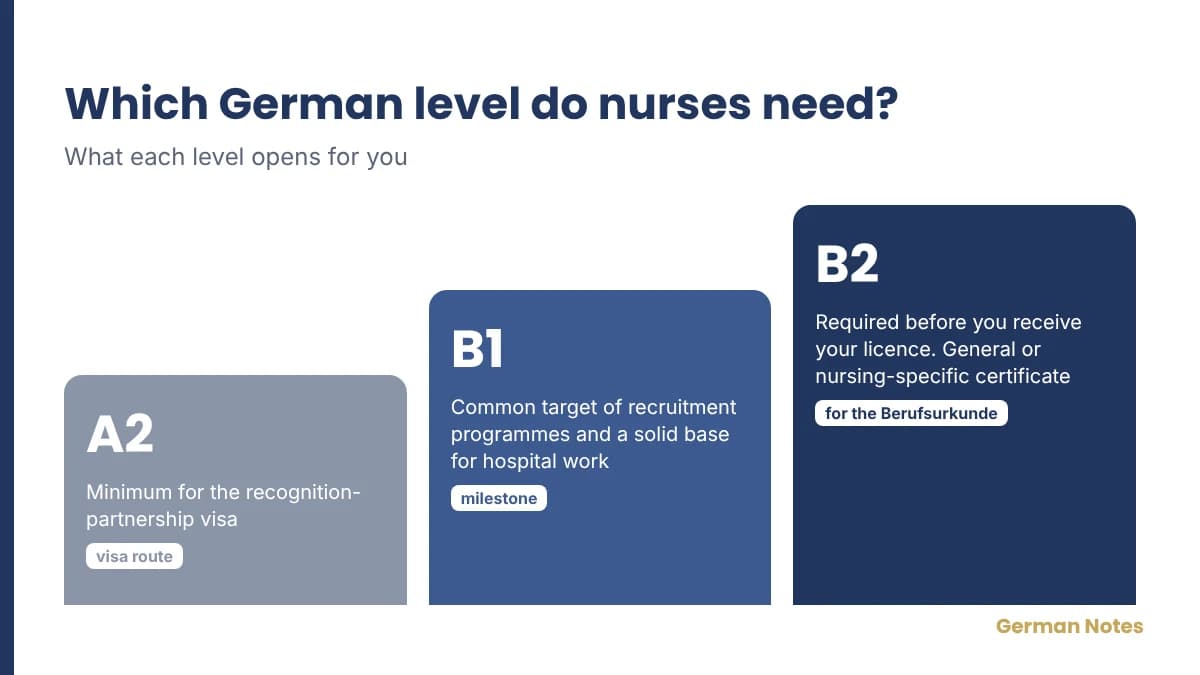
| Level | What it means for you as a nurse |
|---|---|
| A2 | Minimum for the recognition-partnership visa, where you work in Germany while your recognition runs |
| B1 | Common target of recruitment programmes; enough for simple conversations on the ward |
| B2 | Required before you receive your Berufsurkunde; you can write reports and handle handovers |
B2 German for nurse recognition can come from a general exam or a nursing-specific one. Each state publishes the certificates it accepts. Bavaria and Hessen, for example, list telc Deutsch B2, Goethe-Zertifikat B2, ÖSD B2, TestDaF and the nursing version telc Deutsch B2 Pflege. Check your state's list before you book an exam.
हिंदी में समझें
बहुत लोग कहते हैं कि nurses के लिए B1 काफ़ी है, पर license (Berufsurkunde) के लिए B2 चाहिए। B1 एक ज़रूरी पड़ाव है: कई recruitment programmes और hospitals Germany जाने से पहले B1 माँगते हैं। A2 के साथ आप Anerkennungspartnerschaft वाले visa पर जा सकते हैं और वहाँ काम करते हुए B2 तक पहुँच सकते हैं।
Ready to start your B2 German for nurse recognition? Take the free placement test and we will tell you where to begin.
Your course path
Pflegedeutsch Course
German for care work: handovers, documentation and patient talk, with telc Pflege preparation.
B1German B1
The milestone most recruitment programmes ask for before you travel.
B2German B2
The level you need before you receive your nursing licence.
Pflegedeutsch course
Pflegedeutsch is the German nurses use at work. Our Pflegedeutsch course runs at B1 to B2 level and uses real situations from hospitals and care homes, so the vocabulary you learn in class is the vocabulary you need on your first shift.
telc Pflege exam preparation
The telc Deutsch B1·B2 Pflege exam tests German in nursing situations. It has a written part (listening, reading, language elements and a nursing report) and a speaking part taken in pairs. Our telc Pflege exam preparation covers:
- timed practice for every part of the written exam
- writing nursing reports and care documentation in German
- speaking practice in pairs, the way the oral exam is run
- mock exams with feedback before you book the real one
Medical German vocabulary for nurses
The curriculum builds medical German vocabulary for nurses step by step. A few words you will use from the first week:
| German | English |
|---|---|
| die Übergabe | shift handover |
| die Pflegedokumentation | care documentation |
| den Blutdruck messen | to take the blood pressure |
| die Vitalzeichen | vital signs |
| die Medikamentengabe | giving medication |
| die Sturzprophylaxe | fall prevention |
| der Dekubitus | pressure ulcer |
| die Körperpflege | personal hygiene care |
Around this vocabulary the course covers talking to patients and relatives, explaining a procedure, working with doctors, and phone calls and emails in the hospital.
How long does it take to reach B1 German for nurses?
From zero, plan for roughly 9 to 12 months of regular classes and daily practice to reach B1, and about 4 to 6 more months for B2. Treat these numbers as a rough plan. Nurses who can study more hours a week move faster, and those working full shifts usually need longer. The placement test shows where you start, and our guide on how long it takes to reach B1 has realistic timelines for nurse recognition.
You can collect and translate documents while you learn, and in many states you can send your application before your B2 certificate is ready.
German classes for Indian nurses
Our German classes for Indian nurses are live and in small batches, and every level keeps your recognition timeline in mind. You learn with a teacher who knows what the recognition offices and the telc Pflege exam expect.
- live classes with a teacher
- small batches, so you speak in every class
- a free placement test, so you start at the right level
- a 1:1 call to plan your level and your Anerkennung timeline
Working in Germany while your recognition runs
You can finish part of the process in Germany. Two visa routes are common for nurses:
- Recognition partnership (Anerkennungspartnerschaft): you need a German employment contract, an agreement with your employer to complete the recognition, and German at A2 level at least. You work in Germany while the process runs.
- Visa for recognition measures: if your notice lists gaps, you can come to Germany for the adaptation course or the knowledge test preparation. This permit is given for up to 24 months and can be extended to a maximum of three years. German missions may ask for a higher level for this visa, so check the checklist of the German mission responsible for you.
The EU Blue Card is not used for nurses. If your qualification is not recognised as a full nursing qualification, you may still be recognised as a nursing assistant (Pflegehilfskraft).
Other healthcare professions in Germany
Doctors, physiotherapists, midwives and other healthcare workers go through their own recognition process with different language rules. See our German for healthcare professionals page for those paths.
Understand the requirement
German for Nurses
What Anerkennung actually requires, level by level
How long does it take to reach B1?
Realistic timelines for nurse recognition
Frequently asked questions
You need a nursing qualification that the state authority accepts as equal to the German Pflegefachfrau or Pflegefachmann training (or you close the gaps with a knowledge test or adaptation course), German at B2 level, a medical certificate of fitness and a police clearance or certificate of good standing. You apply in the state where you want to work, and the recognition is then valid across Germany.
B2. The recognition authorities ask for German at B2 level before they issue your licence (Berufsurkunde). B1 is an important milestone: many recruitment programmes and employers use it as their target before you travel, but B1 alone does not complete your recognition.
No. Each state publishes its own list. Bavaria and Hessen, for example, accept general B2 certificates such as telc Deutsch B2, Goethe-Zertifikat B2, ÖSD B2 and TestDaF as well as nursing-specific ones such as telc Deutsch B2 Pflege, which comes from the telc Deutsch B1·B2 Pflege exam. Check the list of the state you are applying to.
Starting from zero, plan for roughly 9 to 12 months of regular classes and daily practice to reach B1, and about 4 to 6 more months to reach B2. Your pace depends on how many hours you can study each week alongside work and paperwork.
In many states, yes. Hessen and Bavaria, for example, say you must prove B2 by the time the licence is issued, not when you apply. You can send your application while you are still learning and add the certificate later.
The Kenntnisprüfung is a knowledge test with an oral and a practical part. The Anpassungslehrgang is an adaptation course with classes and supervised practice in a hospital or care home, finishing with a final interview. You choose one of the two; you cannot switch after you have started.
Yes, GNM diploma holders can apply, just like B.Sc Nursing graduates. The authority compares your training hours and subjects with the German training. If it finds gaps, you close them with a knowledge test or an adaptation course.
Yes, through the recognition partnership (Anerkennungspartnerschaft). You need a foreign nursing qualification, a German employment contract, an agreement with your employer to complete the recognition, and German at A2 level at least. You then work in Germany while you finish the process.
Build toward B1/B2 with your Anerkennung timeline in mind.
Live classes, small batches, and a schedule that works alongside the rest of your recognition paperwork. Get our experts to answer your questions within 24 hours.
This page gives general information, not legal advice. Recognition rules are set by each German state and can change. Always check the current requirements with the recognition office of the state where you plan to work.