Quick answer
German conjugation, also called German verb conjugation, means changing a verb to match its subject, tense and mood. In the present tense, regular verbs use a stem plus an ending: lernen becomes ich lerne, du lernst and wir lernen. Irregular verbs need extra attention, while the Perfekt usually combines haben or sein with a past participle.
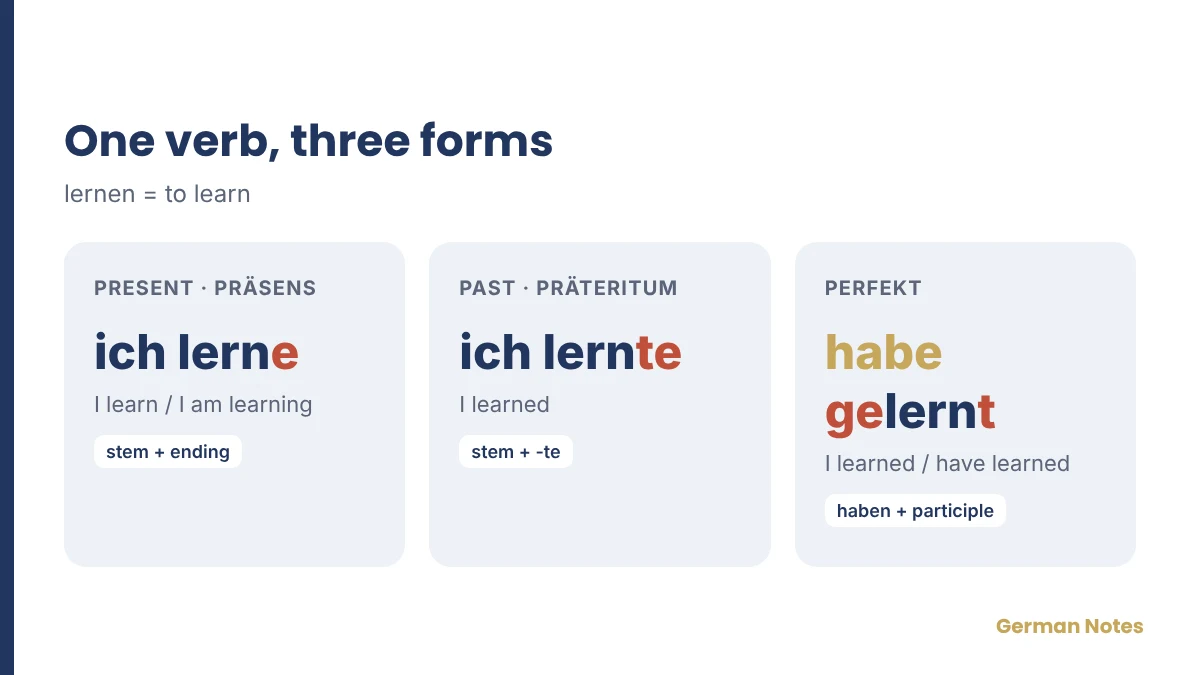
Start with one regular verb and practise it with different subjects. You can build sentences before you know every conjugation. The present, Präteritum and Perfekt forms covered here are useful from beginner through intermediate study; other tenses and moods need separate lessons. If you only need a quick check, jump to the German conjugation chart near the end of the Perfekt section.
In this guide
How does German conjugation work?
The infinitive is the form you find in a dictionary. For many German verbs, you can remove -en to get the stem, then add an ending to match the subject. Check for spelling adjustments or an irregular stem as you go. The conjugated form tells you who is acting and helps show when it happens.
Take lernen, meaning "to learn." Its stem is lern-. With ich (I), add -e: ich lerne (I learn). With wir (we), add -en: wir lernen (we learn). Both are German conjugations of lernen, so you can learn them together as forms of one verb.
The subject determines the verb ending; a nearby object does not. In Die Kinder lernen Deutsch (The children are learning German), Kinder is plural, so the verb is lernen. For the noun and pronoun side of a sentence, use our German cases guide.
How do you conjugate regular verbs in the present tense?
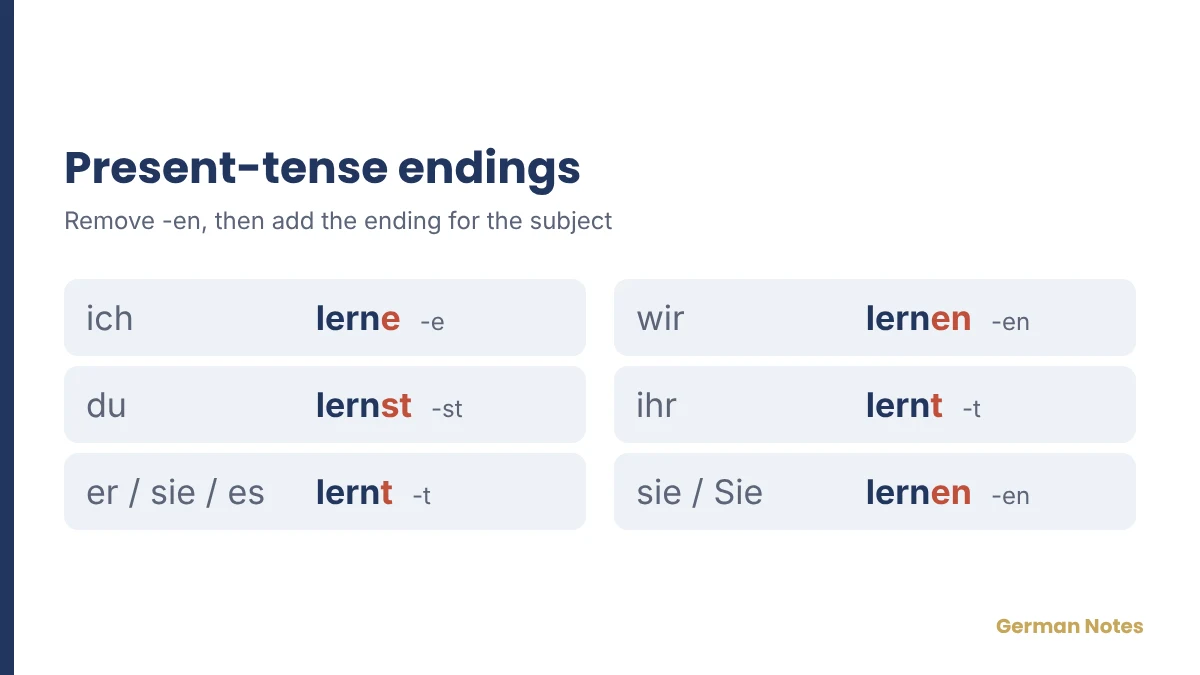
Remove -en from a regular verb and add the ending for its subject: -e, -st, -t, -en, -t or -en. German uses the same present-tense form for a habit and an action happening now. You'll see both translations in the examples below.
| Subject | English | Ending | lernen: to learn | machen: to do/make |
|---|---|---|---|---|
| ich | I | -e | lerne | mache |
| du | you, informal singular | -st | lernst | machst |
| er / sie / es | he / she / it | -t | lernt | macht |
| wir | we | -en | lernen | machen |
| ihr | you, informal plural | -t | lernt | macht |
| sie / Sie | they / you, formal | -en | lernen | machen |
- Ich lerne Deutsch. (I learn German / I am learning German.)
- Wir machen eine Pause. (We are taking a break.)
- Lernt ihr zusammen? (Are you studying together?)
Formal Sie uses the same verb form whether you address one person or several people. Keep its capital letter: Lernen Sie Deutsch? means "Are you learning German?" Lowercase sie can mean "she" or "they"; the verb and context help you identify the meaning.
What steps should you follow with a new regular verb?
Work through the steps with wohnen, meaning "to live." Once you have the right form, put it in a sentence. Saying the whole sentence gives you practice with word order as well as the ending.
- Find the infinitive: wohnen means "to live."
- Choose the subject: du means "you," speaking informally to one person.
- Remove -en: wohnen becomes wohn-.
- Add -st: wohn- becomes wohnst.
- Build a sentence: Du wohnst in Pune. (You live in Pune.)
Now change only the subject: Ich wohne in Pune. (I live in Pune.) Wir wohnen in Pune. (We live in Pune.) Say both aloud and listen to the endings.
Which verbs need spelling adjustments?
Arbeiten follows the regular pattern, with an extra e in forms such as du arbeitest and er arbeitet to make them easier to pronounce. A stem ending in an s sound usually takes only -t with du. These are spelling adjustments; the stem vowel stays the same.
- Du arbeitest heute. (You are working today.)
- Er wartet hier. (He is waiting here.)
- Du heißt Mira. (Your name is Mira.)
The -t in arbeiten and warten is part of the stem. Keep it and add the required ending; do not remove it with the infinitive ending. With heißen, the ß already provides the s sound, so the correct form is heißt.
Check verbs ending in -eln or -ern separately. For example, sammeln (to collect) gives Ich sammle Briefmarken (I collect stamps). The "remove -en" method works for many verbs, but you'll need to adjust it for these infinitives.
What is the difference between regular and irregular German verbs?
Verbs in German fall into three groups. Regular (weak) verbs follow predictable stem and ending patterns across their main forms. Strong verbs change their stem vowel in the past and often have a participle ending in -en; some also change vowels in the present tense. Mixed verbs combine a changed stem with endings that resemble the regular pattern.
| Pattern | Infinitive and meaning | Present: ich | Präteritum: ich | Past participle |
|---|---|---|---|---|
| Regular / weak | lernen: to learn | lerne | lernte | gelernt |
| Strong; present vowel change | sprechen: to speak | spreche | sprach | gesprochen |
| Strong; no present vowel change | kommen: to come | komme | kam | gekommen |
| Mixed | bringen: to bring | bringe | brachte | gebracht |
Kommen has regular-looking present forms and irregular past forms: Ich komme aus Indien (I come from India), but Ich kam gestern (I came yesterday). Check the past forms even when the present tense looks familiar.
With sprechen, lesen and fahren, watch the vowel in the du and er/sie/es forms:
- Du sprichst Deutsch. (You speak German.)
- Sie liest ein Buch. (She is reading a book.)
- Er fährt nach Berlin. (He is travelling to Berlin.)
- Wir fahren nach Berlin. (We are travelling to Berlin.)
Compare fährt with fahren: the vowel change belongs to the singular forms here. When you learn a strong verb, learn its main forms together and check the full conjugation when you need another person or tense.
How do sein, haben, werden and modal verbs work?
Learn the present forms of sein, haben and werden early. These verbs have meanings of their own and also act as helpers in other constructions. With a modal verb such as können or müssen, you conjugate the modal and usually leave the other verb in the infinitive at the end of the sentence.
| Subject | sein: to be | haben: to have | werden: to become | können: can | müssen: must |
|---|---|---|---|---|---|
| ich | bin | habe | werde | kann | muss |
| du | bist | hast | wirst | kannst | musst |
| er / sie / es | ist | hat | wird | kann | muss |
| wir | sind | haben | werden | können | müssen |
| ihr | seid | habt | werdet | könnt | müsst |
| sie / Sie | sind | haben | werden | können | müssen |
- Ich bin müde. (I am tired.)
- Du hast Zeit. (You have time.)
- Sie wird Ärztin. (She is becoming a doctor.)
- Wir können morgen kommen. (We can come tomorrow.)
- Ich muss heute arbeiten. (I have to work today.)
In Ich muss heute arbeiten (I have to work today), muss matches ich and arbeiten stays in the infinitive. Werden has three separate uses: it can mean "become," help form the future, or help form the passive. Its job depends on the rest of the sentence.
Where does a separable prefix go?
With a separable verb in a simple main clause, conjugate the verb and put the prefix at the end. If you add a modal verb, the full infinitive usually stays together at the end. Keep the prefix in both patterns because it carries part of the meaning.
- Ich stehe um sieben Uhr auf. (I get up at seven o'clock.)
- Ich muss um sieben Uhr aufstehen. (I have to get up at seven o'clock.)
The infinitive is aufstehen, meaning "to get up." In the first sentence, stehe matches ich and auf moves to the end. In the second, muss is conjugated, so aufstehen remains intact.
How do you form the German past tense with Präteritum?
The German past tense has two everyday forms: Präteritum and Perfekt. This section covers Präteritum, and the next one covers Perfekt. In the Präteritum, the main verb itself shows the past; there is no separate present-tense helper. Regular verbs add endings built around -te, while strong verbs use a different past stem. Start by learning war and hatte, the useful past forms of sein and haben.
| Subject | lernen: to learn | sein: to be | haben: to have |
|---|---|---|---|
| ich | lernte | war | hatte |
| du | lerntest | warst | hattest |
| er / sie / es | lernte | war | hatte |
| wir | lernten | waren | hatten |
| ihr | lerntet | wart | hattet |
| sie / Sie | lernten | waren | hatten |
- Gestern war ich zu Hause. (Yesterday I was at home.)
- Wir hatten keine Zeit. (We had no time.)
- Er lernte jeden Abend. (He studied every evening.)
Ich and er/sie/es have the same forms in this chart. War stays war with either subject, without the present-tense -t ending. Learn the past stem of a strong verb such as gehen (to go) separately: Ich ging nach Hause means "I went home."
You can use both Präteritum and Perfekt for past events. The choice depends partly on the verb, the situation and regional habits. Avoid treating one as exclusively written German and the other as exclusively spoken German.
How do you form the Perfekt with haben or sein?
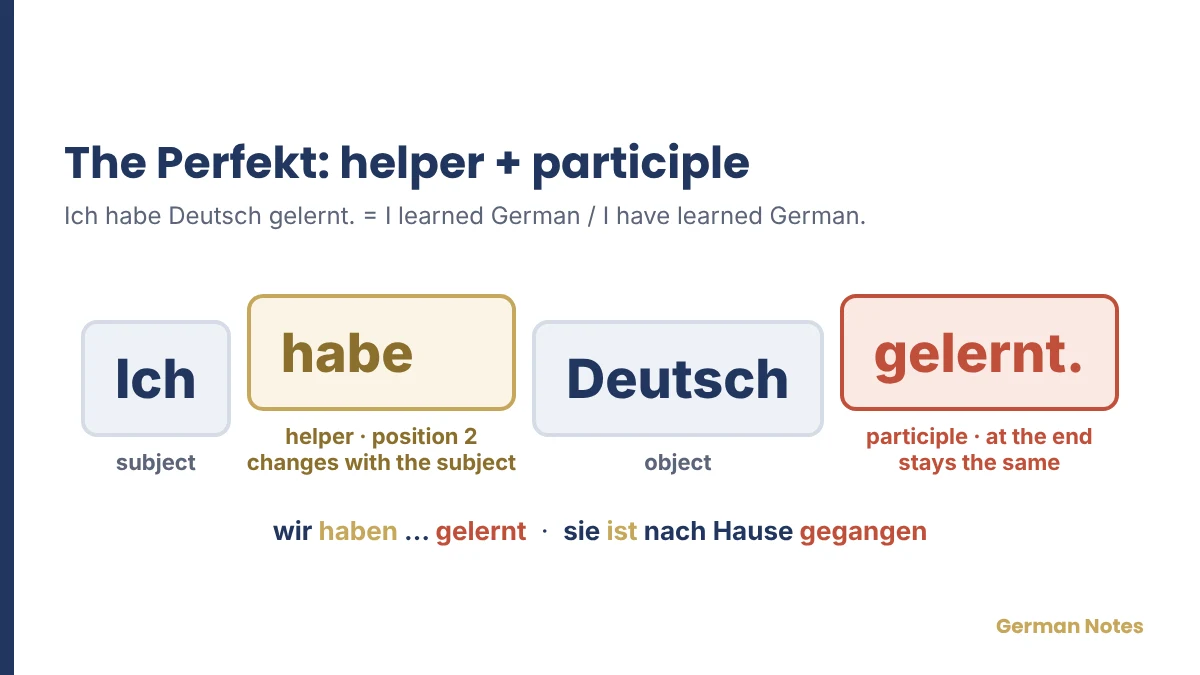
For most verbs, the Perfekt combines a present-tense form of haben or sein with a past participle. The helper changes with the subject; the participle does not. In a simple main clause, put the conjugated helper in the usual verb position and place the participle at the end.
- Ich habe Deutsch gelernt. (I learned German / I have learned German.)
- Wir haben Deutsch gelernt. (We learned German / We have learned German.)
- Sie ist nach Hause gegangen. (She went home / She has gone home.)
The Leibniz Institute for the German Language's Perfekt definition describes this helper-plus-participle structure. In the first two examples, habe changes to haben, while gelernt stays the same. Do not conjugate the participle again.
When should you choose haben or sein?
Haben is the helper for many verbs, including lernen, machen and verbs with an accusative object. Sein is used with many verbs describing movement to a destination or a change of state, as well as sein and bleiben. Learn the helper with the verb; movement alone is not a universal test.
Compare Ich habe gearbeitet (I worked) with Ich bin angekommen (I arrived). Also notice the difference between Ich habe geschlafen (I slept) and Ich bin eingeschlafen (I fell asleep). Einschlafen describes a change of state, which explains the sein helper in this example.
For the fuller distinction, see the IDS explanation of haben and sein. A practical vocabulary note should contain the infinitive, participle and helper together: lernen, gelernt, haben; kommen, gekommen, sein.
How do you build a past participle?
Many regular verbs form the participle with ge- plus the stem plus -t, as in gelernt. Strong verbs often end in -en and may change their stem. Prefixes affect the pattern: separable prefixes usually come before ge-, while common inseparable prefixes and verbs ending in -ieren do not add ge-.
- lernen → gelernt: to learn → learned
- machen → gemacht: to do/make → done/made
- gehen → gegangen: to go → gone
- aufstehen → aufgestanden: to get up → got up
- besuchen → besucht: to visit → visited
- studieren → studiert: to study at university → studied
Check the prefix and verb ending before adding ge-. There's another pattern to learn when a modal accompanies an infinitive: Ich habe arbeiten müssen means "I had to work." Here the Perfekt uses two infinitives instead of the usual past participle.
German conjugation chart at a glance
Use this German conjugation chart to compare the three forms you have met in this guide. It shows lernen (to learn) in the present, Präteritum and Perfekt. These are the main German conjugations to learn first. Copy the pattern for other regular verbs, and check strong and mixed verbs separately.
| Subject | Present | Präteritum | Perfekt |
|---|---|---|---|
| ich | lerne | lernte | habe gelernt |
| du | lernst | lerntest | hast gelernt |
| er / sie / es | lernt | lernte | hat gelernt |
| wir | lernen | lernten | haben gelernt |
| ihr | lernt | lerntet | habt gelernt |
| sie / Sie | lernen | lernten | haben gelernt |
How can you remember German verb conjugation?
Take a sentence you might use, such as Du kommst aus Indien (You come from India). Change the subject, turn it into a question, then try a past event. Keep a note of the forms you get wrong and practise those again in sentences.
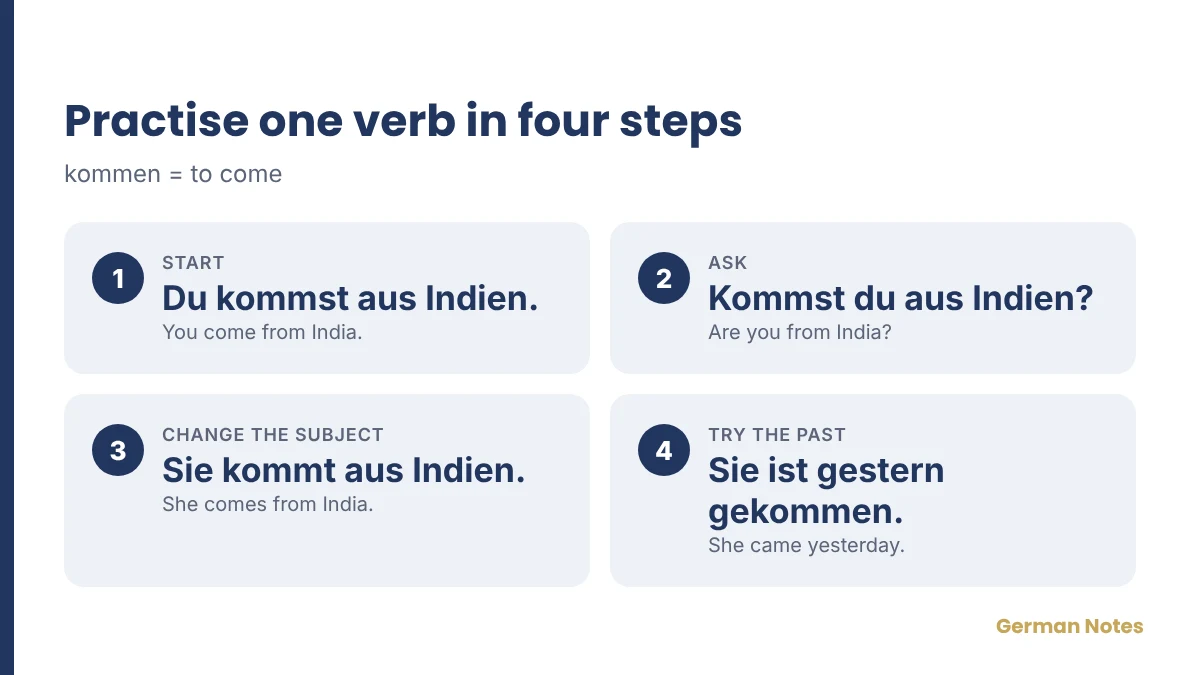
- Start with Du kommst aus Indien. (You come from India.)
- Ask Kommst du aus Indien? (Are you from India?)
- Change the subject: Sie kommt aus Indien. (She comes from India.)
- Try a past event: Sie ist gestern gekommen. (She came yesterday.)
In a statement, the finite verb normally occupies the second position. That means the second sentence element, not necessarily the second word: Heute Abend lerne ich Deutsch means "This evening I am studying German." In a yes/no question, put it first: Lernst du Deutsch? (Are you learning German?)
Avoid translating English "am learning" word for word. German uses Ich lerne Deutsch for "I am learning German." Use our present-tense lesson when you want a shorter refresher, then try the verb conjugation exercises.
Can you choose the correct verb forms?
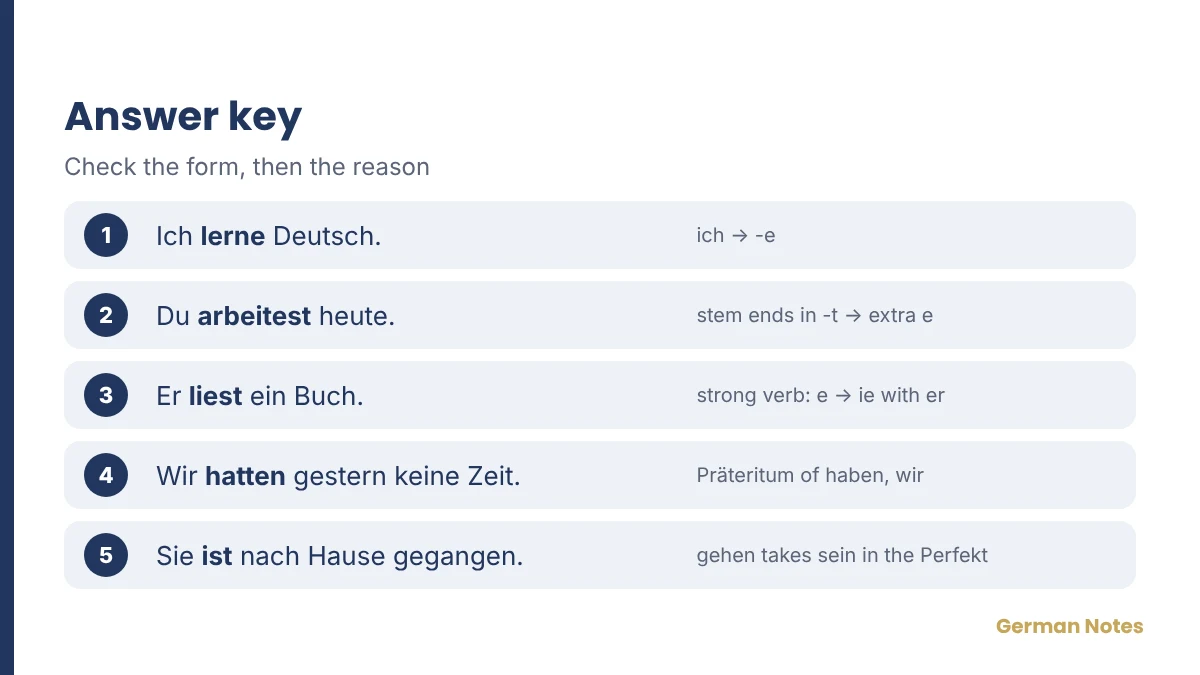
Fill in each gap and say the whole sentence before checking the answers. If you get one wrong, look for the cause: the ending, stem, helper or word order. Practise that part again.
- Ich ___ Deutsch. (lernen) (I am learning German.)
- Du ___ heute. (arbeiten) (You are working today.)
- Er ___ ein Buch. (lesen) (He is reading a book.)
- Wir ___ gestern keine Zeit. (haben, Präteritum) (We had no time yesterday.)
- Sie ___ nach Hause gegangen. (sein; sie = she) (She went home.)
Answers
Answers: 1. lerne; 2. arbeitest; 3. liest; 4. hatten; 5. ist.
Frequently asked questions
What are the regular German present-tense endings?
The usual endings are -e, -st, -t, -en, -t and -en for ich, du, er/sie/es, wir, ihr and sie/Sie. Some verbs need spelling adjustments, so check forms such as du arbeitest (you work) and du heißt (your name is).
Which German verbs should beginners learn first?
Start with sein (to be), haben (to have), and useful everyday verbs such as lernen (to learn), wohnen (to live) and kommen (to come). Add modal verbs as you need to express ability, obligation or permission, and learn each verb in a sentence.
Do all irregular verbs change their vowel in the present tense?
No. Kommen has ordinary present-tense endings but irregular past forms: kam and gekommen. For verbs such as sprechen, the present vowel change occurs with du and er/sie/es: du sprichst (you speak), er spricht (he speaks).
Is Perfekt the same as the English present perfect?
Depending on the situation, ich habe gelernt can mean "I learned" or "I have learned." German Perfekt and English present perfect are used differently, so choose the English translation that fits the meaning.
Should I use haben or sein in the Perfekt?
Learn the helper with each verb: lernen uses haben, while kommen uses sein. Movement and changes of state are useful clues for many sein verbs, but they do not replace checking the verb's actual usage.
What is the German past tense?
German has two common past tenses for everyday use: Präteritum (ich lernte) and Perfekt (ich habe gelernt). Both can describe finished events, and the choice depends partly on the verb and the situation. Learn war and hatte first, then use the Perfekt for most other verbs.
How many tenses are there in German?
German grammar usually lists six tenses: Präsens, Präteritum, Perfekt, Plusquamperfekt, Futur I and Futur II. This guide covers the first three. Plusquamperfekt and the two future tenses need separate lessons.
What does a German verb conjugation chart show?
A chart lists the verb form for each subject: ich, du, er/sie/es, wir, ihr and sie/Sie. Use it to check endings, then say the form in a full sentence so you remember how it sounds.
Related lessons
Book a free demo with GermanNotes to practise these forms in conversation and discuss what you need to work on next.