Quick answer
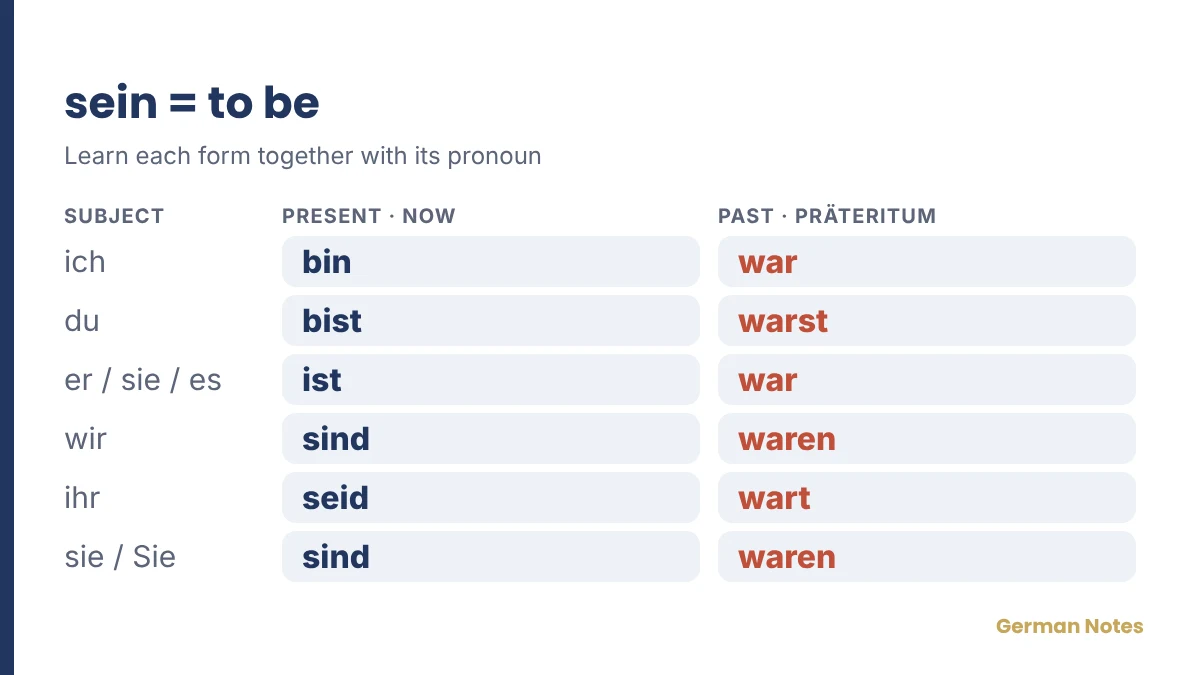
Sein means to be. Its present forms are ich bin, du bist, er/sie/es ist, wir sind, ihr seid and sie/Sie sind. For the past, learn ich war and ich bin gewesen. Sein conjugation is irregular, so memorise the forms with their subjects rather than applying regular verb endings.
हिंदी में समझें
sein का मतलब है होना (to be)। इसके रूप किसी नियम से नहीं बनते, इसलिए हर रूप को उसके pronoun के साथ याद करें: ich bin (मैं हूँ), du bist (तुम हो), er ist (वह है)। बीते समय के लिए ich war (मैं था/थी) और ich bin gewesen (मैं रह चुका/चुकी हूँ)।
Contents
- Sein conjugation chart: present, past and Perfekt at a glance
- Sein conjugation in the present tense
- How do you use sein in everyday sentences?
- When do you use the verb sein?
- What is the simple past of sein?
- How do you form the Perfekt of sein?
- When is sein a helping verb? (including movement and change of state)
- How do you give instructions with sein?
- How do you ask questions and avoid common mistakes?
- Practice: fill in the form of sein
- Frequently asked questions
Sein conjugation chart: present, past and Perfekt at a glance
This chart puts all three tenses side by side. Use it for a quick check, then read the sections below for examples and the reasons behind each form.
| Subject | Present | Präteritum | Perfekt |
|---|---|---|---|
| ich | bin | war | bin gewesen |
| du | bist | warst | bist gewesen |
| er / sie / es | ist | war | ist gewesen |
| wir | sind | waren | sind gewesen |
| ihr | seid | wart | seid gewesen |
| sie / Sie | sind | waren | sind gewesen |
The subject stays the same while the tense changes the picture: Ich bin hier. = I am here. Ich war hier. = I was here. Ich bin hier gewesen. = I have been here.
Sein conjugation in the present tense
The form of sein changes with the subject. You cannot build bin or ist by adding regular endings to the infinitive. Learn the six rows in the chart, then use each form in a short sentence. The plural subjects wir and sie both take sind, as does formal Sie.
| Subject | Sein | English |
|---|---|---|
| ich | bin | I am |
| du | bist | you are, informal singular |
| er / sie / es | ist | he / she / it is |
| wir | sind | we are |
| ihr | seid | you are, informal plural |
| sie / Sie | sind | they are / you are, formal |
Ich bin is the form you need when speaking about yourself. Ich bin müde. = I am tired. Change the subject to wir and you need sind: Wir sind müde. = We are tired.
Sind in German can mean are with we, they or formal you. It is not the form for every English you. Use du bist for one person addressed informally and ihr seid for several people addressed informally.
Compare sie ist (she is) with sie sind (they are) and Sie sind (you are, formal). Capitalization helps in writing, but at the start of a sentence all three begin with a capital. Use the verb and context together.
हिंदी में समझें
हिंदी में तुम हो और आप हैं अलग होते हैं, जर्मन में भी ऐसा ही है। एक दोस्त से: du bist। कई दोस्तों से: ihr seid। अनजान व्यक्ति या ऑफ़िस में: Sie sind। ध्यान दें: sie ist = वह (स्त्री) है, sie sind = वे हैं।
For a shorter first lesson, try the A1 introduction to sein. Sein is also one of the irregular verbs in the German verb conjugation guide.
How do you use sein in everyday sentences?
Use the verb sein to describe identity, age, location or a state. English uses forms of be in many of the same situations. Learn the German expression as a whole, though, because some familiar English phrases use a different verb in German.
- Ich bin Ingenieurin. = I am an engineer. (A woman speaking.)
- Du bist 28 Jahre alt. = You are 28 years old.
- Er ist aus Indien. = He is from India.
- Wir sind zu Hause. = We are at home.
- Ihr seid pünktlich. = You are on time. (Informal plural.)
- Das Essen ist warm. = The food is warm.
Notice that the profession sentence has no ein or eine. German usually omits the indefinite article when stating an unmodified profession after sein. Adjectives and other contexts can change the pattern, so start with a simple introduction such as Ich bin Arzt. = I am a doctor.
Age uses sein: Ich bin 28 Jahre alt. = I am 28 years old. Hunger commonly uses haben: Ich habe Hunger. = I am hungry. You can also say Ich bin hungrig. = I am hungry. Hunger is a noun; hungrig is an adjective.
हिंदी में समझें
पेशा बताते समय ein/eine नहीं लगता: Ich bin Arzt (मैं डॉक्टर हूँ), Ich bin Ingenieurin। उम्र भी sein से: Ich bin 28 Jahre alt। पर भूख के लिए ज़्यादातर haben: Ich habe Hunger, ठीक वैसे जैसे हिंदी में "मुझे भूख है" नहीं, "मुझे भूख लगी है" बोलते हैं।
When do you use the verb sein?
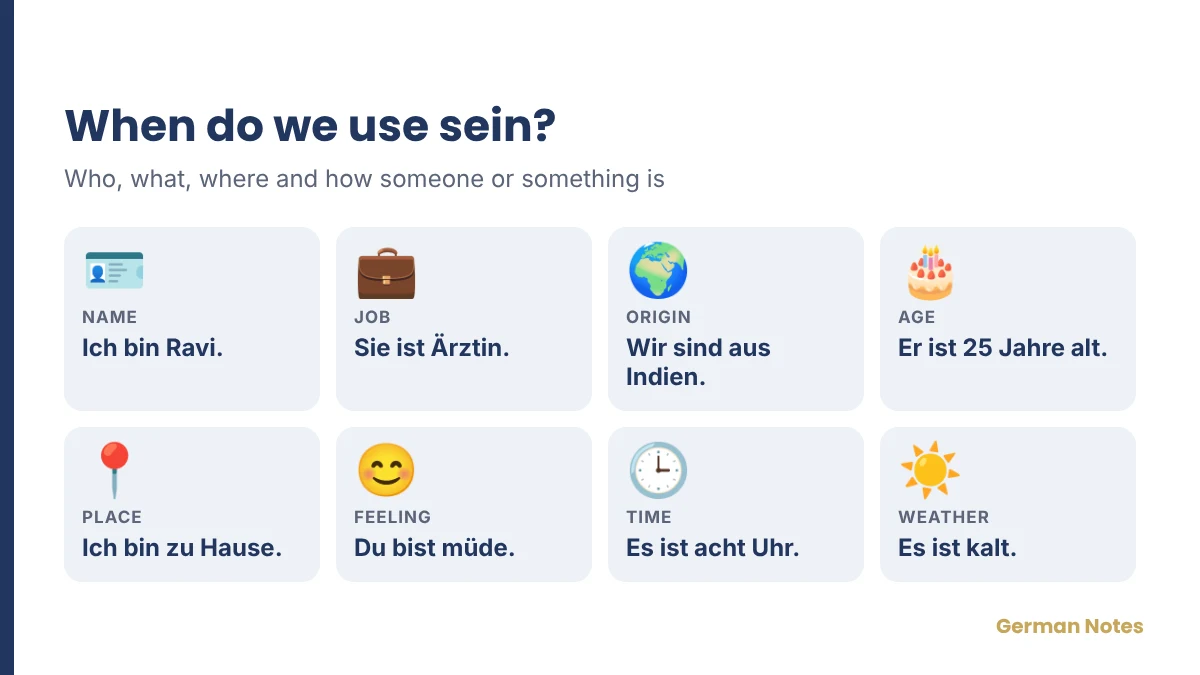
Use sein whenever you say who or what someone is, where they are or what they are like. These are the main uses at A1 and A2 level:
| Use | Example | Meaning |
|---|---|---|
| Name and identity | Ich bin Ravi. · Das ist meine Schwester. | I am Ravi. · This is my sister. |
| Job | Sie ist Ärztin. | She is a doctor. |
| Origin and nationality | Wir sind aus Indien. · Er ist Inder. | We are from India. · He is Indian. |
| Age | Er ist 25 Jahre alt. | He is 25 years old. |
| Place (where something is) | Ich bin zu Hause. · Der Bahnhof ist dort. | I am at home. · The station is there. |
| Feelings and states | Du bist müde. · Wir sind glücklich. | You are tired. · We are happy. |
| Describing people and things | Das Buch ist interessant. | The book is interesting. |
| Time and date | Es ist acht Uhr. · Heute ist Montag. | It is eight o'clock. · Today is Monday. |
| Weather | Es ist kalt. · Es ist sonnig. | It is cold. · It is sunny. |
| Helper in the Perfekt | Ich bin nach Hause gegangen. | I went home. (See the next sections.) |
हिंदी में समझें
sein तब लगता है जब आप बताते हैं कि कोई कौन है, क्या है, कहाँ है या कैसा है: नाम (Ich bin Ravi), पेशा (Sie ist Ärztin), देश (Wir sind aus Indien), उम्र (Er ist 25 Jahre alt), जगह (Ich bin zu Hause), हालत (Du bist müde), समय (Es ist acht Uhr) और मौसम (Es ist kalt)। मौसम और समय में subject हमेशा es होता है।
What is the simple past of sein?
The Präteritum forms of sein are war, warst, war, waren, wart and waren. Use them to say where someone was or what something was like. These forms are common in conversation as well as writing, so you do not need to avoid war when speaking.
| Subject | Präteritum | English |
|---|---|---|
| ich | war | I was |
| du | warst | you were |
| er / sie / es | war | he / she / it was |
| wir | waren | we were |
| ihr | wart | you were, informal plural |
| sie / Sie | waren | they were / you were, formal |
- Gestern war ich krank. = Yesterday I was ill.
- Wir waren am Wochenende in Hamburg. = We were in Hamburg at the weekend.
- Wo wart ihr gestern? = Where were you yesterday? (Informal plural.)
Ich and er/sie/es share war. For ihr, use wart; for wir, sie and formal Sie, use waren. Keep ihr seid and ihr wart together in your notes, because the ihr forms differ from the wir and sie forms.
हिंदी में समझें
war = था/थी। ich war और er war एक जैसे हैं। wir, sie, Sie के साथ waren (थे), और ihr के साथ wart। बोलचाल में भी war बहुत आम है: Gestern war ich krank = कल मैं बीमार था।
The past tense of sein and haben lesson lets you compare war with hatte. Haben has its own pattern, covered in the haben conjugation guide.
How do you form the Perfekt of sein?
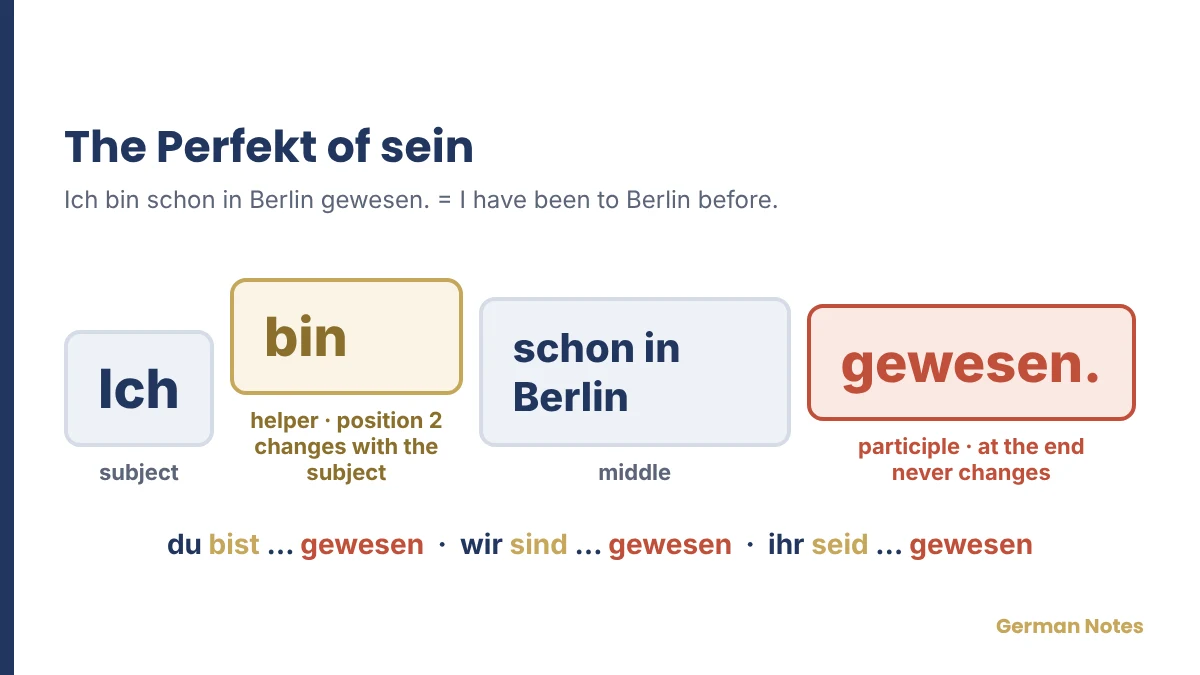
Use a present-tense form of sein plus gewesen, its past participle. The helper changes with the subject, while gewesen stays the same. In an ordinary main-clause statement, the helper occupies the conjugated-verb position and gewesen goes at the end.
| Subject | Perfekt |
|---|---|
| ich | bin gewesen |
| du | bist gewesen |
| er / sie / es | ist gewesen |
| wir | sind gewesen |
| ihr | seid gewesen |
| sie / Sie | sind gewesen |
- Ich bin schon in Berlin gewesen. = I have been to Berlin before.
- Seid ihr schon dort gewesen? = Have you been there before? (Informal plural.)
Both ich war and ich bin gewesen are correct past forms. War is often the simpler choice in everyday conversation. Usage varies by region and context; bin gewesen is not an error or a form reserved for writing.
Do not assume that German Perfekt always needs an English present-perfect translation. Depending on the context, ich bin dort gewesen can mean I was there or I have been there. English and German do not divide past-tense uses in exactly the same way.
हिंदी में समझें
Perfekt = sein का वर्तमान रूप + gewesen। bin, bist, ist subject के साथ बदलते हैं, gewesen कभी नहीं बदलता और वाक्य के आख़िर में आता है। Ich bin schon in Berlin gewesen = मैं पहले बर्लिन जा चुका हूँ। ध्यान रखें: gewesen के साथ हमेशा sein, कभी haben नहीं।
You can check the forms against Duden's sein conjugation table, which also includes tenses and moods beyond this beginner guide.
When is sein a helping verb?
Sein also helps form the Perfekt of other verbs. Compare Ich bin zu Hause. = I am at home, where sein supplies the meaning to be, with Ich bin nach Hause gegangen. = I went home, where bin helps form the past tense of gehen.
Many intransitive verbs expressing a change of place or state use sein in the Perfekt. Common examples include gehen (to go), kommen (to come) and einschlafen (to fall asleep). Sein and bleiben (to stay) also take sein as their helper.
- Sie ist angekommen. = She has arrived.
- Das Kind ist eingeschlafen. = The child has fallen asleep.
- Wir sind zu Hause geblieben. = We stayed at home.
The helper does not mean that every sentence describes travel. Bleiben describes staying, and sein itself forms bin gewesen. Learn each new verb with its participle and helper. Avoid a blanket rule that any physical movement requires sein; many activity verbs use haben.
हिंदी में समझें
sein दो काम करता है। Ich bin zu Hause में इसका अर्थ है "हूँ"। Ich bin nach Hause gegangen में bin सिर्फ़ बीता समय बनाने में मदद करता है: मैं घर गया। जगह या हालत बदलने वाले verbs (gehen, kommen, einschlafen) और bleiben का Perfekt sein से बनता है। हर नए verb को उसके helper के साथ याद करें।
When does a verb take sein in the Perfekt? Movement, change of state and other rules
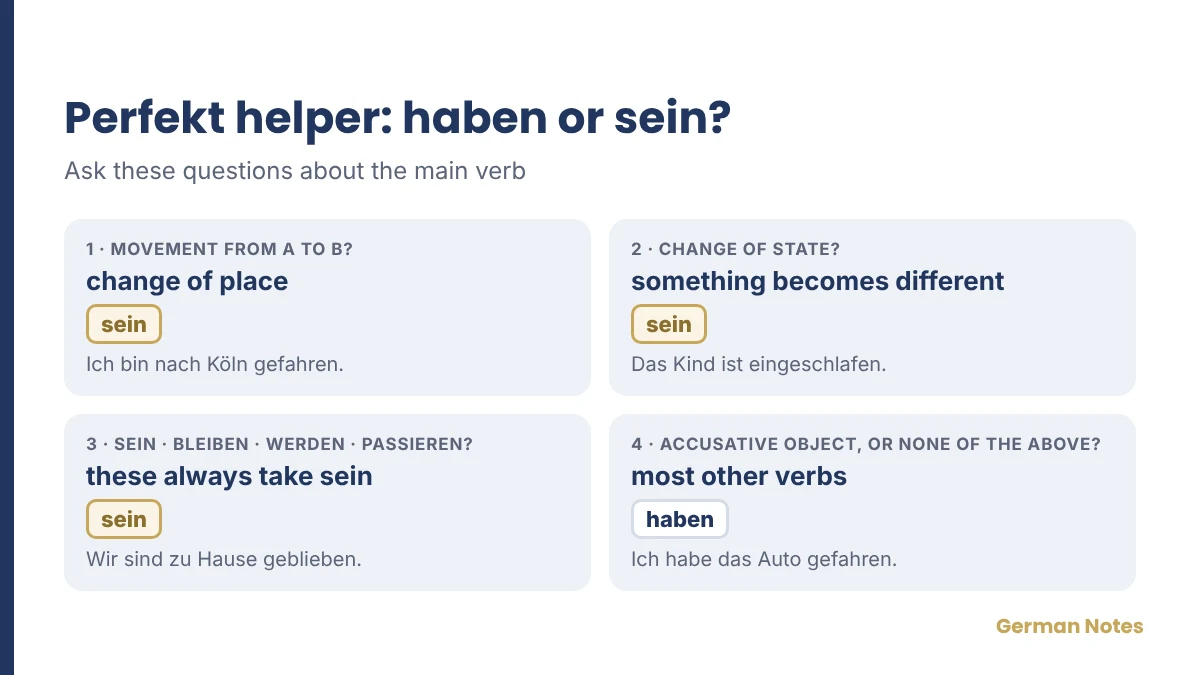
Ask a few questions about the main verb. If the answer to one of the first three is yes, the verb usually takes sein.
- Does the subject itself move from one place to another? Verbs like gehen, kommen, fahren, fliegen, laufen, reisen, fallen, umziehen and aussteigen describe this kind of movement, usually without an accusative object. Ich bin nach Köln gefahren. = I went to Cologne.
- Does the subject change its state and become something different? This is the case with einschlafen, aufwachen, aufstehen, werden, wachsen and sterben. Er ist Lehrer geworden. = He became a teacher.
- Is it one of sein, bleiben, werden, passieren or geschehen? These always take sein, even though nothing moves. Was ist passiert? = What happened?
- If none of this fits, use haben. That covers verbs with an accusative object, reflexive verbs and most activities. Ich habe Deutsch gelernt. = I learned German.
The same verb can change its helper. Fahren takes sein when you travel somewhere, but haben when you drive something: Ich bin nach Berlin gefahren. = I went to Berlin. Ich habe das Auto gefahren. = I drove the car. Movement without a change of place, such as tanzen (to dance), takes haben: Wir haben getanzt. = We danced.
हिंदी में समझें
Perfekt में sein कब? (1) जब subject ख़ुद एक जगह से दूसरी जगह जाता है: Ich bin nach Köln gefahren (मैं कोलोन गया)। (2) जब हालत बदलती है: Das Kind ist eingeschlafen (बच्चा सो गया)। (3) sein, bleiben, werden, passieren हमेशा sein लेते हैं। बाक़ी ज़्यादातर verbs haben लेते हैं। ध्यान दें: Ich habe das Auto gefahren (मैंने गाड़ी चलाई) में object है, इसलिए haben।
How do you give instructions with sein?
The imperative of sein is irregular too. Use Sei for one person you address with du, Seid for several people you address with ihr, and Seien Sie for the formal Sie.
- Sei leise! = Be quiet! (To one person, informal.)
- Seid pünktlich! = Be on time! (To several people, informal.)
- Seien Sie bitte vorsichtig! = Please be careful! (Formal.)
हिंदी में समझें
किसी से कुछ "बनने/रहने" को कहना हो तो: एक दोस्त से Sei …!, कई दोस्तों से Seid …!, और आदर से Seien Sie …!। जैसे Sei leise! = चुप रहो!
How do you ask questions and avoid common mistakes?
For a yes-or-no question, put the conjugated form first: Bist du bereit? = Are you ready? With a question word, put that word first: Wo bist du? = Where are you? In both, choose the form that matches the subject.
| Watch for | Correct form and reason |
|---|---|
| Mixing up ihr and wir | Ihr seid hier. = You are here. Wir sind hier. = We are here. |
| Using haben with gewesen | Ich bin dort gewesen. = I have been there. Sein takes sein in the Perfekt. |
| Confusing seid with seit | Ihr seid müde. = You are tired. Seid is a verb; seit means since or for in time expressions. |
| Copying English am learning | Ich lerne Deutsch. = I am learning German. Ordinary German present-tense statements do not need an extra bin. |
| Confusing the verb sein with sein (his) | Er ist mein Bruder. = He is my brother. Das ist sein Auto. = That is his car. The verb sein (to be) and the possessive sein (his) look the same; the sentence shows which one you have. |
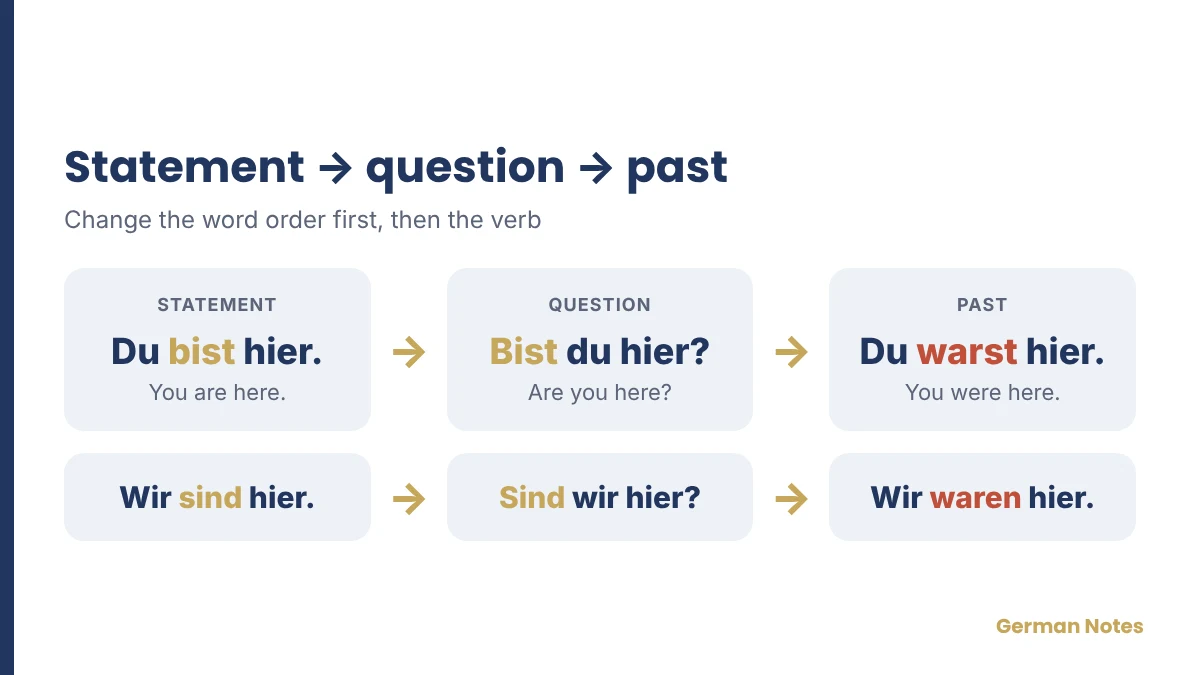
Learn a statement, a question and a past version together: Du bist hier. = You are here. Bist du hier? = Are you here? Du warst hier. = You were here. Repeat the set with wir: Wir sind hier. = We are here. Sind wir hier? = Are we here? Wir waren hier. = We were here.
हिंदी में समझें
सवाल बनाने के लिए verb को पहले रखें: Du bist hier → Bist du hier? (क्या तुम यहाँ हो?)। ग़लती से बचें: seid (हो, ihr के साथ) और seit (से, समय के लिए) अलग शब्द हैं। और sein (होना) और sein (उसका) भी अलग हैं: Das ist sein Auto = यह उसकी कार है।
Practice: fill in the form of sein
Use the tense and English meaning to choose your answer.
- Ich ___ bereit. = I am ready. (Present.)
- Ihr ___ heute früh da. = You are here early today. (Present, informal plural.)
- Gestern ___ wir in Köln. = Yesterday we were in Cologne.
- Wo ___ du gestern? = Where were you yesterday?
- Sie ___ schon dort gewesen. = She has been there before.
- Wir sind zu Hause ___. = We have been at home. (Complete the Perfekt of sein.)
Answers
- bin: the present form with ich.
- seid: the present form with ihr.
- waren: the simple-past form with wir.
- warst: the simple-past form with du.
- ist: she takes ist, including as the helper in the Perfekt.
- gewesen: the past participle of sein.
Frequently asked questions
What is the verb sein in German?
Sein is the German verb meaning to be. It links a subject to an identity, age, place or state, and it also helps form the Perfekt of verbs such as gehen and kommen. Its forms are irregular, so learn them as a set.
What does ich bin mean in German?
Ich bin means I am. It is the first person singular present form of sein, used for identity, age, location and states: Ich bin Anna. Ich bin 28 Jahre alt. Ich bin zu Hause.
Is sein a regular verb?
No. Its present forms are irregular, so learn bin, bist, ist, sind, seid and sind with their pronouns. A regular ending rule will not produce these forms.
What is the difference between war and gewesen?
War is a conjugated simple-past form used with ich and er/sie/es. Gewesen is a past participle and needs a helper in the Perfekt, as in ich bin gewesen.
Does sein take haben or sein in the Perfekt?
It takes sein: ich bin gewesen, du bist gewesen and so on. The helper changes with the subject; gewesen does not.
What is the difference between sind and seid?
Sind goes with wir, sie meaning they, and formal Sie. Seid goes with ihr, meaning you when addressing several people informally.
What does sind mean in German?
Sind means are. It is the present form of sein for wir, for sie meaning they and for formal Sie: Wir sind müde. Sie sind müde. Sind Sie müde?
Can I use war when speaking German?
Yes. The simple-past forms of sein are common in spoken German as well as writing. The Perfekt forms are also correct, with choices influenced by context and regional usage.
When do you use sein in German?
Use sein to say who, what, where or how someone or something is: name (Ich bin Ravi), job (Sie ist Ärztin), origin (Wir sind aus Indien), age, place, feelings, time (Es ist acht Uhr) and weather (Es ist kalt). Sein is also the helper in the Perfekt of many verbs.
Which verbs take sein in the Perfekt?
Verbs that show movement from one place to another (gehen, kommen, fahren, fliegen), verbs that show a change of state (einschlafen, aufwachen, werden, sterben), and sein, bleiben, werden and passieren. Most other verbs, especially those with an accusative object, take haben.
What is the imperative of sein?
Sei for one person you address with du (Sei leise!), seid for several people you address with ihr (Seid pünktlich!) and seien Sie for the formal Sie (Seien Sie vorsichtig!).
Related lessons and practice
Try the sein exercises for more practice with the present forms. If you would like to practise introductions with a teacher, check GermanNotes demo availability.