A1 Grammar · Unit 1 · Topic 1 of 30
The Verb Sein in German: Present Forms, Imperativ and Partizip 2
About 8 minutes · tables, common mistakes and practice with answers
In short
sein means to be. It's one of the first verbs you learn in German, because you need it to introduce yourself. The present forms are irregular (ich bin, du bist, er/sie/es ist, wir sind, ihr seid, sie/Sie sind), so it pays to learn them in your first week.
What does sein mean in German?
Sein in German is the verb to be. You'll find it in the dictionary as the infinitiv sein, but you'll rarely see that form in a sentence. The sein verb changes with every subject: Ich bin Ravi. Du bist nett. Sie ist Lehrerin.
One thing confuses beginners. There's a second sein, and it means his: Das ist sein Buch. = That is his book. You can tell the two apart from the rest of the sentence.
Here we stick to what you need at A1. If you want the full sein conjugation in every tense, our sein conjugation guide has it.
हिंदी में समझें
sein का मतलब है होना (to be)। dictionary में आपको sein मिलता है, पर sentence में यह subject के हिसाब से बदलता है: ich bin (मैं हूँ), du bist (तुम हो), er ist (वह है)। ध्यान रखें: sein Buch में sein का मतलब है उसका।
Present sein: the six forms with personal pronouns
Sein is usually the first verb learners meet, and it breaks the normal rules. Nothing in the infinitiv tells you that ich takes bin or er takes ist. You simply have to learn the six forms.
ich bin·du bist·er/sie/es ist·wir sind·ihr seid·sie/Sie sind
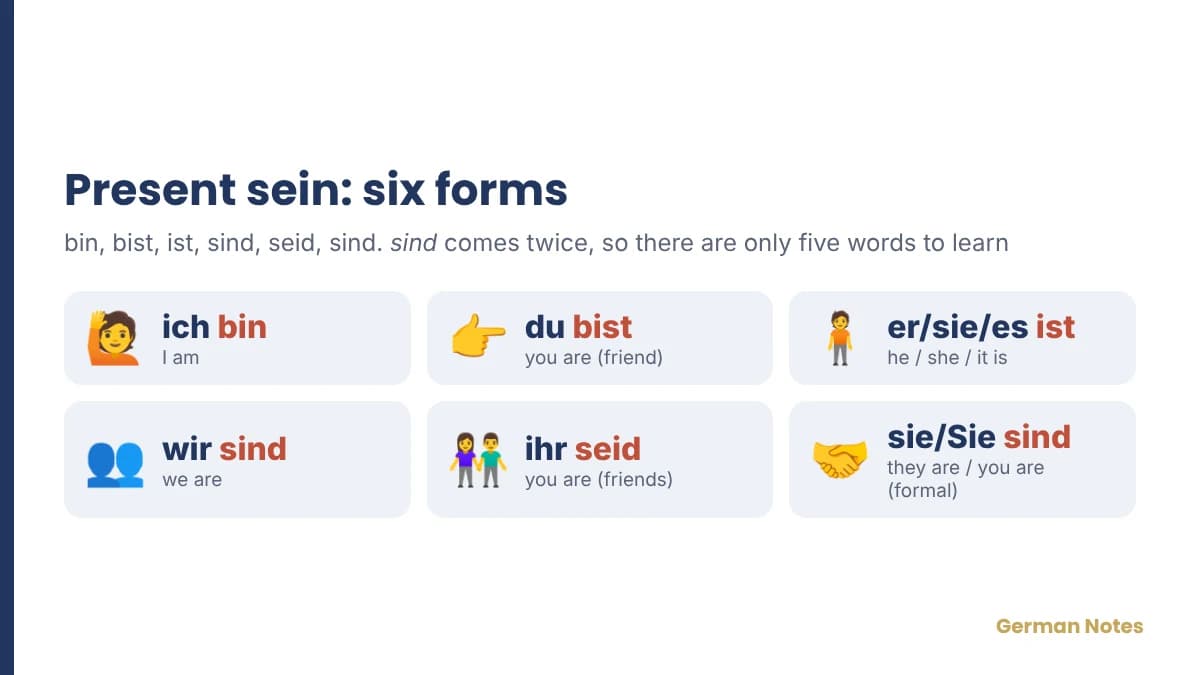
| Pronoun | sein | English | Example |
|---|---|---|---|
| ich | bin | I am | Ich bin Student. |
| du | bist | you are (one friend) | Du bist aus Indien. |
| er / sie / es | ist | he / she / it is | Sie ist Ärztin. |
| wir | sind | we are | Wir sind in Berlin. |
| ihr | seid | you are (several friends) | Ihr seid müde. |
| sie / Sie | sind | they are / you are (formal) | Sind Sie Herr Sharma? |
Use du with friends, family and children. With adults you don't know, at work or in an office, use Sie. Formal Sie and sie (they) both take sind.
हिंदी में समझें
sein सबसे पहला verb है और यह normal pattern पर नहीं चलता, इसलिए इसके छह रूप याद कर लें। दोस्तों, परिवार और बच्चों के साथ du, और अनजान लोगों, ऑफ़िस या सरकारी दफ़्तर में Sie। wir, sie (वे) और Sie (आप) तीनों के साथ sind आता है।
Formen von sein and haben
Haben (to have) comes up just as often. It's irregular as well, though only in two places: du hast and er/sie/es hat. Many learners find the Formen von sein easier to keep apart from haben when they see both side by side.
| Pronoun | sein | haben |
|---|---|---|
| ich | bin | habe |
| du | bist | hast |
| er / sie / es | ist | hat |
| wir | sind | haben |
| ihr | seid | habt |
| sie / Sie | sind | haben |
How do you use sein in a sentence?
At A1 you'll mostly use sein in situations like these:
- Ich bin Priya. = I am Priya. (name)
- Ich bin aus Indien. = I am from India. (origin)
- Er ist Ingenieur. = He is an engineer. (job, without ein)
- Ich bin 25 Jahre alt. = I am 25 years old. (age)
- Wir sind zu Hause. = We are at home. (place)
- Du bist müde. = You are tired. (how someone feels)
- Es ist kalt. = It is cold. (weather)
One small difference from English: with a job, German usually drops ein or eine. You say Ich bin Lehrerin.
Sein Imperativ: Sei! Seid! Seien Sie!
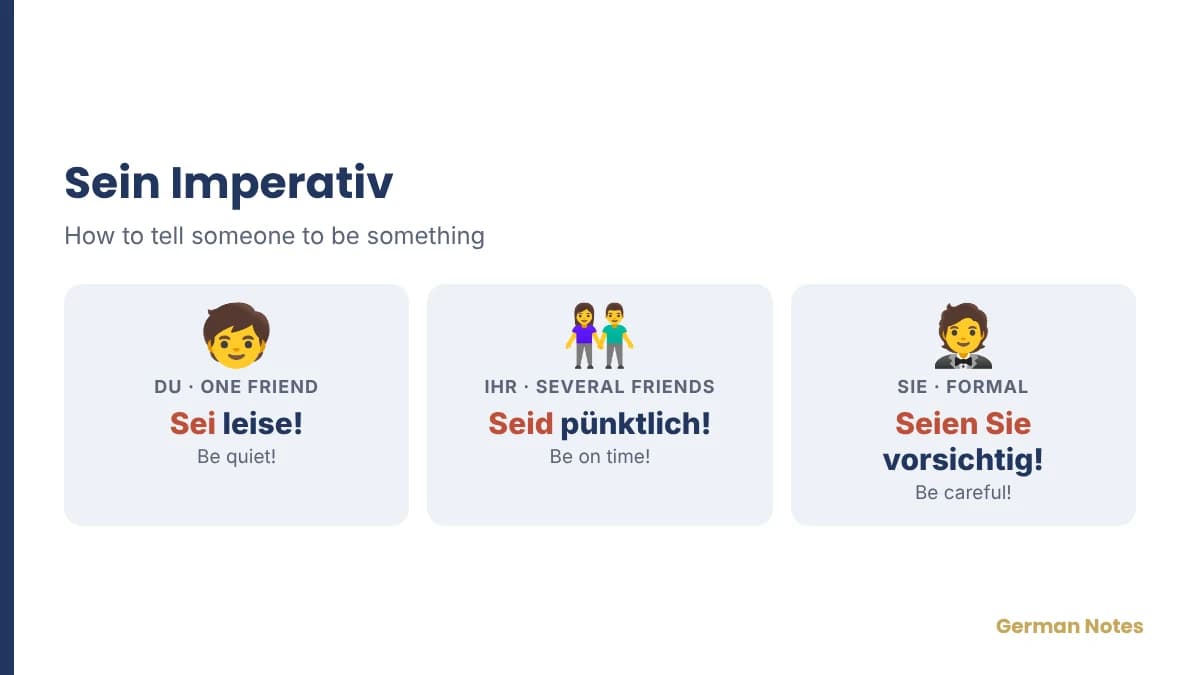
You use the Imperativ to tell someone what to do. With the sein Imperativ, the form depends on who you're talking to.
| You talk to | Imperativ | Example |
|---|---|---|
| one person (du) | Sei! | Sei leise! = Be quiet! |
| several people (ihr) | Seid! | Seid pünktlich! = Be on time! |
| one or more people, formal (Sie) | Seien Sie! | Seien Sie bitte vorsichtig! = Please be careful! |
For wir there's a form that works like English let's: Seien wir ehrlich! = Let's be honest!
हिंदी में समझें
किसी से कहना हो कि ऐसे रहो/बनो, तो एक दोस्त से Sei …!, कई दोस्तों से Seid …! और आदर से Seien Sie …! बोलें। जैसे Sei leise! = चुप रहो!
Sein past tense: war and bin gewesen
There are two ways to put sein into the past, and Germans use both in conversation.
| Pronoun | Präteritum | Perfekt |
|---|---|---|
| ich | war | bin gewesen |
| du | warst | bist gewesen |
| er / sie / es | war | ist gewesen |
| wir | waren | sind gewesen |
| ihr | wart | seid gewesen |
| sie / Sie | waren | sind gewesen |
- Gestern war ich krank. = Yesterday I was ill.
- Ich bin schon in Berlin gewesen. = I have been to Berlin before.
Most A1 learners start with war, since it's a single short word. For more on the sein past tense, see the lesson on the past tense of sein and haben.
Sein Partizip 2: gewesen
The sein Partizip 2 (past participle) is gewesen, and it never changes. In the Perfekt, sein is its own helper verb, and gewesen moves to the end of the sentence:
- Ich bin zu Hause gewesen. = I was at home.
- Wo seid ihr gewesen? = Where have you been?
Learners often say Ich habe gewesen. The correct form is Ich bin gewesen.
हिंदी में समझें
बीते समय के लिए दो तरीक़े हैं: ich war (मैं था/थी) और ich bin gewesen। gewesen sein का Partizip 2 है और यह कभी नहीं बदलता। इसके साथ हमेशा sein आता है, haben नहीं: Ich bin gewesen, Ich habe gewesen नहीं।
Common mistakes with the verb sein
| Wrong | Right | Why |
|---|---|---|
| Ich habe 25 Jahre. | Ich bin 25 Jahre alt. | German uses sein for age. |
| Ich bin Hunger. | Ich habe Hunger. | Hunger and thirst take haben. Ich bin hungrig is also correct. |
| Ihr sind müde. | Ihr seid müde. | ihr always takes seid. |
| Ich bin lerne Deutsch. | Ich lerne Deutsch. | German has no extra bin for English I am learning. |
| Ich bin eine Ärztin. | Ich bin Ärztin. | No ein/eine before a job. |
| Ich habe dort gewesen. | Ich bin dort gewesen. | gewesen goes with sein. |
हिंदी में समझें
उम्र के लिए sein: Ich bin 25 Jahre alt। भूख-प्यास के लिए haben: Ich habe Hunger। और English की तरह Ich bin lerne मत बोलिए, सिर्फ़ Ich lerne Deutsch।
Memory trick
say the forms out loud like a song: bin, bist, ist, sind, seid, sind. Sind comes up twice, so you're really learning five words.
Practice: fill in the form of sein
- Ich ___ Student.
- Du ___ aus Indien.
- Sie (she) ___ Ärztin.
- Wir ___ in Berlin.
- Ihr ___ müde.
- ___ leise! (to one friend)
- Gestern ___ ich krank. (past)
- Ich bin in Köln ___. (Perfekt)
Answers
1. bin · 2. bist · 3. ist · 4. sind · 5. seid · 6. Sei · 7. war · 8. gewesen
Frequently asked questions
Sein means to be. It is the verb in sentences like Ich bin Ravi (I am Ravi) and Wir sind müde (We are tired). The same word sein can also mean his, as in sein Auto (his car); the sentence tells you which one it is.
ich bin, du bist, er/sie/es ist, wir sind, ihr seid, sie/Sie sind. Sind appears twice, so there are five different words to learn.
Sei! for one person you call du, Seid! for several people you call ihr, and Seien Sie! for the formal Sie. For example: Sei leise! Seid pünktlich! Seien Sie bitte vorsichtig!
Gewesen. You use it with a present form of sein to make the Perfekt: Ich bin in Berlin gewesen. = I have been to Berlin.
There are two past forms. The simple past is ich war, du warst, er war, wir waren, ihr wart, sie waren. The Perfekt is ich bin gewesen, du bist gewesen and so on. Both are common when speaking.
Ich bin 25 Jahre alt. German uses sein for age. For hunger and thirst it uses haben: Ich habe Hunger, Ich habe Durst.
Want all the forms of sein in every tense? Read our sein conjugation guide.