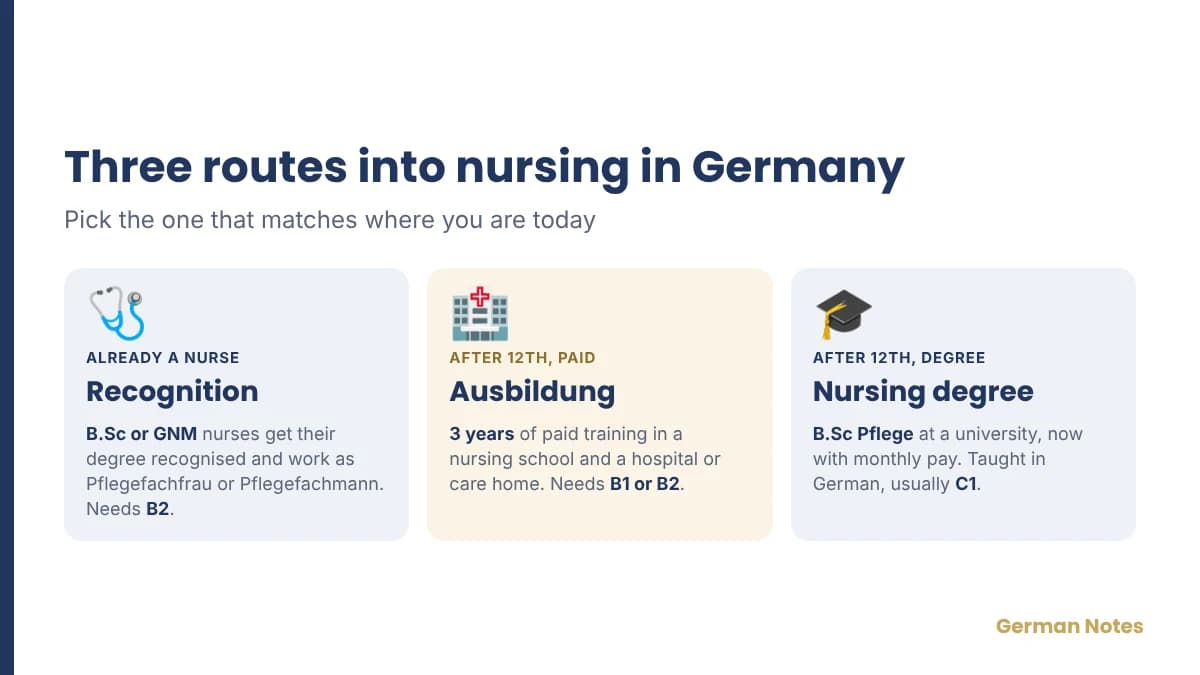
Germany needs nurses, and there are three ways in. If you're already a B.Sc or GNM nurse, you get your qualification recognised. If you've finished Class 12, you can do a paid three-year nursing training (Ausbildung) or study nursing at a university. Every route needs German, but not always at the same level. This guide walks you through each one, from admission to your first job.
हिंदी में समझें
Germany में nursing के तीन रास्ते हैं: (1) अगर आप पहले से B.Sc या GNM nurse हैं, तो अपनी डिग्री की मान्यता (Anerkennung) लें; (2) 12वीं के बाद 3 साल की paid training (Ausbildung); (3) 12वीं के बाद university से nursing degree। हर रास्ते में German चाहिए, पर लेवल अलग-अलग है।
Which route fits you?
| You are… | Route | Duration | German | Money |
|---|---|---|---|---|
| A B.Sc or GNM nurse | Recognition (Anerkennung) | Depends on your case | B2 for the licence | You work and earn once recognised |
| 12th pass, want to start working soon | Ausbildung | 3 years | B1 or B2, depending on the state | Monthly training pay |
| 12th pass, want a degree | Nursing degree (B.Sc Pflege) | Usually 3.5 to 4 years, plus Studienkolleg if needed | Usually C1 | Monthly pay during the degree |
Both the Ausbildung and the degree end with the same licence: Pflegefachfrau or Pflegefachmann. The degree adds a Bachelor's and opens more doors later, but it asks for more German and more paperwork at the start.
Route 1: Recognition for qualified nurses
If you have a B.Sc Nursing degree or a GNM diploma, you don't study again. You apply to the recognition office of the German state where you want to work. It compares your training with the German one. If it finds gaps, you close them with a knowledge test (Kenntnisprüfung) or an adaptation course (Anpassungslehrgang). Then you receive your licence.
- German: B2 is required before the licence is issued. Each state publishes the certificates it accepts.
- Coming early: with a recognition partnership (Anerkennungspartnerschaft), you can start working in Germany while the process runs. For this visa, you need German at A2 level at least, a job offer and an agreement with your employer.
- Programmes: through Triple Win, Germany's Federal Employment Agency and GIZ recruit nurses from Kerala in cooperation with NORKA Roots. Applicants need B1 for the visa and reach B2 in Germany. Placement, language preparation and integration support are free for applicants.
Our page German courses for nurses: your path to Anerkennung explains the recognition steps, documents and fees in detail.
हिंदी में समझें
अगर आप B.Sc या GNM nurse हैं, तो दोबारा पढ़ाई नहीं करनी। आप उस state के office में recognition के लिए apply करते हैं जहाँ काम करना है। license के लिए B2 German ज़रूरी है। Anerkennungspartnerschaft से A2 पर ही Germany जाकर काम शुरू कर सकते हैं। Kerala के nurses के लिए NORKA Roots के ज़रिए Triple Win programme भी है।
Route 2: Ausbildung, paid nursing training
The Ausbildung is Germany's standard way to become a nurse. It lasts three years (five years part-time) and ends with a state exam. You learn the theory at a nursing school and the practice in hospitals, care homes and home care services. The title you get, Pflegefachfrau or Pflegefachmann, is recognised across the EU.
Admission requirements:
- School: an intermediate school certificate (mittlerer Schulabschluss). Your Indian certificates have to be recognised as equivalent, so start that check early.
- German: B1 or B2, depending on the state where you train. Many employers expect B2 before they sign the training contract.
- A training contract with a hospital or care provider, and a visa for vocational training.
You're paid every month during the training. The amount depends on the employer, the region and the year of training. As an example, one common pay scale sets it from May 2026 at 1,490.63 euros gross a month in the first year, 1,552.07 euros in the second and 1,653.38 euros in the third.
Kerala students after Plus Two can also apply to the Triple Win trainee programme, run by NORKA Roots with Germany's Federal Employment Agency and GIZ. It combines a nursing Ausbildung in Germany with a monthly stipend and a job afterwards. Check the NORKA Roots website for current application dates.
हिंदी में समझें
Ausbildung = 3 साल की paid nursing training: पढ़ाई nursing school में और practical hospital या care home में। हर महीने stipend मिलता है (उदाहरण के लिए मई 2026 से एक आम pay scale पर पहले साल लगभग €1,490 महीना)। state के हिसाब से B1 या B2 German चाहिए, और आपके 10वीं/12वीं के certificates की मान्यता भी लेनी होगी।
Route 3: A nursing degree at a public or private university
In Germany, you can also become a nurse through a university degree. A primary-qualifying nursing degree (primärqualifizierendes Pflegestudium) gives you a B.Sc and the nursing licence at the same time. Programmes usually last seven or eight semesters. Since 1 January 2024, these students are paid for the whole course, through a training contract with a hospital or care provider that works with the university.
Not every nursing degree leads to the licence. Some degrees are for nurses who are already qualified, or for management or science. If you want to work as a nurse, check that the programme is primärqualifizierend and leads to the Berufszulassung as Pflegefachfrau or Pflegefachmann.
Public or private university?
| Public university | Private university | |
|---|---|---|
| Tuition | Usually none, only a semester fee. Baden-Württemberg charges non-EU students 1,500 euros per semester. | Tuition fees, which vary by university and programme |
| Language of teaching | German | Mostly German for nursing |
| Admission | University entrance qualification and German at C1 | Same legal requirements, but some private universities have their own admission process |
| Pay during the degree | Yes, for primary-qualifying degrees with a training contract | Yes, under the same rules |
| Check before applying | Application deadlines, practice partners | State recognition, accreditation and that the degree leads to the licence |
Admission for Indian students
- Entrance qualification: an Indian Class 12 certificate on its own usually doesn't give direct entry to a German Bachelor's. Most students first complete a one-year Studienkolleg and its final exam. From winter semester 2026/27, the minimum Class 12 score for this route was raised to 70%. Check your own case in the DAAD admission database and with APS India.
- APS certificate: Indian applicants need an APS certificate for their study visa.
- German: nursing degrees are taught in German, so universities usually ask for C1, for example DSH-2, TestDaF 4x4 or telc Deutsch C1 Hochschule.
- Practice partner: for paid study, you also need a training contract with a hospital or care provider that cooperates with the university.
हिंदी में समझें
University से nursing degree (B.Sc Pflege) लेने पर डिग्री और nurse का license दोनों मिलते हैं, और 2024 से पढ़ाई के दौरान हर महीने पैसे भी मिलते हैं। पर पढ़ाई German में होती है, इसलिए आमतौर पर C1 चाहिए। सिर्फ़ 12वीं से सीधा admission नहीं मिलता, पहले 1 साल का Studienkolleg करना पड़ता है। सरकारी university में tuition fee नहीं होती (सिर्फ़ Baden-Württemberg में €1,500 प्रति semester), private में fee लगती है।
German language requirements by route
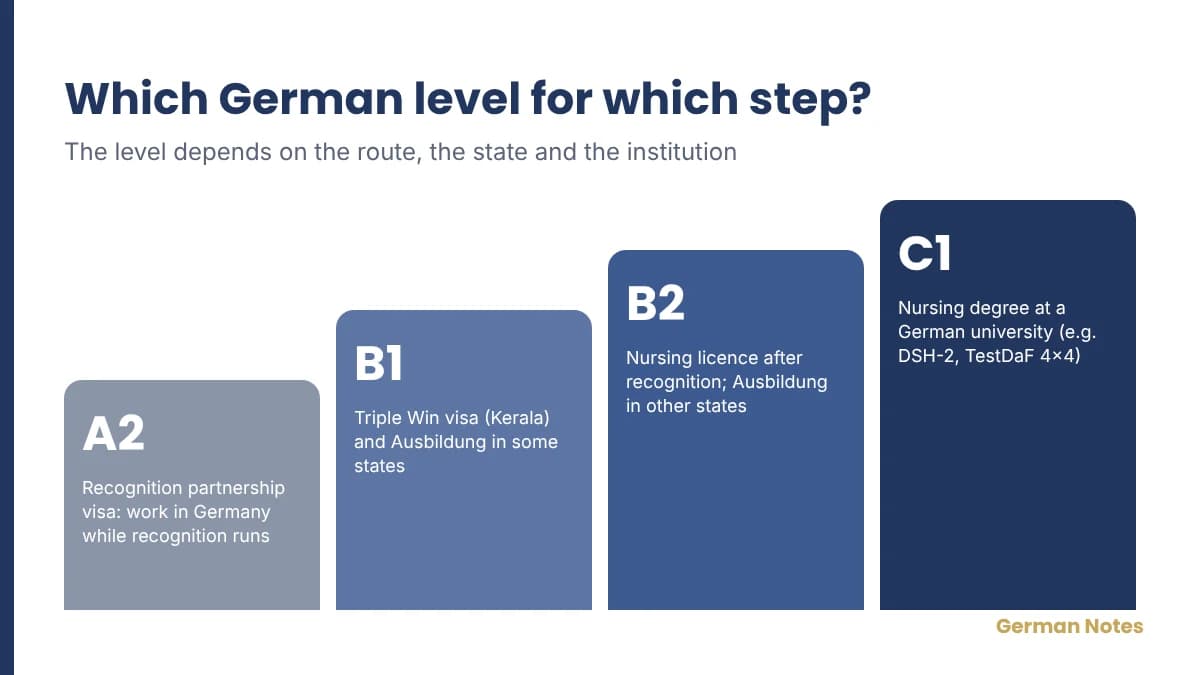
| Level | What it opens |
|---|---|
| A2 | Recognition partnership visa: work in Germany while your recognition runs |
| B1 | Triple Win visa (Kerala); Ausbildung in some states |
| B2 | Nursing licence after recognition; Ausbildung in other states |
| C1 | Nursing degree at a German university |
For recognition, B2 means a certificate on your state's accepted list. Bavaria and Hessen, for example, accept general B2 certificates such as telc B2, Goethe-Zertifikat B2, ÖSD B2 and TestDaF, as well as nursing-specific ones such as telc Deutsch B2 Pflege and Goethe-Test PRO Pflege.
The telc Deutsch B1·B2 Pflege exam gives you a B1 or a B2 certificate, depending on your score. Only the B2 result counts for the licence.
हिंदी में समझें
A2 = Anerkennungspartnerschaft visa, B1 = Triple Win visa और कुछ states में Ausbildung, B2 = nursing license और बाक़ी states में Ausbildung, C1 = university degree। telc Pflege exam में B1 आने पर license के लिए काफ़ी नहीं है, B2 चाहिए।
Nursing jobs and pay in Germany
Qualified nurses work in hospitals, care homes for older people, home care services, hospices, rehabilitation clinics and homes for people with disabilities. Hospitals often let you choose a field later, such as intensive care, the operating theatre or the emergency department.
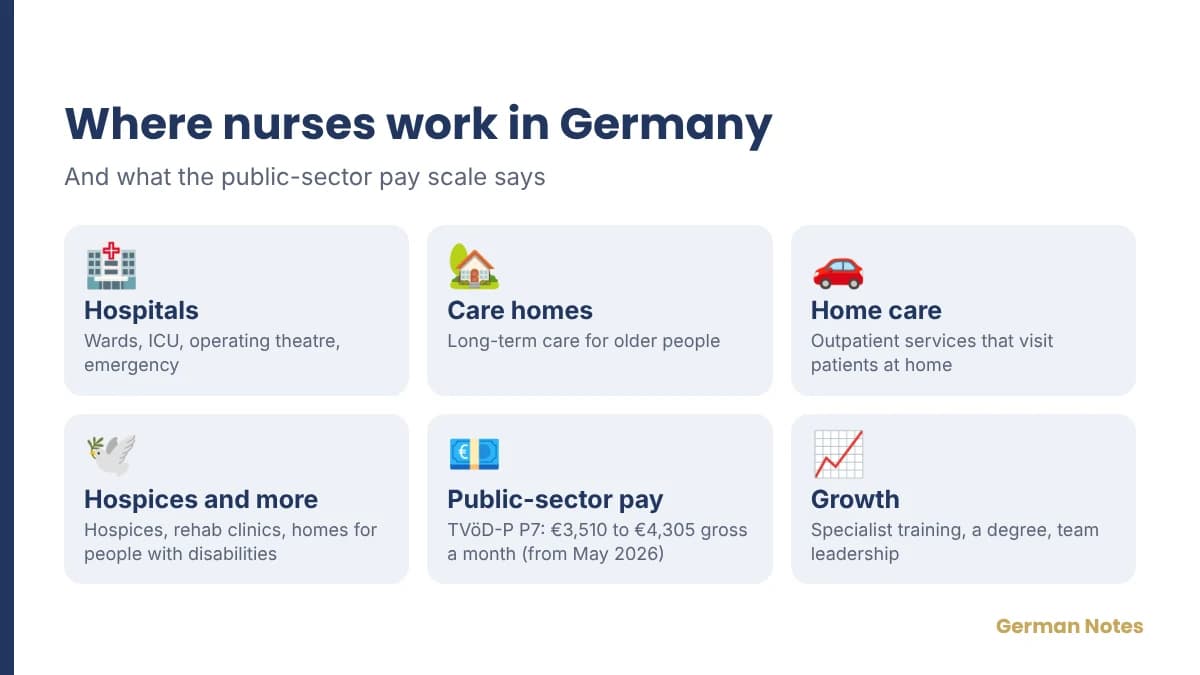
Pay depends on the employer. In the public sector, qualified nurses are usually placed in TVöD-P group P7. From May 2026, that means 3,510 euros gross a month at entry, rising to 4,305 euros with experience, plus a monthly care allowance of 141.82 euros. Private and church employers have their own pay scales, which can be higher or lower.
Where to look for jobs:
- the job board of Germany's Federal Employment Agency (Bundesagentur für Arbeit)
- the job listings on Make it in Germany, the federal government's portal for skilled workers
- Triple Win, for nurses from Kerala, through NORKA Roots
- hospitals' own career pages
Be careful with agents who ask for large fees or promise guaranteed recognition. Kerala's government agencies NORKA Roots and ODEPC recruit nurses for Germany, and Triple Win is free for applicants. If an offer sounds too good, check it with these official sources first.
हिंदी में समझें
Nurses hospital, care home, home care और hospice में काम करते हैं। सरकारी sector (TVöD-P, P7) में मई 2026 से शुरुआती salary लगभग €3,510 महीना (gross) है, अनुभव के साथ €4,305 तक, साथ में €141.82 का care allowance। नौकरी Bundesagentur für Arbeit, Make it in Germany या Triple Win (NORKA Roots) से ढूँढें। बहुत ज़्यादा fee माँगने वाले agents से सावधान रहें।
How to prepare from India
- Choose your route: recognition, Ausbildung or a degree.
- Start German early. Every route needs it, and it usually takes the longest.
- Collect your documents: certificates, mark sheets, registration and experience letters, with certified translations.
- Check the rules of the German state you're aiming for: language certificate, deadlines and documents.
- Look for an employer, a training place or a university, and apply for the right visa.
German Notes teaches German in live small-batch classes. Our Pflegedeutsch course adds nursing vocabulary, patient conversations and B2 exam preparation. Start with the free placement test.
Frequently asked questions
Yes. B.Sc Nursing and GNM nurses can apply to have their qualification recognised and then work as a Pflegefachfrau or Pflegefachmann. For the licence you need German at B2, plus the recognition of your nursing training.
Yes, through two routes: a paid three-year Ausbildung, or a nursing degree (B.Sc Pflege) at a university. For a degree, an Indian Class 12 certificate usually doesn't give direct entry, so most students first complete a one-year Studienkolleg.
Yes. Ausbildung trainees get a monthly training allowance. Since 1 January 2024, students in primary-qualifying nursing degrees also get pay for the whole course, through a training contract with a hospital or care provider.
It depends on the route. A2 for the recognition partnership visa, B1 or B2 for an Ausbildung depending on the state, B2 for the nursing licence, and usually C1 for a nursing degree taught in German.
Most public universities charge no tuition, only a semester fee. Baden-Württemberg is the exception: it charges students from outside the EU 1,500 euros per semester. Private universities charge tuition.
In the public sector, a qualified nurse is usually paid under TVöD-P group P7: from 3,510 to 4,305 euros gross a month from May 2026, plus a care allowance. Private and church employers have their own pay scales.
A programme run by Germany's Federal Employment Agency and GIZ that recruits nurses from partner countries, including Kerala through NORKA Roots. Placement, language training and integration support are free for applicants. There is also a trainee programme for students after Plus Two.
This guide gives general information, not legal or immigration advice. Rules for recognition, training, admission and visas are set by German states, universities and authorities and can change. Always check the current requirements with the responsible office.
Sources
- Make it in Germany: nursing professionals
- Make it in Germany: Ausbildung as a nurse
- Make it in Germany: recognition partnership
- Federal Government: Pflegestudiumstärkungsgesetz (pay for nursing students)
- Hochschule Bremen: primary-qualifying nursing degree, paid since January 2024
- OTH Regensburg: nursing degree admission (C1)
- Universität Heidelberg: tuition for international students in Baden-Württemberg
- DAAD India: Bachelor studies in Germany
- APS India: news and updates
- Federal Employment Agency: Triple Win India
- NORKA Roots: Triple Win trainee programme
- Haufe: nursing training pay from May 2026
- Jobs beim Staat: TVöD-P group P7 (from May 2026)
- Bavarian State Office for Nursing: accepted language certificates (PDF)
- Hessen State Office: language proof for nursing professions (PDF)