Ask most learners what stops them from speaking German, and it's rarely vocabulary. It's the alphabet. Or more specifically, the fear that German letters hide some impossible pronunciation trap around every corner.
They don't. German spelling is actually one of the more forgiving parts of the language. Once you know the German alphabet and its handful of special sounds, you can read a word you've never seen before and pronounce it correctly almost every time. English can't say that about itself (try explaining "though," "through," and "cough" to a beginner).
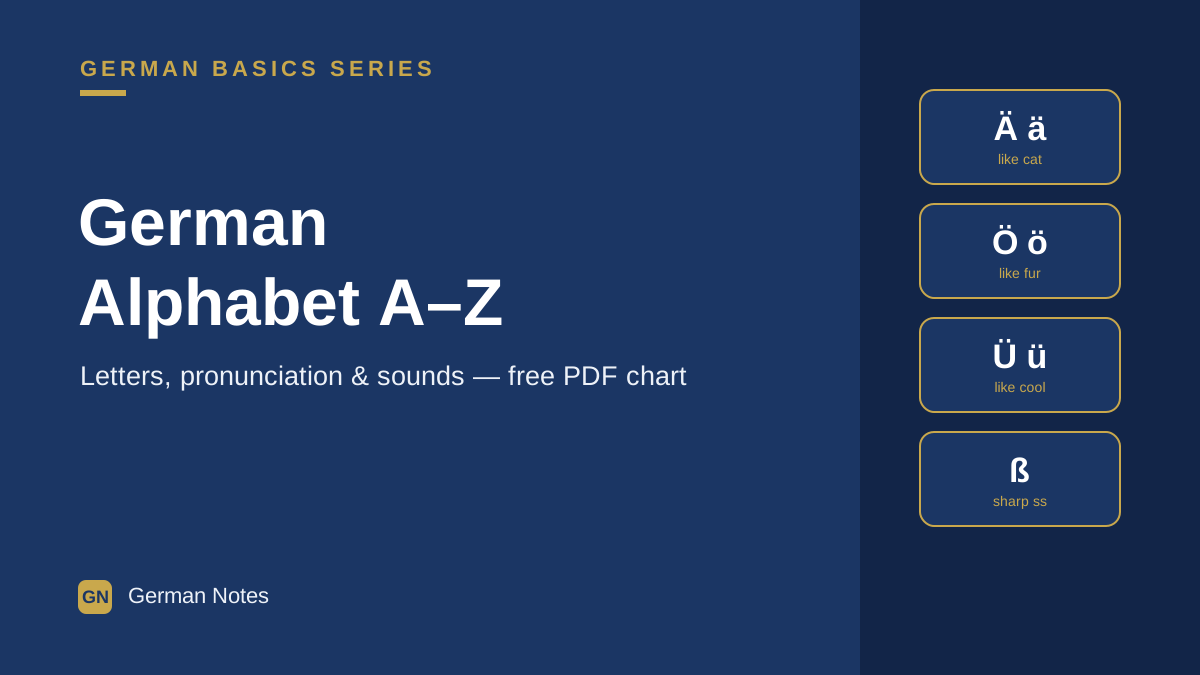
This guide walks through every letter in the German alphabet with pronunciation, the four extra characters that trip up new learners, and the sound combinations that actually matter in daily speech. If you want a version you can keep on your phone or print out, grab the free PDF below, with English and हिंदी pronunciation side by side.
Free German Alphabet PDF Chart
The full A–Z breakdown, umlauts, and sound rules with English + हिंदी pronunciation, in one printable PDF.
How Many Letters Are in the German Alphabet?
The German alphabet has 26 standard letters, identical in shape to the English alphabet:
A, B, C, D, E, F, G, H, I, J, K, L, M, N, O, P, Q, R, S, T, U, V, W, X, Y, Z
On top of those 26, German uses four additional characters that don't exist in English:
- Ä / ä (A-umlaut)
- Ö / ö (O-umlaut)
- Ü / ü (U-umlaut)
- ß (Eszett, or "sharp S")
Add those four to the base 26, and you get what's commonly called the German alphabet with 30 letters. Whether you count it as 26 or 30 depends on how strictly you define "letter" (the umlauts are technically vowel variants, and ß has no uppercase-only status in most contexts), but for learning purposes, treat it as 30 characters you need to recognize on sight.
The German Alphabet A to Z (With Pronunciation)
Every letter, how it's said out loud in German, and a real word that uses it. The "Sounds Like" column is the closest English approximation of how each letter is named when Germans recite the alphabet, not how it sounds inside a word, which we cover further down.
| Letter | Sounds Like | हिंदी | Example Word | Meaning |
|---|---|---|---|---|
| A a | „Ah“ | आ | Ahnung | idea |
| B b | „Bay“ | बे | Buch | book |
| C c | „Tsay“ | त्से | Café | café |
| D d | „Day“ | डे | Dach | roof |
| E e | „Ay“ | ए | Elefant | elephant |
| F f | „Eff“ | एफ़ | Fisch | fish |
| G g | „Gay“ | गे | Garten | garden |
| H h | „Hah“ | हा | Haus | house |
| I i | „Eee“ | ई | Insel | island |
| J j | „Yot“ | योट | Jacke | jacket |
| K k | „Kah“ | का | Katze | cat |
| L l | „Ell“ | एल | Lampe | lamp |
| M m | „Emm“ | एम | Maus | mouse |
| N n | „Enn“ | एन | Nase | nose |
| O o | „Oh“ | ओ | Ofen | oven |
| P p | „Pay“ | पे | Papier | paper |
| Q q | „Koo“ | कू | Quelle | spring / source |
| R r | „Err“ | एर् | Regen | rain |
| S s | „Ess“ | एस | Sonne | sun |
| T t | „Tay“ | टे | Tisch | table |
| U u | „Oo“ | ऊ | Uhr | clock |
| V v | „Fow“ | फ़ाउ | Vogel | bird |
| W w | „Vay“ | वे | Wasser | water |
| X x | „Iks“ | इक्स | Xylophon | xylophone |
| Y y | „Üpsilon“ | उप्सीलॉन | Yoga | yoga |
| Z z | „Tset“ | त्सेट | Zug | train |
A few of these are worth flagging on their own, because they're the letters that cause the most mix-ups for English speakers.
The Letter A in German
German a is a short, open "ah" sound, closer to the vowel in "father" than the flat English "a" in "cat." Words like Apfel and Ahnung use this sound. When you see a in German paired with an umlaut (ä), the sound changes completely. More on that below.
The Letter I in German
I in German is always a clean "ee" sound, like the "ee" in "see." There's no soft "ih" version the way English uses "i" in "sit." So Insel sounds like "IN-zel," not "IN-sil."
The Letter Y in German
Y in German is the one letter most English speakers guess wrong. It's called Üpsilon and, inside words, it's pronounced almost like a German ü, a rounded, front-of-mouth "ee" sound, not the English "y" as in "yes" or "yellow."
The Letter J in German
Unlike English, where J makes a "juh" sound (as in "jump"), the German J is pronounced like an English Y. Jacke (jacket) sounds like "YAH-kuh," and Ja (yes) sounds like "yah."
German Umlauts: Ä, Ö, Ü Explained
Umlauts are the two dots you'll see sitting above certain vowels in German words, such as Mädchen, schön, and müde. They're not decoration. Each umlaut represents a genuinely different vowel sound, and mixing them up changes the meaning of the word.
| Character | Name & Sound | हिंदी | Example | Meaning |
|---|---|---|---|---|
| Ä ä | „Ay-Umlaut,“ like the “a” in “cat” | ऐ | Äpfel | apples |
| Ö ö | „Oh-Umlaut,“ like the “ir” in “fur” | इयो | Öl | oil |
| Ü ü | „Oo-Umlaut,“ like the “oo” in “cool” (lips rounded) | इयू | Über | over |
Here's the fastest way to learn them: say the base vowel (a, o, u) while rounding and tightening your lips slightly, without changing the shape of your tongue. That lip position is the entire trick behind German umlauts, and it's why English speakers often flatten them out of habit. The tongue position feels right, but the lips are doing the wrong thing.
Umlauts also matter for meaning, not just pronunciation. Schon (already) and schön (beautiful) are completely different words. Mutter (mother) and Mütter (mothers) are separated by one umlaut. Skipping the dots isn't a shortcut. It's a spelling mistake that can change what you're saying.
What Is ß Called? The Eszett Explained
The ß character, called the Eszett or "sharp S" (हिंदी: एस्सेट), is the letter most English speakers have never seen anywhere else. It only appears in German (and a few closely related languages) and represents a sharp, unvoiced "ss" sound, as in Straße (street) or groß (big / tall).
A few practical points on ß:
- It's always lowercase. Even at the start of a sentence, German capitalizes the rest of the word but keeps ß as is (a capital version, ẞ, exists but is rarely used outside all-caps signage).
- In Switzerland, ß isn't used at all. Swiss German writes "ss" instead, so Straße becomes Strasse.
- You can usually substitute "ss" for ß without changing meaning, which is exactly what happens automatically when German text is typed on a keyboard without the character, or converted for search engines and URLs.
- ß is not the same as a capital B, even though it looks similar at a glance.
So if you've ever wondered what ä and ß are called, now you have both answers in one place: ä is the A-umlaut, and ß is the Eszett.
Special Pronunciation Rules Every Learner Needs
The 26 base letters plus four extras only get you halfway. German also has a small set of letter combinations that behave consistently enough to memorize as rules, and once you know them, you'll stop guessing.
The CH Rule
CH is the trickiest combination in the German alphabet, but it follows a genuinely reliable pattern:
- After A, O, U, and AU it makes a throaty, guttural "kh" sound (think of clearing your throat lightly). Examples: Bach, Nacht, Buch, auch, noch.
- Everywhere else (after E, I, or a consonant) it makes a soft "hsh" sound, made toward the front of the mouth. Examples: ich, nicht, München, Chemie.
It's genuinely one rule with two outcomes, decided entirely by what comes before the CH. Once that clicks, city names like München and everyday words like ich stop being a guessing game.
EI vs. IE
These two get swapped constantly by beginners, mostly because English readers instinctively want to sound out letters in the order they appear:
- EI sounds like the English "eye," as in mein, Arbeit, Freitag.
- IE sounds like a long English "ee," as in Liebe, Spielen, Bier.
A trick that sticks: German pronounces the second letter of the pair. IE gives you "eee" (the E wins). EI gives you "eye" (the I wins). It's a small rule, but it clears up a huge chunk of German spelling confusion on its own.
German Alphabet vs. English Alphabet: What's Actually Different
If you're coming from English, here's the honest comparison:
- Letter count: English has 26 letters. German has the same 26 plus ä, ö, ü, and ß, so functionally 30.
- Pronunciation consistency: German spelling maps to sound far more reliably than English. Once you learn the rules, you can read new words aloud correctly. English can't promise that.
- Capitalization: German capitalizes every noun, not just proper nouns. Haus, Buch, and Auto are always capitalized mid-sentence.
- No silent letters (mostly): German rarely drops letters the way English silently drops the "k" in "knife" or the "b" in "comb."
- Consistent vowel sounds: German vowels don't shift the way English vowels do across regional accents and word positions.
How to Learn the German Alphabet (Without Wasting Time)
A German alphabet chart is a starting point, not a finish line. Here's a practical order that actually works:
- Memorize the 26 base letters first, saying them out loud in German, not English.
- Layer in the four extras, ä, ö, ü, ß, as their own small set, since they behave differently from the core 26.
- Drill CH, EI, and IE with five or six example words each until the pattern is automatic, not memorized case by case.
- Read simple words out loud daily. German rewards this more than most languages, because correct pronunciation almost always follows correct spelling.
- Use audio alongside text. Seeing "Ü" on a page and hearing it said are two different learning channels, and combining them is what actually locks pronunciation in.
Free German Alphabet PDF Chart
The full A–Z breakdown, umlauts, and sound rules with English + हिंदी pronunciation, in one printable PDF.
For learners building vocabulary alongside pronunciation, it's worth pairing this with our A1 vocabulary flashcards, and if grammar is next on your list, our German cases explained guide picks up right where this one leaves off. You can also work through the full A1 grammar syllabus or try our free practice exercises to put the alphabet to use straight away.
FAQ
What are the German letters A to Z?
The German alphabet from A to Z uses the same 26 Latin letters as English: A, B, C, D, E, F, G, H, I, J, K, L, M, N, O, P, Q, R, S, T, U, V, W, X, Y, Z. German also adds four extra characters, ä, ö, ü, and ß, which aren't part of the core A to Z sequence but are treated as essential letters in everyday writing and spelling.
What is ä ß called?
Ä is called an "umlaut," specifically the A-umlaut, pronounced like the "a" in "cat." ß is called an Eszett (also known as "sharp S"), and it represents a sharp, unvoiced "ss" sound, as in Straße.
How many letters are in the German alphabet?
Technically 26, matching English. In practice, most sources count the German alphabet as having 30 letters once you include ä, ö, ü, and ß, since all four appear regularly in standard German spelling.
Is the German alphabet the same as the English alphabet?
The base 26 letters are identical in form. The difference is the four extra German-only characters (ä, ö, ü, ß) and the fact that German pronunciation of individual letters, and letter combinations like CH, EI, and IE, follows different, more consistent rules than English.
How do you say the alphabet in German?
Reciting the alphabet in German means saying each letter by its German name. For example, A is "ah," B is "bay," C is "tsay," rather than the English "ay," "bee," "see." The full letter-by-letter pronunciation is in the chart above.
What is the difference between a and ä in German?
A is an open "ah" sound, close to the English "a" in "father." Ä is a completely different vowel sound, closer to the English "e" in "bed" or "a" in "cat." They are not interchangeable; swapping them can change a word's meaning entirely.
Do I need to memorize the German alphabet before learning vocabulary?
Yes, at least the basics. Knowing how each German letter sounds, and how CH, EI, and IE behave, means you can pronounce new vocabulary correctly the first time you see it, instead of guessing or mispronouncing words you'll need to unlearn later.
The Bottom Line
The German alphabet looks intimidating from the outside: extra dots, an unfamiliar ß, letters that don't sound the way you'd expect. In practice, it's 26 familiar letters, four additions, and three or four sound rules that stay consistent no matter which word you're reading. Spend a focused hour with the chart above, drill CH/EI/IE with real words, and you'll be reading German out loud with reasonable accuracy well before you've built much vocabulary at all.
Free German Alphabet PDF Chart
The full A–Z breakdown, umlauts, and sound rules with English + हिंदी pronunciation, in one printable PDF.
Not sure where your German currently stands? Take our free placement test . About 20 minutes, and it tells you exactly which level to start from. Prefer to talk it through first? Book a free consultation, or go straight to enrolling in a live batch that fits your schedule.