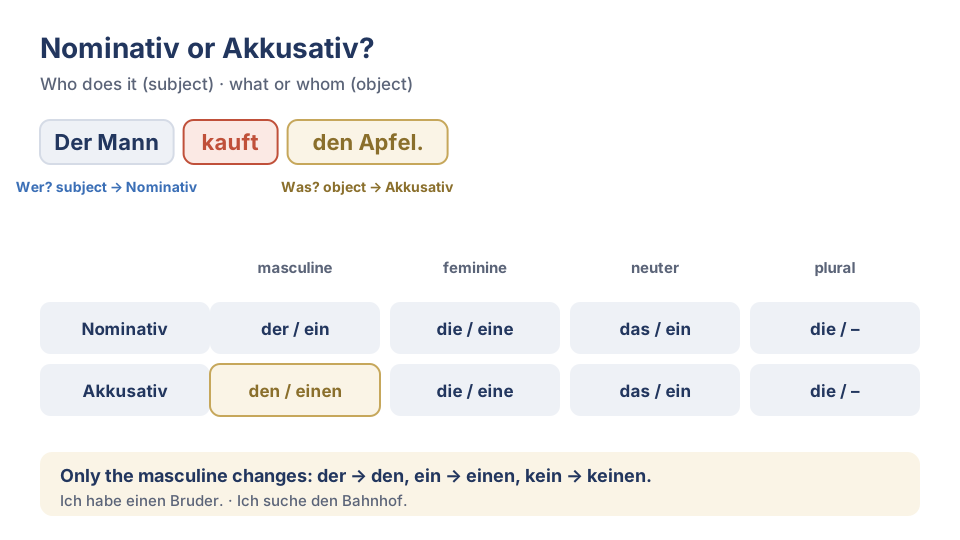
Only the masculine changes: der → den, ein → einen, kein → keinen. Feminine, neuter and plural stay the same. To find the object, ask "Wen oder was?" (Whom or what?).
Nominativ or Akkusativ?
Swipe the picture sideways to see all of it →
Ask two questions. Who is doing it? That's the Nominativ. What or whom is it done to? That's the Akkusativ. At A1 the good news is that only the masculine changes: der becomes den, ein becomes einen and kein becomes keinen.
हिंदी में समझें
दो सवाल पूछिए। काम कौन कर रहा है (Wer?) = Nominativ। काम किस पर हो रहा है (Wen? Was?) = Akkusativ। अच्छी बात यह है कि A1 में सिर्फ़ masculine बदलता है: der → den, ein → einen, kein → keinen।
The accusative case in German marks the direct object: the thing you buy, eat, see or need. At A1 it mostly comes down to one change: masculine der becomes den.
What is the accusative case?
Most German sentences have a subject, the person or thing doing the action, and many also have an object that receives it. The subject is in the nominative and the object is in the accusative. In Ich kaufe den Kaffee, I am the one buying and the coffee is what I buy, so den Kaffee is accusative.
German textbooks and the telc and Goethe exam papers call it Akkusativ, so you will see that word more often than the English one. Both mean the same thing. If you can't tell whether a noun is the subject or the object, the next lesson, Nominative vs Accusative, compares the two cases side by side.
When do you use the accusative?
After most everyday verbs, such as haben, möchten, brauchen, kaufen, sehen, essen, trinken and suchen.
After es gibt: Es gibt einen Supermarkt hier.
After the prepositions durch, für, gegen, ohne and um: Das ist für den Chef.
Article changes in the German accusative case
The
A/An
No/Not a
My
masculine
der → den
ein → einen
kein → keinen
mein → meinen
neuter
das
ein
kein
mein
feminine
die
eine
keine
meine
plural
die
(none)
keine
meine
For articles, the accusative only changes the masculine row. Possessives like dein, sein, ihr and unser work like mein.
Ich habe einen Bruder. (I have a brother.)
Wir brauchen keinen Termin. (We don't need an appointment.)
Sie sucht ihre Tasche. (She is looking for her bag. Tasche is feminine, so nothing changes.)
Accusative pronouns
Personal pronouns change in more places than articles do, so it helps to learn the accusative pronouns as a list.
Nominative
Accusative
Example
ich
mich
Er kennt mich.
du
dich
Ich sehe dich.
er
ihn
Ich frage ihn.
sie (she)
sie
Wir besuchen sie.
es
es
Ich kaufe es.
wir
uns
Sie ruft uns an.
ihr
euch
Ich verstehe euch.
sie (they) / Sie
sie / Sie
Ich höre Sie gut.
The masculine pronoun follows the same pattern as the article: er becomes ihn with an -n, just as der becomes den.
Common Mistakes in Accusative Case
"Ich möchte ein Kaffee." Wrong. Kaffee is masculine and it is the object: einen Kaffee. "Das ist einen Kaffee." Wrong. Sein takes no object, so the noun stays nominative: Das ist ein Kaffee. "Es gibt ein Supermarkt." Wrong. Es gibt always takes the accusative: einen Supermarkt. "Ich liebe er." Wrong. Pronouns change too: Ich liebe ihn. You can catch most wrong accusatives with two questions: is the noun masculine, and is it the object?
Memory trick
Only the men get a new hat with an -n: der → den, ein → einen, er → ihn. Ladies (die) and neutral things (das) stay the same.
Practice
Fill in the gap.
Ich trinke ___ Tee. (ein, masculine)
Siehst du ___ Bus? (der)
Wir kaufen ___ Lampe. (eine)
Kennst du Mohan? Ja, ich kenne ___ gut.
Das Geschenk ist für ___. (du)
Show answers
Answers: einen, den, eine (feminine, so it doesn't change), ihn, dich (für takes the accusative).
The accusative is the case of the direct object: the form a noun or pronoun takes when the verb acts on it. In Ich sehe den Hund, den Hund is accusative.
Masculine articles change (der → den, ein → einen, kein → keinen, mein → meinen), and so do some personal pronouns (ich → mich, du → dich, er → ihn, wir → uns, ihr → euch).
No. Sein (to be) doesn't take an object, so both sides stay in the nominative.
Durch, für, gegen, ohne and um, and also bis. Many learners remember the first five with the made-up word "DOGFU".