German articles (der, die, das) mark a noun's gender and change across all four cases. This lesson has the full der, die, das chart, when each form changes, and the mistakes to avoid.
der, die, das
Swipe the picture sideways to see all of it →
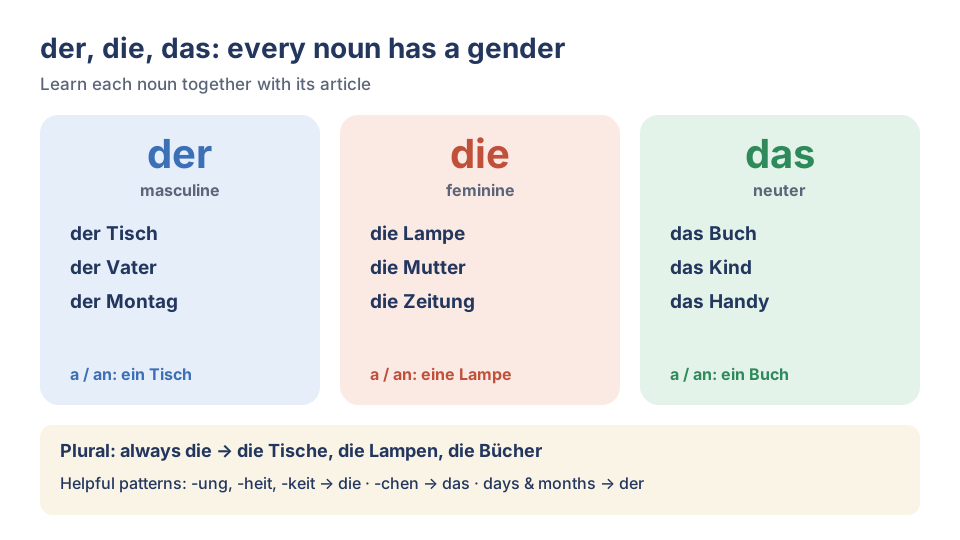
Every noun has a gender, and it often isn't the one you'd guess from meaning. Learn each noun together with its article and plural. A few endings help: words ending in -ung, -heit or -keit are die, words ending in -chen are das, and days and months are der.
हिंदी में समझें
हर noun का gender होता है, और अक्सर यह अर्थ से अंदाज़ा नहीं लगता। इसलिए हर noun को article और plural के साथ याद करें। कुछ endings मदद करती हैं: -ung, -heit, -keit वाले शब्द die, -chen वाले das, और दिन व महीने der।
Every German noun has a gender: masculine (der), feminine (die), or neuter (das). Learn the article with every new noun. You don't have to guess blindly, though. Some endings and word groups give you the article every single time. Others are right most of the time and come with a short list of exceptions. Start with the sure ones: they cost nothing to learn and never let you down.
100% reliable
100% Patterns: Trust These Completely
See one of these endings or word groups and you know the article. No exceptions to memorize.
dermasculine
Pattern
Examples
-ling
der Lehrling, der Schmetterling, der Frühling
Only English loanwords that happen to end in -ling break it (das Bowling).
-ismus
der Tourismus, der Realismus, der Optimismus
-ist (people)
der Tourist, der Pianist, der Optimist
Only for people. die List (a trick) is not a person.
Days of the week
der Montag, der Dienstag, der Mittwoch
Months
der Januar, der Februar, der März
Seasons
der Frühling, der Sommer, der Herbst, der Winter
das Frühjahr is a separate word for spring, not an exception.
Compass directions
der Norden, der Süden, der Osten, der Westen
Car brands
der BMW, der Mercedes, der Volkswagen
diefeminine
Pattern
Examples
-in (female people)
die Lehrerin, die Pilotin, die Ärztin
Only female forms. der Termin just ends in -in.
-ung
die Zeitung, die Wohnung, die Übung
-heit
die Freiheit, die Gesundheit, die Schönheit
-keit
die Möglichkeit, die Freundlichkeit
-schaft
die Freundschaft, die Wissenschaft, die Mannschaft
-ie
die Energie, die Demokratie, die Melodie
One rare word breaks it: das Genie.
-tion
die Nation, die Information, die Situation
-tät
die Universität, die Qualität, die Realität
Motorbikes and ships
die Harley, die Titanic
A naming convention, very reliable.
dasneuter
Pattern
Examples
-chen (little)
das Mädchen, das Brötchen, das Häuschen
-lein (also "little")
das Büchlein, das Fräulein, das Vöglein
Letters of the alphabet
das A, das B, das C
Colors used as nouns
das Rot, das Blau, das Grün
Languages
das Deutsch, das Englisch, das Hindi
Hotels and cinemas
das Hilton, das Odeon
A naming convention.
Grammar always wins over meaning: das Mädchen (girl) is neuter purely because of the -chen ending, not because of what the word means.
Mostly reliable
Mostly Right: Guess, Then Learn the Exceptions
These patterns are right most of the time. Use them to guess, and learn the listed exceptions by heart, because those are exactly the words that catch learners out.
dermasculine
-er
der Lehrer, der Computer, der Finger
Learn by heart
die Mutter
die Tochter
das Fenster
das Zimmer
das Wasser
-or
der Motor, der Doktor, der Professor
Learn by heart
das Tor
das Labor
Weather
der Regen, der Schnee, der Wind
Learn by heart
das Gewitter
das Eis
die Sonne
die Wolke
Alcoholic drinks
der Wein, der Schnaps, der Whisky
Learn by heart
das Bier
diefeminine
-e
die Lampe, die Frage, die Straße
Right about 9 times in 10.
Learn by heart
der Name
der Käse
der Junge
das Auge
das Ende
-ur, -ik
die Kultur, die Natur, die Musik
Learn by heart
das Abitur
der Pazifik
das Mosaik
Numbers used as nouns
die Eins, die Zwei, die Million
Learn by heart
das Hundert
das Tausend
das Dutzend
Flowers
die Rose, die Tulpe, die Lilie
Learn by heart
der Löwenzahn
der Krokus
das Veilchen
Trees
die Eiche, die Birke, die Tanne
Learn by heart
der Ahorn
Rivers outside Germany
die Themse, die Seine, die Wolga
Rivers inside Germany are mixed: der Rhein and der Main, but die Elbe, die Spree and die Mosel.
Learn by heart
der Nil
der Ganges
der Amazonas
der Mississippi
dasneuter
-um
das Museum, das Zentrum, das Studium
Learn by heart
der Irrtum
der Reichtum
der Konsum
-o
das Auto, das Kino, das Radio
Learn by heart
der Euro
der Zoo
die Disco
-ment
das Instrument, das Dokument, das Experiment
Learn by heart
der Moment
der Zement
-nis
das Ergebnis, das Ereignis, das Geheimnis
The weakest pattern here: right only about 7 times in 10.
Learn by heart
die Erlaubnis
die Kenntnis
die Wildnis
Metals
das Gold, das Silber, das Eisen
Learn by heart
der Stahl
die Bronze
If Hindi is your first language, this isn't a new idea, just a different tool for the same job. Hindi marks a relationship like "to the boy" (लड़के को) with a postposition. German marks that same relationship by changing the article instead. That's really all definite articles in German are doing: der, die, das, moving to show what role a noun is playing in the sentence, the same way we teach it in German Notes' live A1 classes.
Das in German: neuter, stays das·Der in German: der → den
Definite Articles in German: Der, Die, Das
Gender
The
A/An
No/Not a
masculine
der
ein
kein
neuter
das
ein
kein
feminine
die
eine
keine
plural
die
(none)
keine
Plural has several patterns, so learn the plural with the noun: das Buch → die Bücher, die Lampe → die Lampen. Plural always uses die, whatever the gender.
Der, Die, Das: The Full Chart, All 4 Cases
Nominative
Accusative
Dative
Genitive
masculine
der
den
dem
des
neuter
das
das
dem
des
feminine
die
die
der
der
plural
die
die
den
der
Genitive is rare in spoken German (see below).
Three Rules With No Exceptions
Plural always takes die, whatever the gender: der Tisch → die Tische.
Only masculine changes in the accusative: der → den. Die and das stay the same.
Dative articles always end in -m, -r or -n: dem, der, den.
Ein, Eine: The Same Chart for "A/An"
Nominative
Accusative
Dative
masculine
ein
einen
einem
neuter
ein
ein
einem
feminine
eine
eine
einer
Kein (not a, no) follows the exact same pattern as ein, just with a k in front: kein, keinen, keinem, keine.
Once der/die/das and der → den feel automatic, the next step is dative: the case for saying to whom or for whom something happens, needed for verbs like helfen, geben, and gefallen. That's A2 territory, covered in full in the pronoun cases and dative verbs lessons.
Genitive (showing possession, like des Mannes for "the man's") is a B1 topic, and most spoken German skips it anyway, using dative with von instead: das Buch vom Mann rather than das Buch des Mannes. Germans even have a joke about it: "Der Dativ ist dem Genitiv sein Tod," the dative is the death of the genitive. Recognize genitive for B1; don't worry about producing it perfectly yet.
This chart is also in the free A1 grammar notes PDF, so you can download it, print it, and keep it next to you while you study.
Common Mistakes in German Articles (Der, Die, Das)
Learn every noun with its article: not "Tisch" but "der Tisch." A noun without its article is only half learned. Don't treat a "mostly" pattern as a rule either: -er usually means der, but it's die Mutter and das Fenster. There's no ein for plural, it's die Kinder, not eine Kinder. And "Ich sehe Mann" is missing its article entirely; it has to be "Ich sehe den Mann."
Memory trick
Write nouns in three colors as you learn them: blue for der, pink for die, green for das. Your eyes remember the color before you remember the word. Then one rule covers accusative: only der gets a new ending, den. Die and das stay exactly the same.
Practice
Fill in the blank.
___ Mann ist müde. (the man)
Ich habe ___ Tochter. (a daughter)
Das ist ___ Tee. (not a tea)
___ Kinder spielen. (the children)
Ich sehe ___ Lehrer. (the teacher, accusative)
___ Zeitung liegt auf dem Tisch. (the newspaper)
___ Zimmer ist groß. (the room)
Show answers
Answers: Der, eine, kein, Die, den, Die (-ung is always die), Das (Zimmer is an exception to -er).