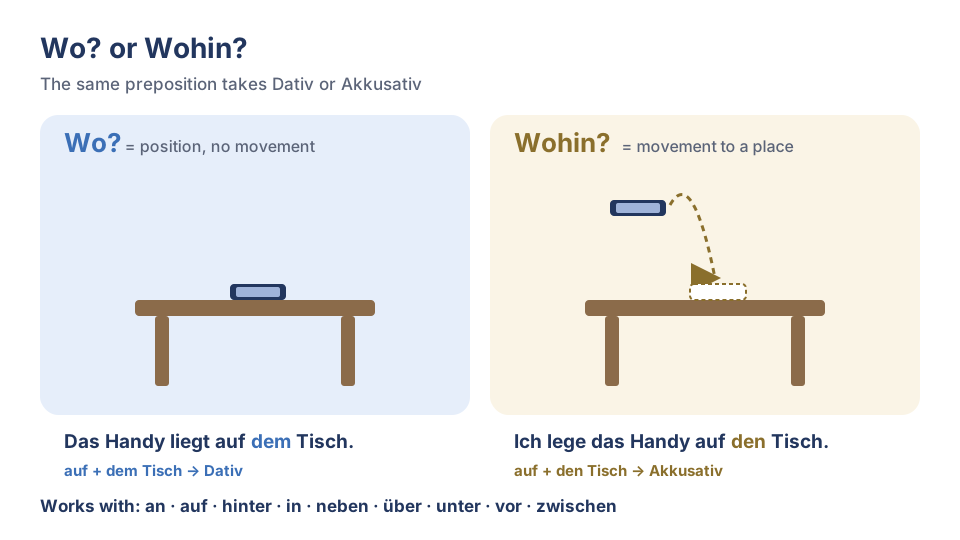
Wo (where are you) uses the dative. Wohin (where to) uses zu, nach, or in with the accusative.
Wo? or Wohin?
Swipe the picture sideways to see all of it →
The same preposition can take two cases. If something is already in a place and not moving, ask Wo? and use the Dativ. If it's moving to that place, ask Wohin? and use the Akkusativ.
हिंदी में समझें
एक ही preposition दो case ले सकता है। चीज़ पहले से वहाँ रखी है और हिल नहीं रही, तो सवाल Wo? और Dativ। चीज़ वहाँ ले जाई या रखी जा रही है, तो सवाल Wohin? और Akkusativ।
Master German prepositions of place and German location expressions. Wo (where are you) uses the dative: in, an, auf, bei, hinter, neben, über, unter, vor, zwischen.
Wohin (where to) uses different prepositions. Use zu + dative for people and places (zum Arzt, zur Bank). Use nach for cities, countries, and "nach Hause." Use in + accusative for rooms and buildings (ins Kino, in die Schweiz).
German dative articles for location: der → dem, das → dem, die → der, plural den. German dative contractions: in + dem = im, an + dem = am, bei + dem = beim, zu + dem = zum, zu + der = zur, in + das = ins.
With people: bei (where you are) and zu (where you're going): bei der Freundin, zur Freundin.
Wo? (dative)
Wohin?
im Kino
ins Kino
beim Arzt
zum Arzt
bei der Bank
zur Bank
in Berlin
nach Berlin
zu Hause
nach Hause
Krishna ist beim Arzt. Er geht zum Arzt.·Ich wohne in der Nähe vom Bahnhof.·Das Handy liegt neben dem Buch.·Wir fahren nach Hamburg.
Common Mistakes in German Place Prepositions: Wo? and Wohin?
"Ich gehe im Kino" is wrong. It's ins Kino. Wo is static (dative), wohin is movement (zu/nach/in + accusative).
Memory trick
Wo = at rest (dative). Wohin = moving (zu/nach/in + accusative).