A2 Grammar · Unit 1 · Topic 1 of 46
German Conjunction Weil
About 3 minutes · examples, common mistakes, Hindi help and practice with answers
In short
weil (because) gives a reason. The conjugated verb goes to the end of the weil clause.
Ich lerne Deutsch, weil ich in Deutschland arbeiten möchte.
weil means "because". It joins a reason to a sentence, and it changes the word order: the conjugated verb moves to the very end of the weil clause.
How it works
- Put a comma before weil.
- The conjugated verb goes to the end: …, weil ich müde bin.
- With a modal verb, the modal goes last: …, weil ich arbeiten muss.
- In the Perfekt, haben or sein goes last: …, weil ich verschlafen habe.
- A weil clause can also come first. Then the main verb follows straight after the comma: Weil es regnet, bleibe ich zu Hause.
Examples
- Ich lerne Deutsch, weil ich in Deutschland arbeiten möchte. (I'm learning German because I want to work in Germany.)
- Ravi kommt heute nicht, weil er krank ist. (Ravi isn't coming today because he's ill.)
- Ich bin spät, weil der Bus nicht gekommen ist. (I'm late because the bus didn't come.)
- Weil es so kalt ist, trinken wir einen Chai. (Because it's so cold, we're having a chai.)
- Warum gehst du schon? – Weil ich morgen früh aufstehen muss. (Why are you leaving already? – Because I have to get up early tomorrow.)
हिंदीweil = क्योंकि। weil के बाद वाले हिस्से में verb सबसे आख़िर में जाता है।
Where the verb goes after weil, dass, wenn and deshalb
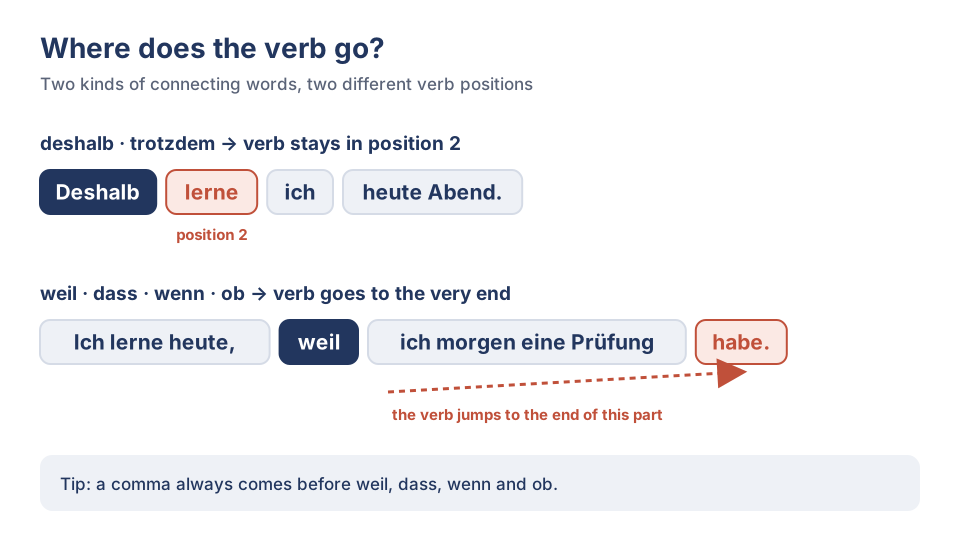
Swipe the picture sideways to see all of it →
Both groups join two ideas, but they treat the verb differently. After weil, dass, wenn and ob the conjugated verb moves to the end of its clause. After deshalb and trotzdem it stays in position 2, straight after the connecting word.
दोनों तरह के शब्द दो बातों को जोड़ते हैं, पर verb की जगह अलग होती है। weil, dass, wenn और ob के बाद verb उस हिस्से के बिल्कुल आख़िर में जाता है। deshalb और trotzdem के बाद verb तुरंत दूसरे नंबर पर आता है।
Common mistakes
Keeping the verb in second place after weil: ✗ …, weil ich bin müde. ✓ …, weil ich müde bin. Separable verbs join up again at the end: ✓ …, weil der Zug um acht ankommt.
Practice
Join the two sentences with weil.
- Ich bleibe zu Hause. Ich bin erkältet.
- Geeta lernt viel. Sie hat morgen eine Prüfung.
- Wir nehmen ein Taxi. Es ist schon spät.
- Mohan ist glücklich. Er hat eine neue Stelle gefunden.
Show answers
Answers: 1. …, weil ich erkältet bin. 2. …, weil sie morgen eine Prüfung hat. 3. …, weil es schon spät ist. 4. …, weil er eine neue Stelle gefunden hat.
German Conjunction Weil: frequently asked questions
Both mean "because". After weil the verb goes to the end (…, weil ich müde bin). After denn the word order stays normal (…, denn ich bin müde). In everyday speech weil is far more common.