| A2.1 · Weeks 1–4 |
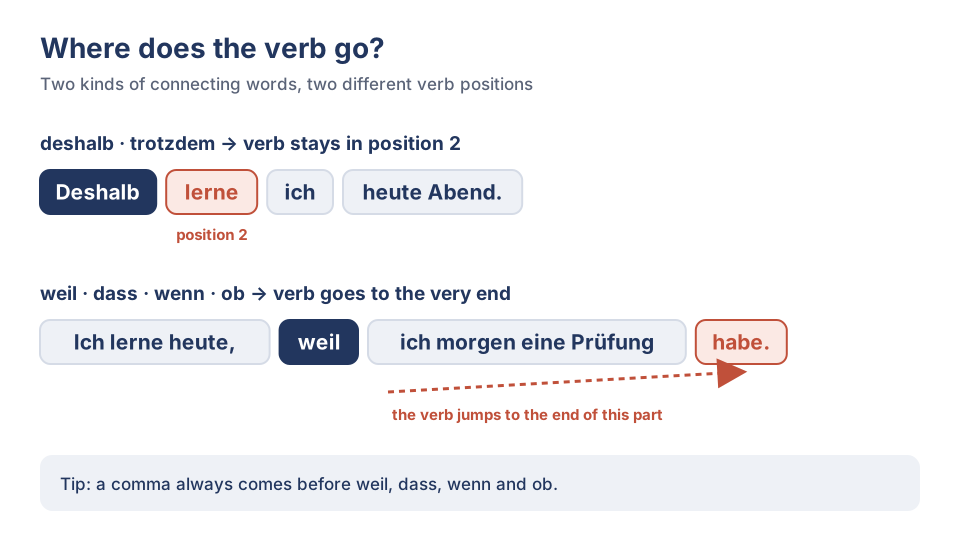
| German Conjunction Weil | Unit 1 | Ich lerne Deutsch, weil ich in Deutschland arbeiten möchte. weil (because) gives a reason. The conjugated verb goes to the end of the weil clause. हिंदी: weil = क्योंकि। weil के बाद वाले हिस्से में verb सबसे आख़िर में जाता है। Open the lesson →See the picture ↓ |
|---|
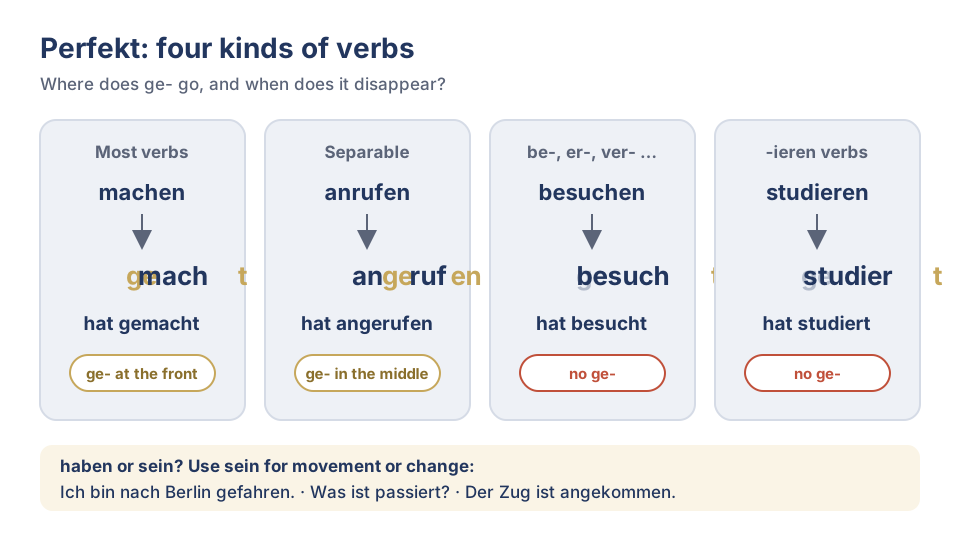
| Perfekt: Separable Verbs | Unit 1 | Ich habe meine Schwester angerufen. · Der Zug ist pünktlich angekommen. ge- goes between the prefix and the verb: anrufen → angerufen, einkaufen → eingekauft. हिंदी: Separable verbs में ge- बीच में आता है: anrufen → angerufen, einkaufen → eingekauft। Open the lesson →See the picture ↓ |
|---|
| Perfekt: Inseparable Verbs | Unit 1 | Hast du die Aufgabe verstanden? · Wir haben unsere Tante besucht. Verbs starting with be-, er-, ver-, ent- or zer- take no ge-: besuchen → besucht. हिंदी: be-, er-, ver-, ent-, zer- जैसे prefix वाले verbs में ge- नहीं लगता: besuchen → besucht। Open the lesson →See the picture ↓ |
|---|
| Perfekt: Verbs Ending in -ieren | Unit 1 | Was ist passiert? · Ich habe in Bangalore studiert. Verbs ending in -ieren also take no ge-: studieren → studiert, passieren → passiert. हिंदी: -ieren पर ख़त्म होने वाले verbs में भी ge- नहीं लगता: studieren → studiert। Open the lesson →See the picture ↓ |
|---|
| Showing Possession: Names with -s and von | Unit 1 | Priyas Bruder · der Bruder von Priya Add -s (no apostrophe) to a name before the noun. In speech, von + dative means the same. हिंदी: नाम के साथ -s जोड़कर ‘का/की’ बताते हैं: Priyas Bruder = प्रिया का भाई। बोलचाल में von भी चलता है। Open the lesson → |
|---|
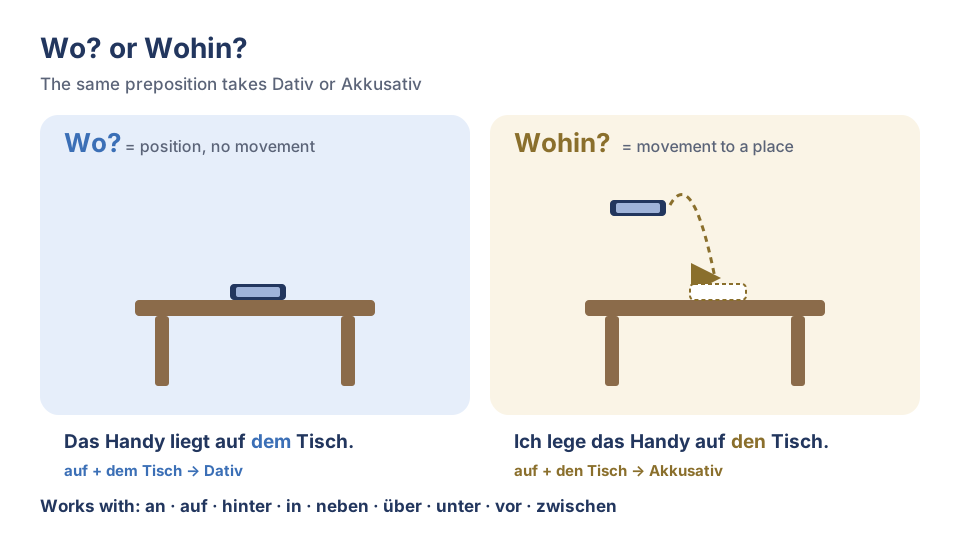
| Two-Way Prepositions (Wechselpräpositionen) | Unit 2 | Das Handy liegt auf dem Tisch. (Wo?) · Ich lege das Handy auf den Tisch. (Wohin?) an, auf, hinter, in, neben, über, unter, vor, zwischen: dative for Wo?, accusative for Wohin? हिंदी: Wo? (चीज़ कहाँ है) पूछें तो Dativ। Wohin? (चीज़ कहाँ रखी या ले जाई जा रही है) पूछें तो Akkusativ। Open the lesson →See the picture ↓ |
|---|
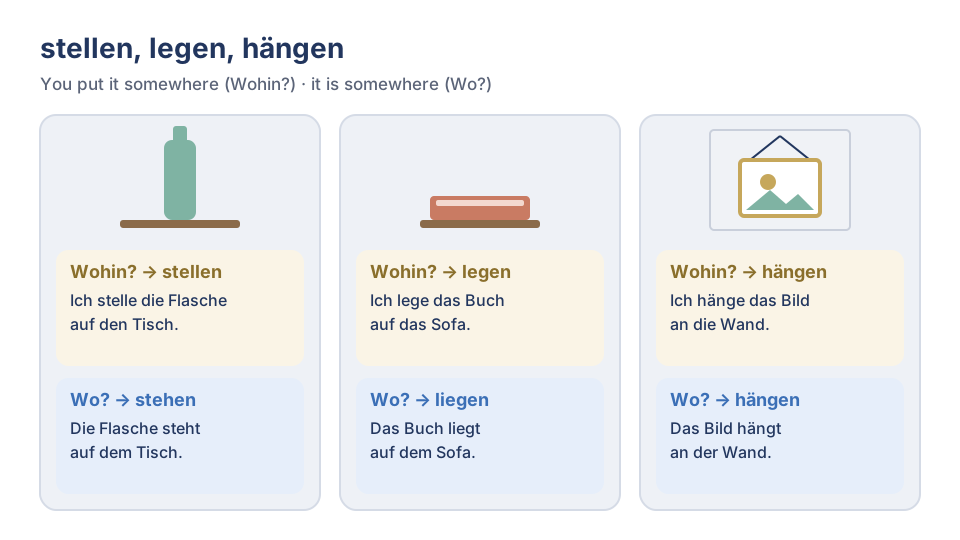
| Position Verbs: stellen/stehen, legen/liegen, hängen, stecken | Unit 2 | Ich stelle die Milch in den Kühlschrank. · Die Milch steht im Kühlschrank. Putting something somewhere takes the accusative; saying where it is takes the dative. हिंदी: stellen, legen, hängen = कुछ रखना या टाँगना (Akkusativ)। stehen, liegen, hängen = चीज़ कहाँ रखी है (Dativ)। Open the lesson →See the picture ↓ |
|---|
| Directional Adverbs: dahin, rein, raus, rauf, runter | Unit 2 | Stell den Koffer bitte dahin. · Komm doch rein! Short words for direction you hear every day: there, in, out, up, down. हिंदी: ये शब्द दिशा बताते हैं: dahin = उस तरफ़, rein = अंदर, raus = बाहर, rauf = ऊपर, runter = नीचे। Open the lesson → |
|---|
| Frequency Words: immer, oft, selten, nie | Unit 3 | Ich koche meistens am Abend. · Ich trinke zweimal am Tag Chai. Say how often something happens: immer, meistens, oft, manchmal, selten, nie. हिंदी: कोई काम कितनी बार होता है: immer (हमेशा), oft (अक्सर), manchmal (कभी-कभी), selten (कम ही), nie (कभी नहीं)। Open the lesson → |
|---|
| Indefinite Pronouns: einer, eins, eine, welche | Unit 3 | Brauchst du einen Löffel? Hier ist einer. · Ich habe keine Gabel. Hast du eine? Replace a noun so you don't repeat it. The ending shows the gender; the plural is welche. हिंदी: noun दोबारा बोलने की जगह einer, eins, eine बोलते हैं: Hier ist einer = यहाँ एक है। Open the lesson → |
|---|
| German Conjunction Wenn | Unit 4 | Wenn ich Zeit habe, gehe ich ins Fitnessstudio. · Ruf mich an, wenn du Fragen hast. wenn (if, when) sends the verb to the end. If the wenn clause comes first, the next verb follows straight after the comma. हिंदी: wenn = अगर या जब। weil की तरह यहाँ भी verb आख़िर में जाता है। Open the lesson →See the picture ↓ |
|---|
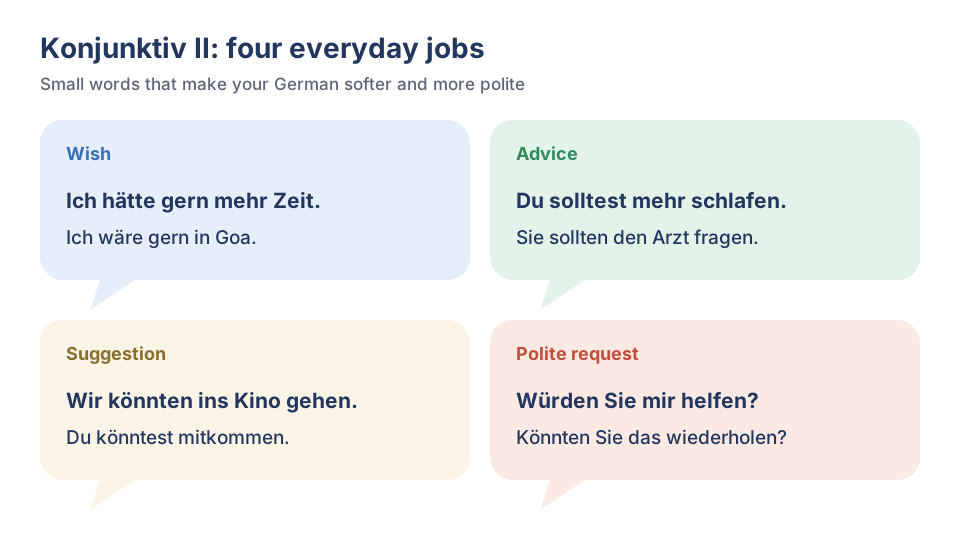
| Giving Advice with sollte (Konjunktiv II) | Unit 4 | Du solltest früher schlafen gehen. · Sie sollten Ihre Chefin fragen. sollte gives friendly advice: ich/er/sie sollte, du solltest, Sie sollten. हिंदी: सलाह देने के लिए sollte: Du solltest … = तुम्हें … करना चाहिए। Open the lesson →See the picture ↓ |
|---|
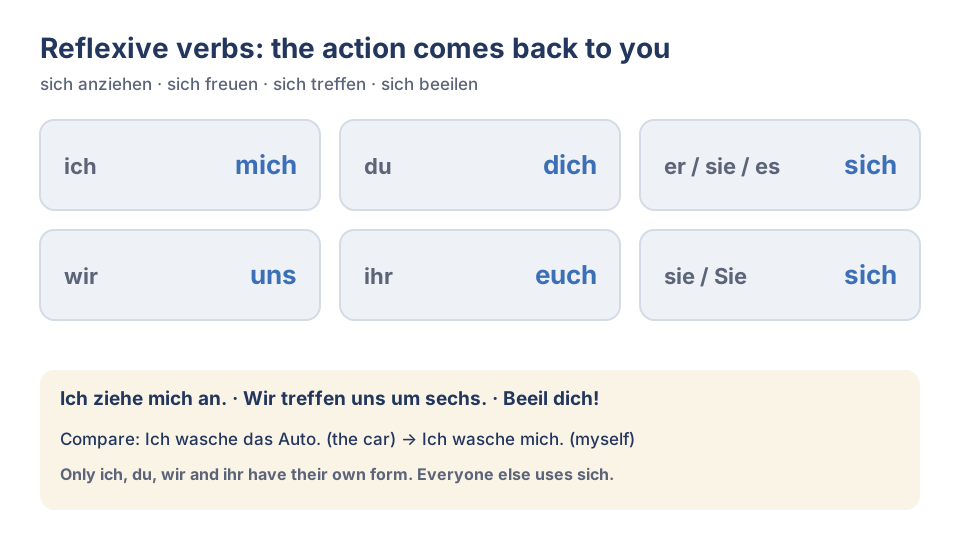
| Reflexive Verbs | Unit 5 | Ich ziehe mich schnell an. · Wir treffen uns um sechs Uhr. Some verbs need a pronoun that points back to the subject: mich, dich, sich, uns, euch. हिंदी: जब काम ख़ुद पर होता है तो mich, dich, sich जैसे pronoun लगते हैं: Ich ziehe mich an = मैं कपड़े पहनता हूँ। Open the lesson →See the picture ↓ |
|---|
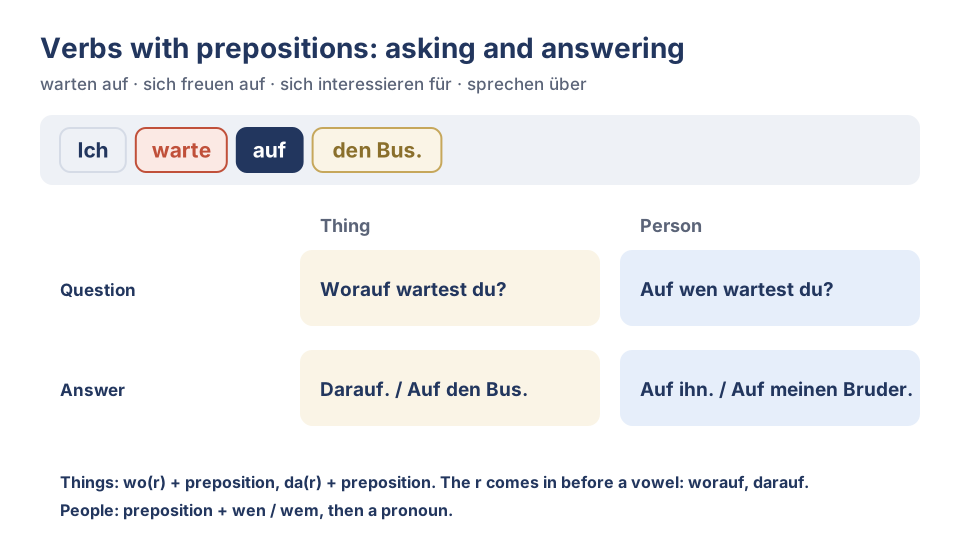
| Verbs with Prepositions | Unit 5 | Ich warte auf den Bus. · Sie interessiert sich für Yoga. Many verbs come with a fixed preposition. Learn the verb and the preposition together. हिंदी: कुछ verbs के साथ हमेशा एक तय preposition आता है: warten auf (इंतज़ार करना), sich interessieren für (रुचि होना)। इन्हें जोड़े में याद करें। Open the lesson →See the picture ↓ |
|---|
| Question Words and Pronouns: worauf? / darauf | Unit 5 | Worauf freust du dich? · Auf den Urlaub. Ich freue mich sehr darauf. For things, ask with wo(r)- + preposition and answer with da(r)- + preposition. हिंदी: चीज़ के लिए सवाल Wo(r)- से (Worauf?) और जवाब Da(r)- से (Darauf)। इंसान के लिए: Auf wen? Auf ihn। Open the lesson →See the picture ↓ |
|---|
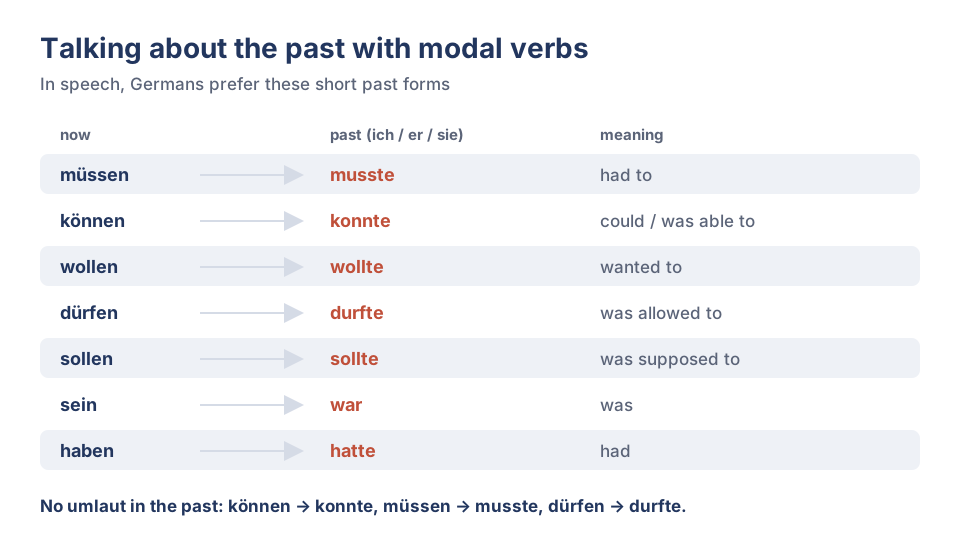
| Modal Verbs in the Past (Präteritum) | Unit 6 | Als Kind wollte ich Pilot werden. · Gestern musste ich lange arbeiten. Modal verbs use the short Präteritum in the past: musste, konnte, wollte, durfte, sollte. हिंदी: बीते समय में modal verbs: musste (करना पड़ा), konnte (कर पाया), wollte (चाहता था)। इनमें umlaut नहीं रहता। Open the lesson →See the picture ↓ |
|---|
| German Conjunction Dass | Unit 6 | Ich finde, dass Deutsch gar nicht so schwer ist. · Es ist wichtig, dass du jeden Tag übst. dass (that) introduces an opinion or a fact. The verb goes to the end. हिंदी: dass = कि। Ich finde, dass … = मुझे लगता है कि …। यहाँ भी verb आख़िर में। Open the lesson →See the picture ↓ |
|---|
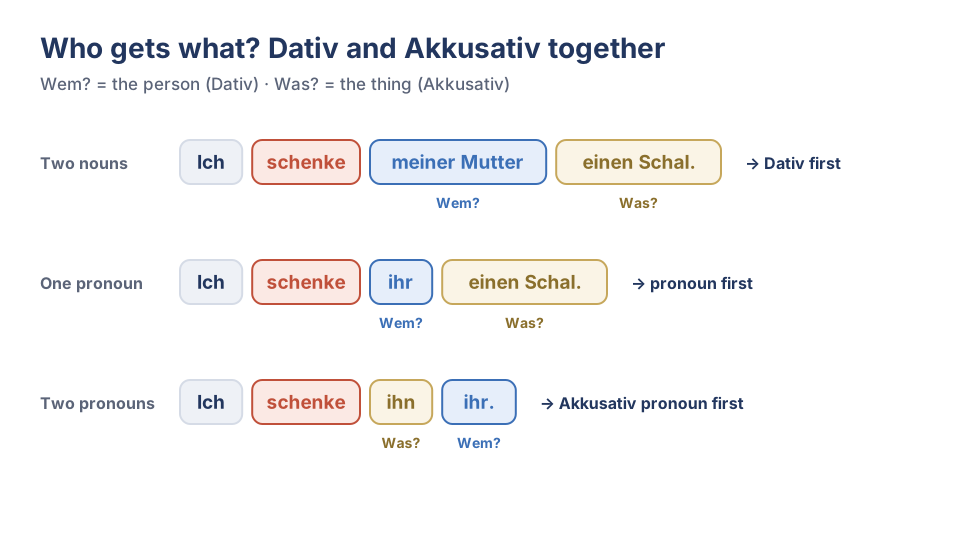
| Dative as Indirect Object | Unit 7 | Ich schenke meiner Mutter einen Schal. · Er kauft seinem Sohn ein Fahrrad. The person who receives something is in the dative (Wem?), the thing in the accusative (Was?). हिंदी: जिसे कुछ दिया जाए वह व्यक्ति Dativ में (Wem?), और जो चीज़ दी जाए वह Akkusativ में (Was?)। Open the lesson →See the picture ↓ |
|---|
| Word Order with Two Objects | Unit 7 | Ich gebe dem Kollegen das Ladekabel. · Ich gebe es ihm. Two nouns: dative first. Two pronouns: accusative first. हिंदी: दोनों noun हों तो पहले Dativ, फिर Akkusativ। दोनों pronoun हों तो Akkusativ वाला (es, ihn) पहले। Open the lesson →See the picture ↓ |
|---|
| Preposition von + Dative | Unit 7 | Die Uhr ist von meinem Vater. · Das habe ich von ihr bekommen. von (from) always takes the dative. हिंदी: von = से। von के बाद हमेशा Dativ: von meinem Vater = मेरे पिता से। Open the lesson → |
|---|
| A2.2 · Weeks 5–8 |
| Konjunktiv II: wäre, hätte, würde (Wishes) | Unit 8 | Ich hätte gern mehr Freizeit. · Ich wäre jetzt gern in Goa. hätte gern and wäre gern say what you wish for. हिंदी: इच्छा बताने के लिए: Ich hätte gern … = काश मेरे पास … होता, Ich wäre gern … = काश मैं … होता। Open the lesson →See the picture ↓ |
|---|
| Making Suggestions with könnte | Unit 8 | Wir könnten am Samstag ins Kino gehen. · Du könntest auch mitkommen. Wir könnten … and Du könntest … make a friendly suggestion. हिंदी: सुझाव देने के लिए: Wir könnten … = हम … कर सकते हैं। Open the lesson →See the picture ↓ |
|---|
| German Connector Trotzdem | Unit 8 | Es regnet. Trotzdem gehe ich joggen. trotzdem (anyway) shows a contrast. The verb comes straight after it, in position 2. हिंदी: trotzdem = फिर भी। इसके बाद verb तुरंत दूसरे नंबर पर आता है। Open the lesson →See the picture ↓ |
|---|
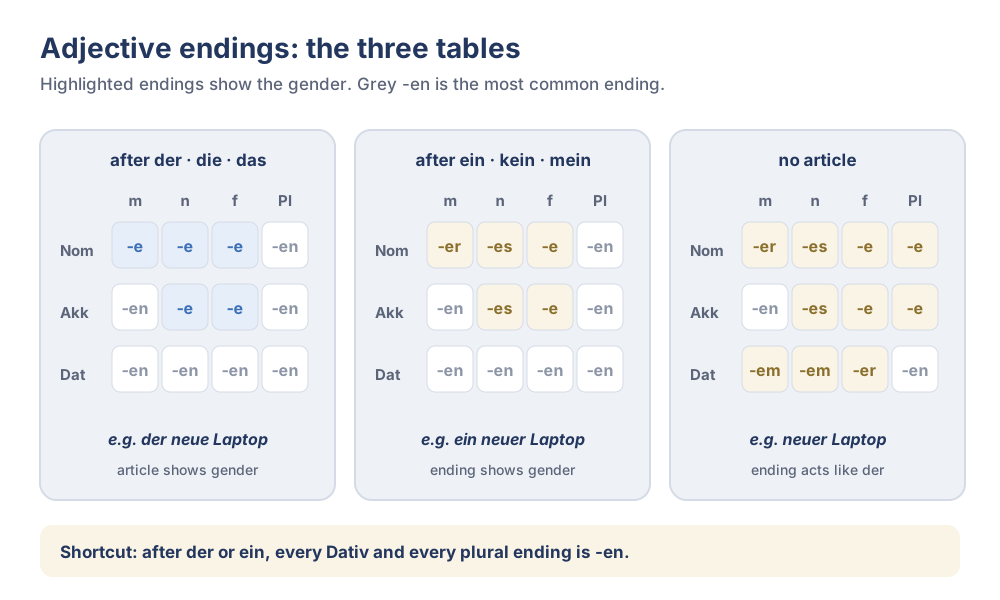
| Adjective Endings after ein, kein, mein | Unit 9 | ein neues Handy · Ich suche einen günstigen Laptop. · mit meinem alten Fahrrad After ein, kein and mein the adjective ending shows the gender the article doesn't. हिंदी: ein, kein, mein के बाद adjective की ending gender बताती है: ein neuer Laptop, ein neues Handy। Open the lesson →See the picture ↓ |
|---|
| Comparative and Superlative: Irregular Forms | Unit 9 | groß, größer, am größten · hoch, höher, am höchsten Short adjectives often add an umlaut, and a few change completely: gut, besser, am besten. हिंदी: कुछ adjectives में umlaut आ जाता है या रूप बदल जाता है: groß → größer, gut → besser, gern → lieber। Open the lesson → |
|---|
| Comparing with als and wie | Unit 9 | Mein Zimmer ist kleiner als deins. · Er ist genauso alt wie ich. Different: comparative + als. The same: (genau)so + wie. हिंदी: बराबर न हों तो comparative + als (से)। बराबर हों तो genauso + wie (जितना)। Open the lesson → |
|---|
| Adjectives with -los | Unit 9 | die Kosten → kostenlos · die Arbeit → arbeitslos · Der Eintritt ist kostenlos. -los means without: kostenlos (free of charge), arbeitslos (unemployed). हिंदी: -los = बिना: kostenlos = बिना पैसे के (मुफ़्त), arbeitslos = बेरोज़गार। Open the lesson → |
|---|
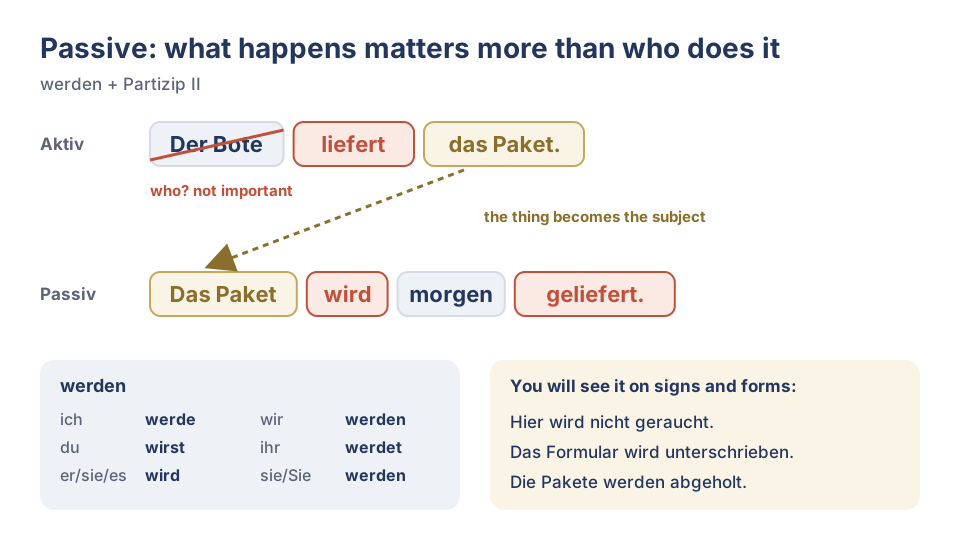
| Passive Voice: Present Tense | Unit 10 | Das Paket wird morgen geliefert. · Hier wird nicht geraucht. werden + Partizip II, when what happens matters more than who does it. हिंदी: जब करने वाला ज़रूरी न हो: werden + Partizip II। Das Paket wird geliefert = पैकेट डिलीवर किया जाता है। Open the lesson →See the picture ↓ |
|---|
| Asking What Kind: Was für ein ...? | Unit 10 | Was für ein Handy hast du? · Was für eine Wohnung suchen Sie? Asks what kind of thing. The ending of ein follows the case of the noun. हिंदी: Was für ein …? = किस तरह का …? जवाब में चीज़ का प्रकार बताते हैं। Open the lesson → |
|---|
| Adjective Endings after der, die, das | Unit 10 | der rote Koffer · Ich nehme den blauen Pullover. · mit dem neuen Handy After the definite article the ending is mostly -e or -en, because the article already shows the gender. हिंदी: der/die/das के बाद ending ज़्यादातर -e या -en होती है, क्योंकि article पहले ही gender बता देता है। Open the lesson →See the picture ↓ |
|---|
| Word Building: Nouns with -ung, Adjectives with un- | Unit 10 | wohnen → die Wohnung · bequem → unbequem Verb + -ung makes a noun (always die). un- gives an adjective the opposite meaning. हिंदी: verb में -ung जोड़ने से noun बनता है (हमेशा die): wohnen → die Wohnung। un- से उल्टा अर्थ: bequem → unbequem। Open the lesson → |
|---|
| Where From? aus and von + Dative | Unit 11 | Ich komme gerade aus dem Supermarkt. · Sie kommt vom Arzt. Woher? aus for coming out of a place, von for coming from a person or an activity. Both take the dative. हिंदी: Woher? (कहाँ से) के लिए aus (किसी जगह के अंदर से) और von (किसी व्यक्ति या जगह से)। दोनों के बाद Dativ। Open the lesson → |
|---|
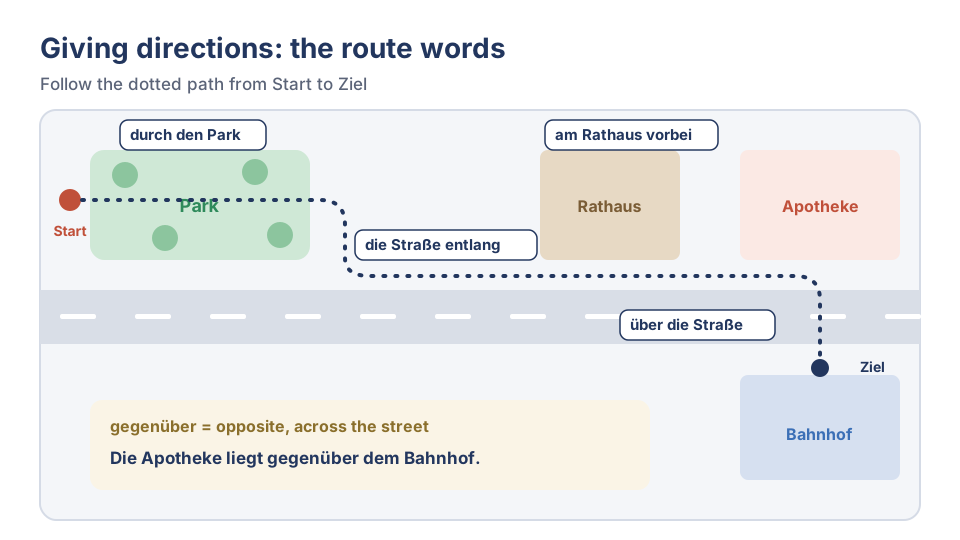
| Prepositions for Directions: durch, über, entlang, gegenüber | Unit 11 | Gehen Sie durch den Park. · Die Apotheke ist gegenüber dem Bahnhof. · am Rathaus vorbei Route words: through, across, along, past. gegenüber (opposite) takes the dative. हिंदी: रास्ता बताने के शब्द: durch (के बीच से), über (के पार), entlang (के किनारे-किनारे), an … vorbei (के पास से), gegenüber (के सामने)। Open the lesson →See the picture ↓ |
|---|
| German Connector Deshalb | Unit 11 | Ich habe morgen eine Prüfung. Deshalb lerne ich heute Abend. deshalb (that's why) gives a result. The verb comes straight after it, in position 2. हिंदी: deshalb = इसलिए। पहले कारण, फिर नतीजा। deshalb के बाद verb तुरंत आता है। Open the lesson →See the picture ↓ |
|---|
| Adjectives with -bar, -ig, -isch | Unit 11 | die Sonne → sonnig · waschen → waschbar · der Typ → typisch -bar means it can be done. -ig and -isch turn a noun into an adjective. हिंदी: -bar = जो किया जा सके (waschbar = धोने लायक)। -ig और -isch से noun का adjective बनता है: sonnig = धूप वाला। Open the lesson → |
|---|
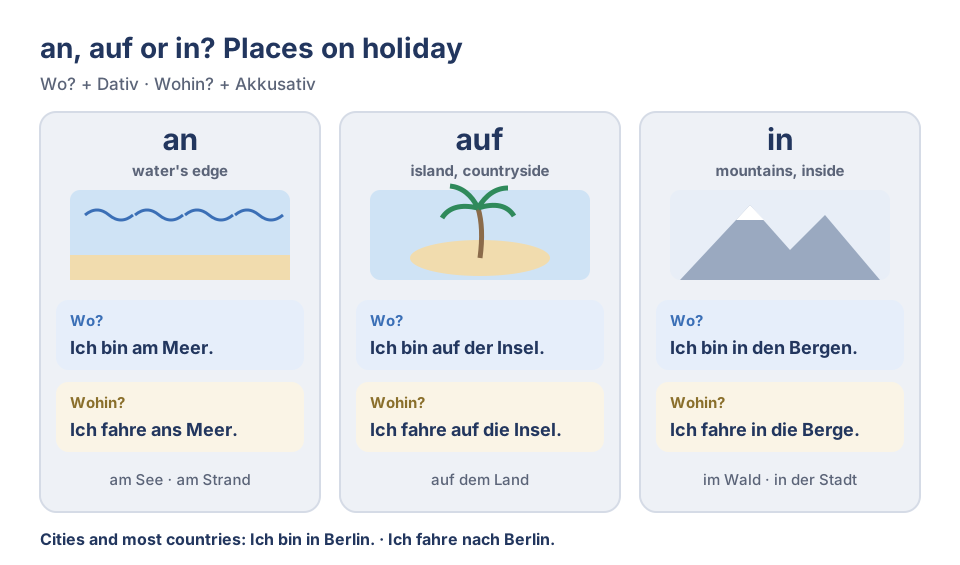
| an, auf, in with Places: Wo? and Wohin? | Unit 12 | Wir sind am Meer. · Wir fahren ans Meer. · in den Bergen / in die Berge an for the water's edge, auf for islands and the countryside, in for mountains and areas. हिंदी: पानी के किनारे के लिए an, द्वीप या देहात के लिए auf, पहाड़ों और इलाक़ों के अंदर के लिए in। Open the lesson →See the picture ↓ |
|---|
| Adjective Endings without an Article | Unit 12 | Zimmer mit großem Balkon · Hotel mit kostenlosem WLAN With no article, the adjective takes the ending the article would have had. हिंदी: Article न हो तो adjective ख़ुद article वाली ending ले लेता है: mit großem Balkon (dem → -em)। Open the lesson →See the picture ↓ |
|---|
| Time Prepositions: von ... an, über | Unit 12 | Von Montag an arbeite ich im Homeoffice. · Die Fahrt dauert über drei Stunden. von … an marks a starting point. über with a number means more than. हिंदी: von … an = … से शुरू करके। über = से ज़्यादा: über drei Stunden = तीन घंटे से ज़्यादा। Open the lesson → |
|---|
| Preposition ohne | Unit 12 | ein Zimmer ohne Frühstück · Ich fahre nie ohne mein Handy weg. ohne (without) always takes the accusative. हिंदी: ohne = बिना। इसके बाद हमेशा Akkusativ: ohne meinen Pass। Open the lesson → |
|---|
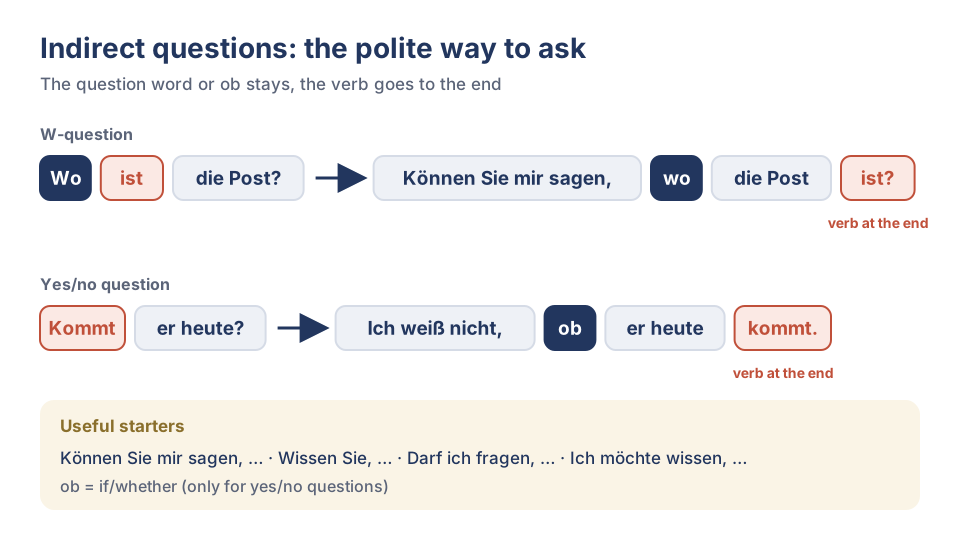
| Indirect Questions with Question Words | Unit 13 | Können Sie mir sagen, wo die Post ist? · Wissen Sie, wann der Kurs anfängt? A polite opener, then the question word, with the verb at the end. हिंदी: विनम्र सवाल: Können Sie mir sagen, wo … ist? सवाल वाला शब्द वहीं रहता है, verb आख़िर में जाता है। Open the lesson →See the picture ↓ |
|---|
| Indirect Yes/No Questions with ob | Unit 13 | Ich weiß nicht, ob er heute kommt. · Darf ich fragen, ob ich bar zahlen kann? For a yes/no question, use ob (whether), with the verb at the end. हिंदी: हाँ/ना वाले सवाल को indirect बनाने के लिए ob (कि क्या) लगाते हैं: Ich weiß nicht, ob … Open the lesson →See the picture ↓ |
|---|
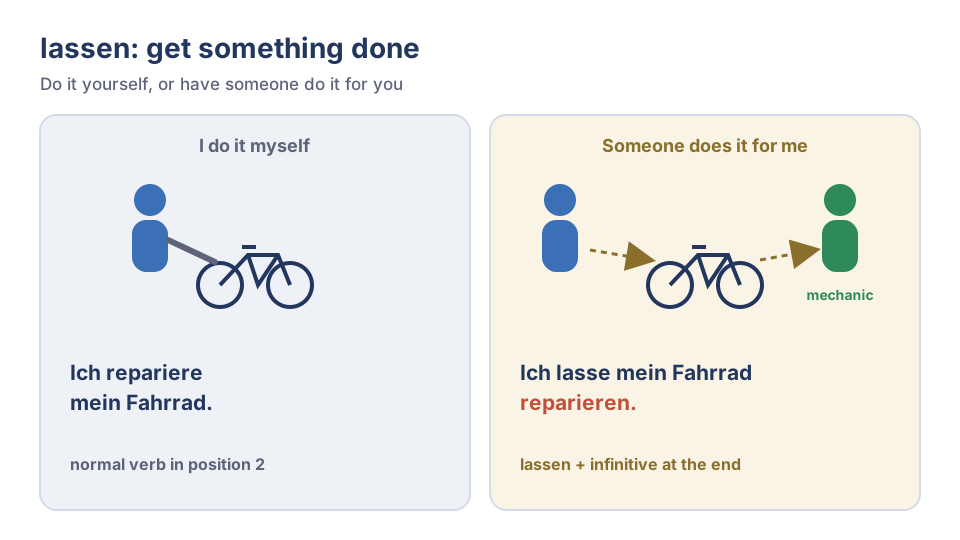
| The Verb lassen | Unit 13 | Ich lasse meine Haare schneiden. · Er lässt sein Auto reparieren. lassen + infinitive: someone else does it for you. हिंदी: lassen = कोई काम किसी और से करवाना: Ich lasse mein Auto reparieren = मैं अपनी कार ठीक करवाता हूँ। Open the lesson →See the picture ↓ |
|---|
| Review: Perfekt and Präteritum | Unit 14 | Am Wochenende habe ich meine Freunde getroffen. · Ich war müde, aber ich wollte nicht nach Hause. Perfekt for most verbs when you speak; Präteritum for sein, haben and the modal verbs. हिंदी: बोलचाल में ज़्यादातर Perfekt बोलते हैं, पर sein, haben और modal verbs के लिए Präteritum (war, hatte, musste) ज़्यादा आम है। Open the lesson →See the picture ↓ |
|---|
| Review: Sentences with weil, dass and wenn | Unit 14 | Ich bin froh, dass du da bist. · Ich rufe dich an, wenn ich ankomme. All three send the verb to the end of their clause. हिंदी: तीनों में verb आख़िर में जाता है: weil = क्योंकि, dass = कि, wenn = अगर/जब। Open the lesson →See the picture ↓ |
|---|
| Review: Konjunktiv II for Wishes, Advice and Suggestions | Unit 14 | Ich würde gern Spanisch lernen. · Du solltest mal Pause machen. würde, hätte, wäre, könnte and sollte for wishes, advice, suggestions and polite requests. हिंदी: würde, hätte, wäre, könnte, sollte: इच्छा, सलाह, सुझाव और विनम्र अनुरोध के लिए। Open the lesson →See the picture ↓ |
|---|
| Word Building: -chen, -er, -in and Compound Nouns | Unit 14 | das Brot → das Brötchen · lehren → der Lehrer, die Lehrerin · die Haustür -chen makes something small (always das), -er and -in name a person, and a compound noun takes the article of its last part. हिंदी: -chen से चीज़ छोटी हो जाती है (das Brötchen), -er/-in से व्यक्ति (der Lehrer, die Lehrerin), दो noun जोड़कर नया शब्द (die Haustür)। Open the lesson → |
|---|