A2 Grammar · Unit 10 · Topic 28 of 46
Passive Voice: Present Tense
About 3 minutes · examples, common mistakes, Hindi help and practice with answers
In short
werden + Partizip II, when what happens matters more than who does it.
Das Paket wird morgen geliefert. · Hier wird nicht geraucht.
The passive puts the action first, not the person doing it. It's common on signs, in instructions and in the news. Form: werden + Partizip II.
How it works
- werden (conjugated) + participle at the end: Das Paket wird morgen geliefert.
- Plural subject: Die Briefe werden am Montag verschickt.
- Who does it (if needed): von + dative: Das Essen wird von meiner Mutter gekocht.
- Impersonal: Hier wird nicht geraucht. (No smoking here.)
Examples
- Das Paket wird morgen geliefert. (The parcel will be delivered tomorrow.)
- Hier wird nicht geraucht. (There's no smoking here.)
- In Deutschland wird der Müll getrennt. (In Germany rubbish is separated.)
- Die Wohnungen werden im Sommer renoviert. (The flats are being renovated in the summer.)
हिंदीजब करने वाला ज़रूरी न हो: werden + Partizip II। Das Paket wird geliefert = पैकेट डिलीवर किया जाता है।
Present passive
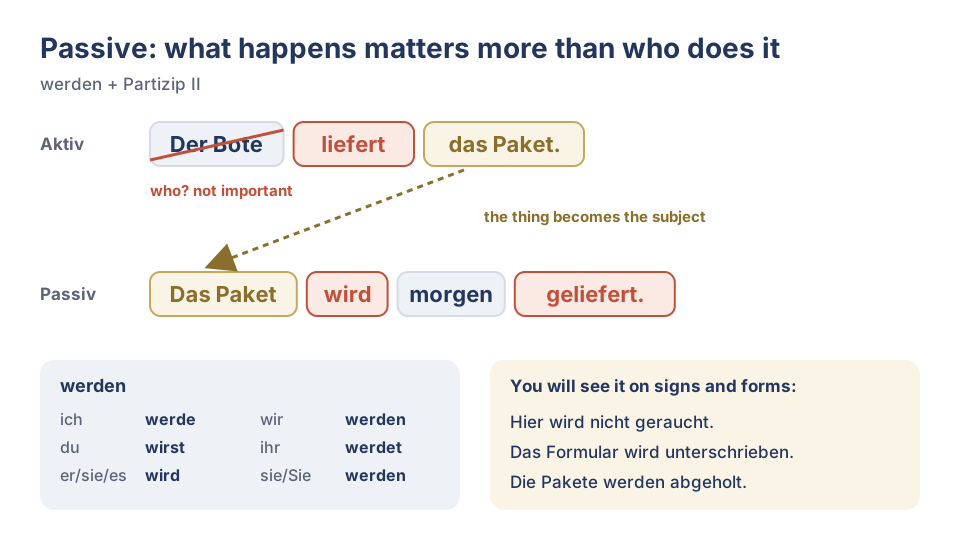
Swipe the picture sideways to see all of it →
Use the passive when the person doing the action isn't important. The object of the active sentence becomes the subject, werden goes in position 2 and the participle goes to the end. You'll see it all the time on signs, forms and instructions.
Passive तब इस्तेमाल होता है जब काम करने वाला ज़रूरी नहीं होता। Active वाक्य का object, passive में subject बन जाता है। werden दूसरे नंबर पर आता है और Partizip II आख़िर में। Signs, forms और instructions में यह बहुत दिखता है।
Common mistakes
Using sein instead of werden: ✗ Das Paket ist morgen geliefert. ✓ Das Paket wird morgen geliefert.
Practice
Put into the passive.
- Man repariert das Auto.
- Man öffnet die Tür um acht.
- Man spricht hier Deutsch.
Show answers
Answers: 1. Das Auto wird repariert. 2. Die Tür wird um acht geöffnet. 3. Hier wird Deutsch gesprochen.