A2 Grammar · Unit 2 · Topic 6 of 46
Two-Way Prepositions (Wechselpräpositionen)
About 3 minutes · examples, common mistakes, Hindi help and practice with answers
In short
an, auf, hinter, in, neben, über, unter, vor, zwischen: dative for Wo?, accusative for Wohin?
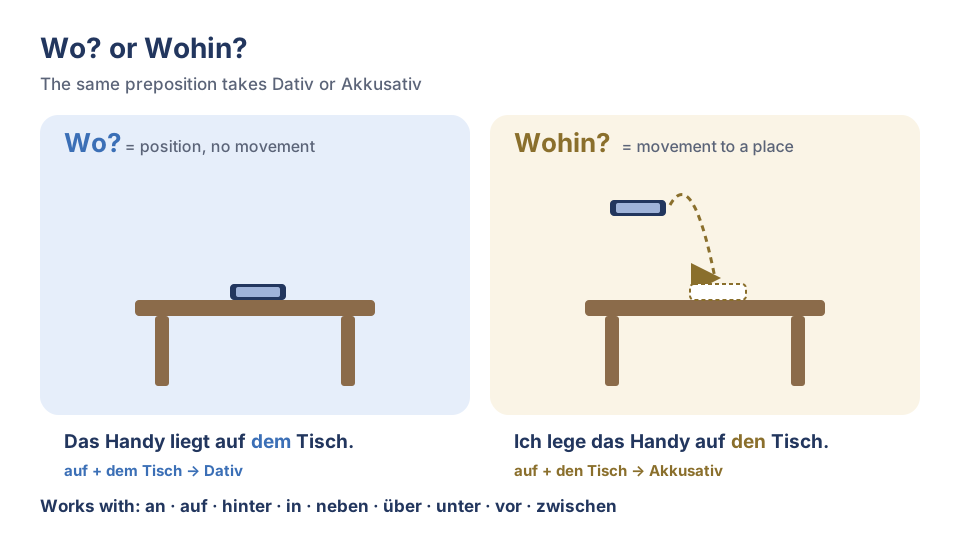
Das Handy liegt auf dem Tisch. (Wo?) · Ich lege das Handy auf den Tisch. (Wohin?)
Nine prepositions can take either the dative or the accusative: an, auf, hinter, in, neben, über, unter, vor, zwischen. The question decides: Wo? (where, no movement) takes the dative; Wohin? (where to, movement) takes the accusative.
How it works
- Wo? → dative: Das Handy liegt auf dem Tisch.
- Wohin? → accusative: Ich lege das Handy auf den Tisch.
- Short forms: in dem → im, an dem → am, in das → ins, an das → ans.
- Verbs of movement (gehen, legen, stellen, hängen) usually ask Wohin?; verbs of position (sein, liegen, stehen, hängen) ask Wo?
| der | die | das | Plural | |
|---|---|---|---|---|
| Wo? (Dativ) | auf dem Tisch | in der Küche | im Zimmer | in den Regalen |
| Wohin? (Akkusativ) | auf den Tisch | in die Küche | ins Zimmer | in die Regale |
Examples
- Der Laptop ist im Büro. (The laptop is in the office. (Wo?))
- Ich bringe den Laptop ins Büro. (I'm taking the laptop to the office. (Wohin?))
- Die Katze schläft unter dem Bett. (The cat is sleeping under the bed.)
- Die Katze läuft unter das Bett. (The cat runs under the bed.)
- Wir hängen das Bild an die Wand. (We're hanging the picture on the wall.)
हिंदीWo? (चीज़ कहाँ है) पूछें तो Dativ। Wohin? (चीज़ कहाँ रखी या ले जाई जा रही है) पूछें तो Akkusativ।
Wechselpräpositionen: Wo? or Wohin?
Swipe the picture sideways to see all of it →
Nine prepositions can take either case. Ask yourself one question: is the thing already in that place, or is it moving there? If it's already there, use the Dativ (auf dem Tisch). If it's moving there, use the Akkusativ (auf den Tisch).
ये नौ prepositions दोनों case ले सकते हैं। ख़ुद से एक सवाल पूछिए: चीज़ पहले से वहाँ है, या वहाँ ले जाई जा रही है? पहले से है तो Dativ (auf dem Tisch)। वहाँ रखी जा रही है तो Akkusativ (auf den Tisch)।
Common mistakes
Using the dative after a movement verb: ✗ Ich gehe in der Küche. ✓ Ich gehe in die Küche. (Wohin?) ✓ Ich bin in der Küche. (Wo?)
Practice
Dative or accusative? Fill in the article.
- Ich stelle die Flasche auf ___ Tisch.
- Die Flasche steht auf ___ Tisch.
- Wir gehen in ___ Park.
- Die Kinder spielen in ___ Park.
Show answers
Answers: 1. den 2. dem 3. den 4. dem