A2 Grammar · Unit 14 · Topic 44 of 46
Review: Sentences with weil, dass and wenn
About 3 minutes · examples, common mistakes, Hindi help and practice with answers
In short
All three send the verb to the end of their clause.
Ich bin froh, dass du da bist. · Ich rufe dich an, wenn ich ankomme.
weil, dass and wenn all send the conjugated verb to the end. Here's when to use each one.
How it works
- weil: a reason. Ich bleibe zu Hause, weil ich krank bin.
- dass: what someone thinks, says or feels. Ich bin froh, dass du da bist.
- wenn: a condition or a repeated event. Ich rufe dich an, wenn ich ankomme.
- Clause first? Then the main verb comes straight after the comma: Wenn ich ankomme, rufe ich dich an.
Examples
- Ich bin froh, dass du da bist. (I'm glad you're here.)
- Ich rufe dich an, wenn ich ankomme. (I'll call you when I arrive.)
- Wir essen draußen, weil es so warm ist. (We're eating outside because it's so warm.)
- Wenn du Zeit hast, können wir zusammen lernen. (If you have time, we can study together.)
हिंदीतीनों में verb आख़िर में जाता है: weil = क्योंकि, dass = कि, wenn = अगर/जब।
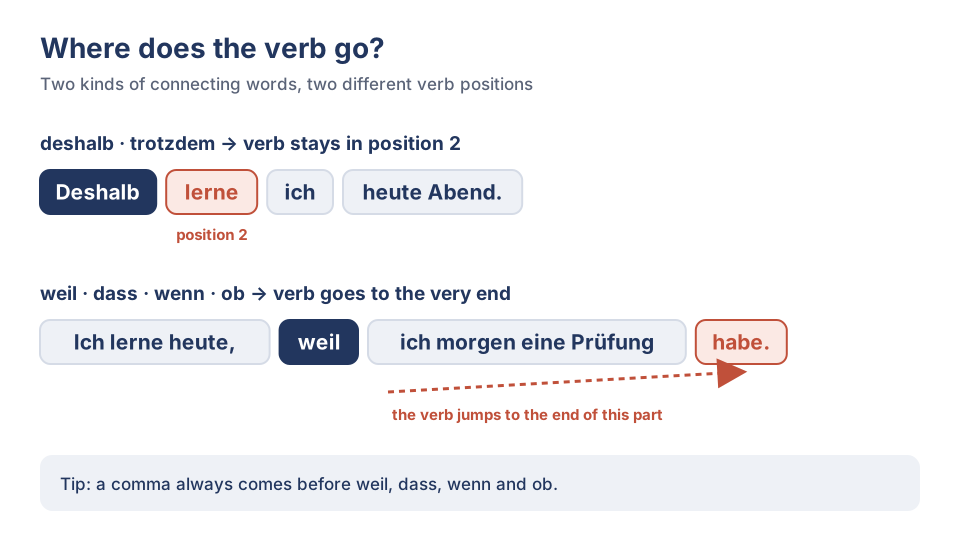
Where the verb goes after weil, dass, wenn and deshalb
Swipe the picture sideways to see all of it →
Both groups join two ideas, but they treat the verb differently. After weil, dass, wenn and ob the conjugated verb moves to the end of its clause. After deshalb and trotzdem it stays in position 2, straight after the connecting word.
दोनों तरह के शब्द दो बातों को जोड़ते हैं, पर verb की जगह अलग होती है। weil, dass, wenn और ob के बाद verb उस हिस्से के बिल्कुल आख़िर में जाता है। deshalb और trotzdem के बाद verb तुरंत दूसरे नंबर पर आता है।
Common mistakes
The verb in second place in the clause: ✗ …, weil es ist warm. ✓ …, weil es warm ist.
Practice
weil, dass or wenn?
- Ich hoffe, ___ das Wetter morgen schön ist.
- Ich komme nicht, ___ ich arbeiten muss.
- ___ du Hilfe brauchst, ruf mich an.
- Es ist toll, ___ du die Prüfung bestanden hast.
Show answers
Answers: 1. dass 2. weil 3. Wenn 4. dass