A2 Grammar · Unit 6 · Topic 17 of 46
German Conjunction Dass
About 3 minutes · examples, common mistakes, Hindi help and practice with answers
In short
dass (that) introduces an opinion or a fact. The verb goes to the end.
Ich finde, dass Deutsch gar nicht so schwer ist. · Es ist wichtig, dass du jeden Tag übst.
dass means "that". It introduces what someone thinks, says, knows or hopes. Like weil and wenn, it sends the conjugated verb to the end.
How it works
- After verbs like finden, glauben, denken, wissen, hoffen, sagen: Ich finde, dass Deutsch nicht so schwer ist.
- After phrases like Es ist wichtig, … / Ich bin froh, … : Es ist wichtig, dass du jeden Tag übst.
- Always a comma before dass.
- dass (that, a conjunction) is different from das (the / which).
Examples
- Ich finde, dass Deutsch gar nicht so schwer ist. (I think German isn't that hard at all.)
- Es ist wichtig, dass du jeden Tag übst. (It's important that you practise every day.)
- Ich hoffe, dass wir uns bald sehen. (I hope we'll see each other soon.)
- Mohan hat gesagt, dass er später kommt. (Mohan said he'll come later.)
हिंदीdass = कि। Ich finde, dass … = मुझे लगता है कि …। यहाँ भी verb आख़िर में।
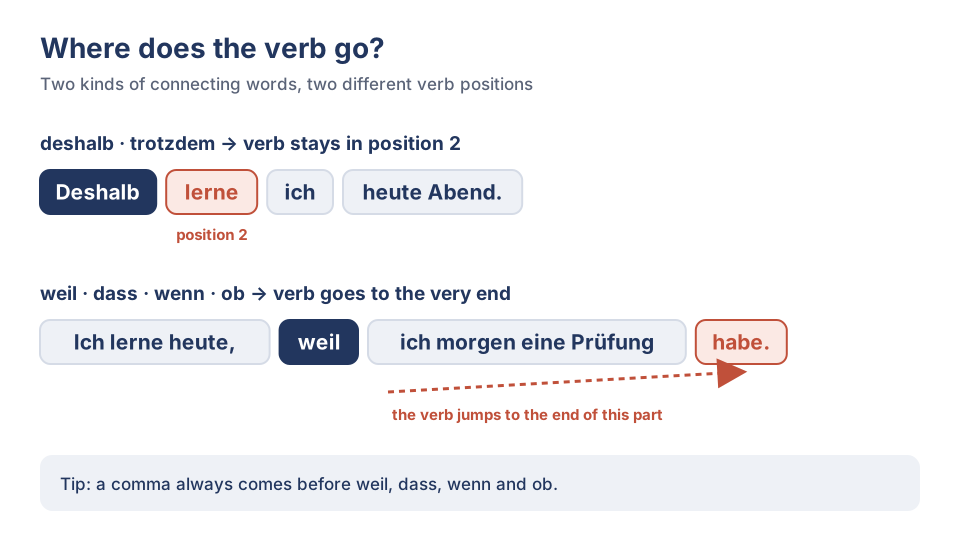
Where the verb goes after weil, dass, wenn and deshalb
Swipe the picture sideways to see all of it →
Both groups join two ideas, but they treat the verb differently. After weil, dass, wenn and ob the conjugated verb moves to the end of its clause. After deshalb and trotzdem it stays in position 2, straight after the connecting word.
दोनों तरह के शब्द दो बातों को जोड़ते हैं, पर verb की जगह अलग होती है। weil, dass, wenn और ob के बाद verb उस हिस्से के बिल्कुल आख़िर में जाता है। deshalb और trotzdem के बाद verb तुरंत दूसरे नंबर पर आता है।
Common mistakes
Normal word order after dass: ✗ Ich glaube, dass er ist krank. ✓ Ich glaube, dass er krank ist. And spelling: ✗ Ich weiß, das du recht hast. ✓ dass
Practice
Make one sentence with dass.
- Ich glaube: Der Kurs beginnt um neun.
- Es ist schön: Du bist hier.
- Sie weiß: Das Restaurant ist am Montag geschlossen.
Show answers
Answers: 1. Ich glaube, dass der Kurs um neun beginnt. 2. Es ist schön, dass du hier bist. 3. Sie weiß, dass das Restaurant am Montag geschlossen ist.