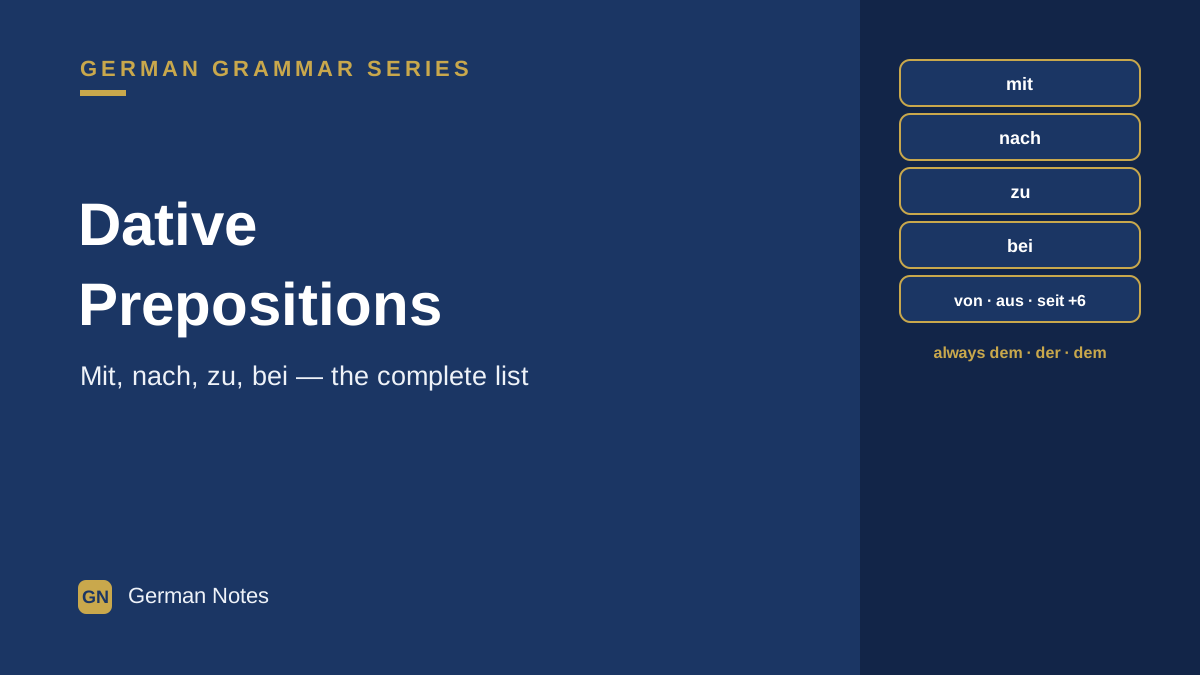
Dative prepositions always take dative case — the largest group of fixed-case prepositions in German. Once you know the dative case itself and this list, case choice after these words stops being a decision.
Complete List of Dative Prepositions
| Preposition | Meaning | Dative Form | Example | English |
|---|---|---|---|---|
| mit | with | mit + dat | Ich gehe mit meinem Freund | I go with my friend |
| nach | after / to | nach + dat | Nach dem Film essen wir | After the film we eat |
| zu | to / at | zu + dat | Wir gehen zum Arzt | We go to the doctor |
| bei | at / near | bei + dat | Ich bin bei meinem Vater | I am at my father's |
| von | from / of | von + dat | Das ist von meinem Bruder | That is from my brother |
| aus | from / out of | aus + dat | Ich komme aus der Schule | I come from school |
| seit | since | seit + dat | Seit letztem Jahr arbeite ich hier | Since last year I work here |
| gegenüber | opposite / across | gegenüber + dat | Die Bank ist gegenüber dem Bahnhof | The bank is opposite the station |
| außer | except / besides | außer + dat | Außer meinem Bruder kommen alle | Except my brother, everyone comes |
Detailed Examples for Each Preposition
Mit (with)
- Ich gehe mit meinem Freund ins Kino. (I go to the cinema with my friend.)
- Sie spricht mit dem Lehrer. (She speaks with the teacher.)
- Wir essen mit der Familie. (We eat with the family.)
Nach (after / to)
- Nach der Schule spielen wir Fußball. (After school we play soccer.)
- Wir fahren nach Berlin. (We drive to Berlin.)
- Nach dem Essen gehen wir spazieren. (After eating we go for a walk.)
Zu (to / at)
- Ich gehe zum Arzt. (I go to the doctor — zu + dem = zum)
- Wir fahren zur Oma. (We drive to grandmother's — zu + der = zur)
- Komm zu mir! (Come to my place!)
Bei (at / near)
- Ich bin beim Arzt. (I am at the doctor's — bei + dem = beim)
- Wir übernachten bei unseren Großeltern. (We stay overnight at our grandparents'.)
- Er arbeitet bei einer Bank. (He works at a bank.)
Von (from / of)
- Das ist von meinem Bruder. (That is from my brother.)
- Der Mann vom Bahnhof ist freundlich. (The man from the station is friendly.)
- Ein Buch von Goethe. (A book by Goethe.)
Aus (from / out of)
- Ich komme aus der Schule. (I come from school.)
- Das Auto kommt aus Deutschland. (The car comes from Germany.)
- Der Stift ist aus Holz. (The pencil is made of wood.)
Seit (since)
- Seit letztem Jahr arbeite ich hier. (Since last year I have worked here.)
- Seit drei Wochen bin ich krank. (For three weeks I have been sick.)
Gegenüber (opposite / across)
- Die Bank ist gegenüber dem Bahnhof. (The bank is opposite the station.)
- Unser Haus ist gegenüber der Schule. (Our house is opposite the school.)
Außer (except / besides)
- Außer meinem Bruder kommen alle. (Except my brother, everyone comes.)
- Außer dem Preis ist alles gut. (Except for the price, everything is good.)
What about neben? Neben (beside) isn't on this list because it's a two-way preposition. It takes the dative for a location (Die Lampe steht neben dem Tisch) and the accusative for movement (Ich stelle die Lampe neben den Tisch).
Important: Dative Plural Rule
In dative plural, all nouns get -n or -en:
- die Kinder (nominative plural) → den Kindern (dative plural)
- Ich helfe den Kindern. (I help the children.)
- Wir spielen mit den Freunden. (We play with the friends.)
- die Frauen (nominative) → den Frauen (dative — already ends in -n)
Note: if the nominative plural already ends in -n (die Frauen), you don't add another one. If it doesn't (die Kinder), you add -n to get "den Kindern."
Practice: Dative Prepositions
Fill in the correct dative form:
- Ich gehe mit _____ Freund. (I go with the friend — masculine) — Answer: meinem
- Nach _____ Film gehen wir essen. (After the film — masculine) — Answer: dem
- Sie geht zu _____ Jungen. (She goes to the boy — masculine) — Answer: dem
- Das ist von _____ Lehrerin. (That is from the teacher — feminine) — Answer: der
- Ich komme aus _____ Schule. (I come from school — feminine) — Answer: der
- Wir spielen mit _____ Kindern. (We play with the children — plural dative) — Answer: den
- Seit _____ Jahr arbeite ich hier. (Since one year — neuter) — Answer: einem
- Bei _____ Großeltern übernachte ich. (At grandparents', I stay overnight — plural dative) — Answer: den
Zu + Dative = Special Contractions
German often combines "zu" with articles:
- zu + dem = zum — Ich gehe zum Arzt.
- zu + der = zur — Wir fahren zur Oma.
- zu + die = zu den — Wir gehen zu den Kindern.
Always use the contraction when one exists. "Zum Arzt," not "zu dem Arzt."
Common Mistakes with Dative Prepositions
Mistake 1: Using Accusative Instead of Dative
Wrong: Ich helfe den Freund. (accusative article "den")
Right: Ich helfe dem Freund. (dative article "dem")
Mistake 2: Forgetting the Plural -n
Wrong: Ich spiele mit die Kinder. (no -n ending)
Right: Ich spiele mit den Kindern. (plural dative needs -n)
Mistake 3: Not Using Contractions with "Zu"
Avoid: Ich gehe zu dem Arzt.
Prefer: Ich gehe zum Arzt. (zu + dem = zum)
Mistake 4: Confusing Zu (to) and In (into)
Wrong: Ich gehe zu die Schule. (zu takes dative, not accusative)
Right: Ich gehe in die Schule. (in takes accusative for motion into a place)
Tip: "Zu" is for going to a person or a place you'd name specifically (zum Freund). "In" is for going into an institution or enclosed space (in die Schule).
Quick Reference: Dative Prepositions
Remember: all of these always take dative — accusative is never an option.
- mit = with
- nach = after / to
- zu = to / at
- bei = at / near
- von = from / of
- aus = from / out of
- seit = since
- gegenüber = opposite
- außer = except
Real-World Usage
- mit meinem Freund — with my friend
- nach der Schule — after school
- zum Arzt — to the doctor
- bei mir — at my place
- von meinen Eltern — from my parents
- aus Deutschland — from Germany
Summary
Dative prepositions always take dative case (dem, der, dem, den for plural). Dative prepositions are the largest group — nine-plus common ones — but once you know them, case choice is automatic.
Practice tip: make a flashcard for each preposition with its dative example built in, rather than learning the word alone.
FAQ
Which dative prepositions are most important?
Mit, nach, zu, bei, von, aus. These six cover the large majority of everyday usage.
Why do dative prepositions take dative?
Historically fixed through language evolution — each preposition's case was set centuries ago and just has to be learned, the same way English keeps traces of older case forms.
What's the difference between "zu" and "bei"?
"Zu" is motion toward someone or somewhere; "bei" is already being at someone or somewhere. Wir gehen zu meinem Freund. (We go to my friend's.) Wir sind bei meinem Freund. (We are at my friend's.)
Do I need to memorize all dative prepositions?
Learn the top six first — mit, nach, zu, bei, von, aus. The rest come naturally with reading and practice.
Related Grammar
See the accusative-only equivalents in our accusative prepositions guide, the genitive-only ones inside our genitive case guide, or the underlying case itself in dative case: indirect objects. Compare all four cases at once in our case comparison guide.
Not sure where your German currently stands? Take our free placement test — about 20 minutes, and it tells you exactly which level to start from. Prefer to talk it through first? Book a free consultation to discuss your grammar goals, or go straight to enrolling in a live batch that fits your schedule.