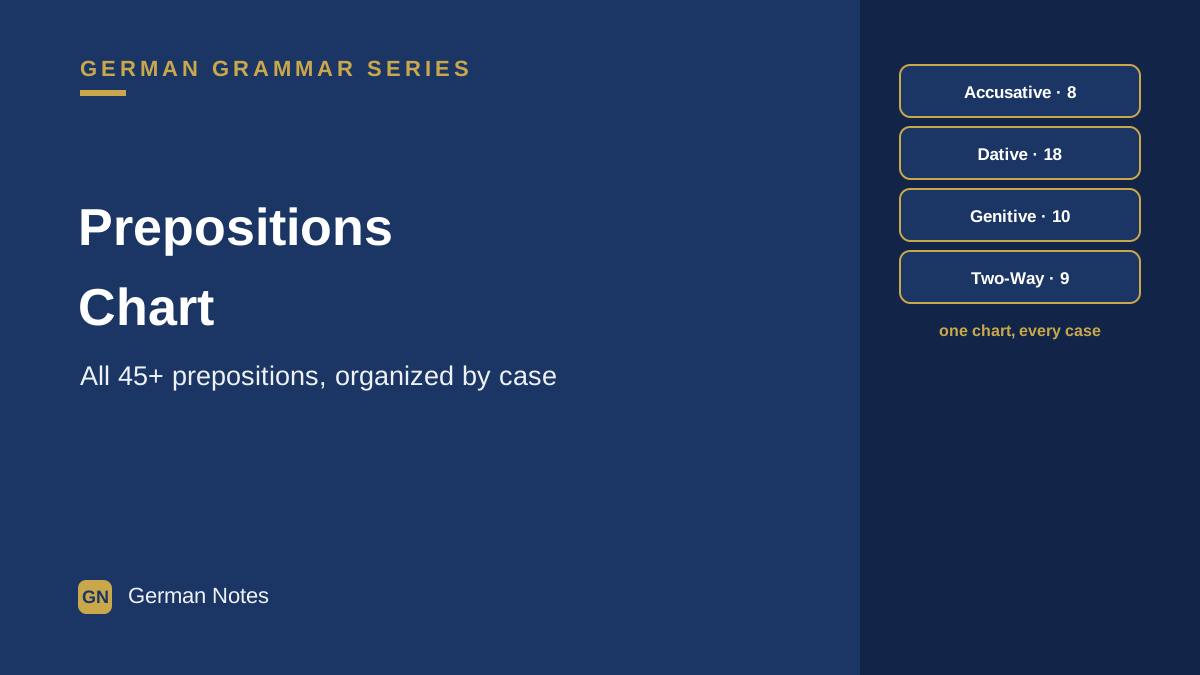
This is the one page to bookmark: every German preposition, organized by the case it takes. If you've already read the individual guides — accusative, dative, genitive, and two-way — this is the condensed version to check against.
The Complete German Prepositions Chart
Accusative Prepositions Only (8)
These always take accusative. No dative option.
| Preposition | English | Example | Translation |
|---|---|---|---|
| durch | through | durch den Park | through the park |
| für | for | für meinen Bruder | for my brother |
| gegen | against / towards | gegen die Wand | against the wall |
| ohne | without | ohne meinen Freund | without my friend |
| um | around | um den Tisch | around the table |
| bis | until | bis nächsten Freitag | until next Friday |
| entlang | along | den Fluss entlang | along the river |
| wider | against (formal) | wider die Regeln | against the rules |
Remember: accusative only = den (masc), die (fem), das (neut), die (plural).
Dative Prepositions Only (18)
These always take dative. The last nine are two-way prepositions shown in their locative (state) use — see the two-way section below for their accusative/motion use.
| Preposition | English | Example | Translation |
|---|---|---|---|
| mit | with | mit meinem Freund | with my friend |
| nach | after / to | nach der Schule | after school |
| zu | to / at | zum Arzt | to the doctor |
| bei | at / near | bei meinem Vater | at my father's |
| von | from / of | von meinem Bruder | from my brother |
| aus | from / out of | aus der Schule | from school |
| seit | since | seit letztem Jahr | since last year |
| gegenüber | opposite | gegenüber dem Bahnhof | opposite the station |
| außer | except | außer meinem Bruder | except my brother |
| neben (locative) | beside (state) | neben meinem Freund | beside my friend |
| unter (locative) | under (state) | unter dem Tisch | under the table |
| über (locative) | over (state) | über dem Sofa | over the sofa |
| hinter (locative) | behind (state) | hinter dem Haus | behind the house |
| vor (locative) | in front (state) | vor dem Fenster | in front of the window |
| zwischen (locative) | between (state) | zwischen den Büchern | between the books |
| in (locative) | in (state) | im Wald | in the forest |
| an (locative) | at / on (state) | an der Wand | on the wall |
| auf (locative) | on (state) | auf dem Tisch | on the table |
Remember: dative = dem (masc), der (fem), dem (neut), den (plural, with -n on the noun).
Genitive Prepositions Only (10)
These always take genitive. More formal / written.
| Preposition | English | Example | Translation | Informal Alt. |
|---|---|---|---|---|
| während | during | während des Krieges | during the war | — |
| trotz | despite | trotz des Regens | despite the rain | trotz dem |
| wegen | because of | wegen der Krankheit | because of illness | wegen dem |
| statt | instead of | statt des Autos | instead of the car | — |
| außerhalb | outside | außerhalb der Stadt | outside the city | — |
| innerhalb | within | innerhalb der Woche | within the week | — |
| diesseits | this side of | diesseits der Grenze | this side of the border | — |
| jenseits | beyond | jenseits der Berge | beyond the mountains | — |
| oberhalb | above | oberhalb des Flusses | above the river | — |
| unterhalb | below | unterhalb des Berges | below the mountain | — |
Remember: genitive = des (masc), der (fem), des (neut), der (plural).
Two-Way Prepositions (9)
These take either accusative (motion) or dative (state).
| Preposition | + Accusative (Wohin? To) | + Dative (Wo? Where) |
|---|---|---|
| in | in den Wald (into the forest) | im Wald (in the forest) |
| auf | auf den Tisch (onto the table) | auf dem Tisch (on the table) |
| über | über den Fluss (over the river) | über dem Fluss (above the river) |
| unter | unter den Tisch (under the table) | unter dem Tisch (under the table) |
| vor | vor das Haus (in front of the house) | vor dem Haus (in front of the house) |
| hinter | hinter das Haus (behind the house) | hinter dem Haus (behind the house) |
| neben | neben den Stuhl (beside the chair) | neben dem Stuhl (beside the chair) |
| zwischen | zwischen die Bücher (between the books) | zwischen den Büchern (between the books) |
| an | an die Wand (onto the wall) | an der Wand (on the wall) |
Rule: accusative = motion/direction, dative = location/state. Full breakdown in our two-way prepositions guide.
Common Contractions
German combines two-way and dative prepositions with articles:
| Contraction | Full Form | Case | Example |
|---|---|---|---|
| im | in + dem | dative | Ich bin im Wald |
| ins | in + das | accusative | Ich gehe ins Kino |
| am | an + dem | dative | Er sitzt am Tisch |
| ans | an + das | accusative | Ich gehe ans Fenster |
| zum | zu + dem | dative | Ich gehe zum Arzt |
| zur | zu + der | dative | Sie fährt zur Oma |
| beim | bei + dem | dative | Er ist beim Arzt |
| vom | von + dem | dative | Das ist vom Bruder |
| aufs | auf + das | accusative | Ich springe aufs Dach |
| durchs | durch + das | accusative | Wir gehen durchs Haus |
Quick Learning Strategy
Priority 1: Learn These 14 First (covers ~80% of usage)
- mit (with) — dative
- in (in) — accusative/dative
- zu (to) — dative
- auf (on) — accusative/dative
- von (from) — dative
- für (for) — accusative
- nach (after/to) — dative
- bei (at) — dative
- über (over) — accusative/dative
- unter (under) — accusative/dative
- vor (in front) — accusative/dative
- gegen (against) — accusative
- ohne (without) — accusative
- zwischen (between) — accusative/dative
Priority 2: Then Learn These 10 (covers the remaining ~15%)
- während (during) — genitive
- trotz (despite) — genitive
- wegen (because of) — genitive
- aus (from) — dative
- seit (since) — dative
- durch (through) — accusative
- außer (except) — dative
- neben (beside) — accusative/dative
- hinter (behind) — accusative/dative
- an (at/on) — accusative/dative
Priority 3: Learn These Last (formal / less common)
- statt (instead) — genitive
- außerhalb (outside) — genitive
- innerhalb (within) — genitive
- gegenüber (opposite) — dative
- entlang (along) — accusative
- diesseits (this side) — genitive
- jenseits (beyond) — genitive
- oberhalb (above) — genitive
- unterhalb (below) — genitive
- wider (against) — accusative
Summary Table: All Prepositions by Case
| Category | Count | Prepositions | Key Rule |
|---|---|---|---|
| Accusative Only | 8 | durch, für, gegen, ohne, um, bis, entlang, wider | Always accusative article |
| Dative Only | 18 | mit, nach, zu, bei, von, aus, seit, gegenüber, außer, + others | Always dative article |
| Genitive Only | 10 | während, trotz, wegen, statt, außerhalb, innerhalb, + others | Always genitive article |
| Two-Way | 9 | in, auf, über, unter, vor, hinter, neben, zwischen, an | Accusative for motion / dative for state |
| Total | 45+ |
How to Master All Prepositions
- Master accusative prepositions first — smallest group, easiest to learn
- Learn dative prepositions — largest group, most used
- Understand two-way prepositions — the motion vs. state distinction
- Study genitive prepositions — formal/written, least used in speech
- Memorize contractions — in + dem = im, zu + dem = zum, and the rest
Decision Tree: Which Case?
NO → continue
NO → continue
NO → continue
NO → rare/other preposition — look it up
Common Preposition Patterns
Location Patterns
"Where are you?" (Wo?) — dative: im Wald, in der Schule, zu Hause (at home)
"Where are you going?" (Wohin?) — two-way accusative: in den Wald, in die Schule, nach Hause (to home)
Dative-only "zu" + person/place: Ich gehe zu meinem Freund. (to my friend) · Ich gehe zu Hause. (home — a fixed idiom, not the regular two-way test)
Time Patterns
When? (Wann?)
- nach (after): Nach der Schule
- seit (since): Seit letztem Jahr
- während (during): Während des Films
- bis (until): Bis Freitag
Cause/Reason Patterns
Why? (Warum?)
- wegen (because of): Wegen der Krankheit
- trotz (despite): Trotz der Schwierigkeiten
Purpose Patterns
Why/For what? (Wofür?)
- für (for): Für meinen Bruder
- zu (for): Zu Weihnachten (for Christmas)
FAQ
Do I need to memorize all 45+ prepositions?
No — learn the top 14 first. The rest come naturally with reading and listening exposure.
Which prepositions do I use most?
In, auf, von, zu, mit, für, nach, über, gegen, vor, unter, zwischen, an, um — these fourteen cover the large majority of everyday speech and writing.
Why does German have so many prepositions with different cases?
Cases mark grammatical relationships, and each preposition's case was fixed through centuries of language evolution — there's no shortcut, just memorization backed by exposure.
Can two-way prepositions ever be optional?
No. Motion takes accusative, state takes dative — the case choice is mandatory and changes the meaning.
Are genitive prepositions becoming obsolete?
Not obsolete, but in informal speech dative is increasingly common as a substitute (trotz dem instead of trotz des). Genitive remains the grammatically correct, formal choice.
Printable Quick Reference
Accusative: durch für gegen ohne um bis
Dative: mit nach zu bei von aus seit außer
Genitive: während trotz wegen statt außerhalb innerhalb
Two-Way: in auf über unter vor hinter neben zwischen an
Using This Chart
- When writing: reference this for formal/written German, especially genitive.
- When speaking: lean on the most important everyday prepositions — in, auf, zu, mit, von, für, nach.
- When reading: use it to parse prepositions in texts and understand the case choices behind them.
- When practicing: make a flashcard per preposition with a full example sentence, not just the word alone.
Next Steps
- Learn Priority 1 — the top 14 prepositions
- Create flashcards — one preposition per card with an example
- Practice daily — use prepositions in your own sentences
- Reference this chart when writing or unsure
- Add Priority 2 prepositions once Priority 1 feels automatic
Related Grammar
For the full detail behind each category, see accusative prepositions, dative prepositions, genitive prepositions, and two-way prepositions. For the cases themselves, see our case comparison guide and articles by case chart.
Not sure where your German currently stands? Take our free placement test — about 20 minutes, and it tells you exactly which level to start from. Prefer to talk it through first? Book a free consultation to discuss your grammar goals, or go straight to enrolling in a live batch that fits your schedule.