Quick answer
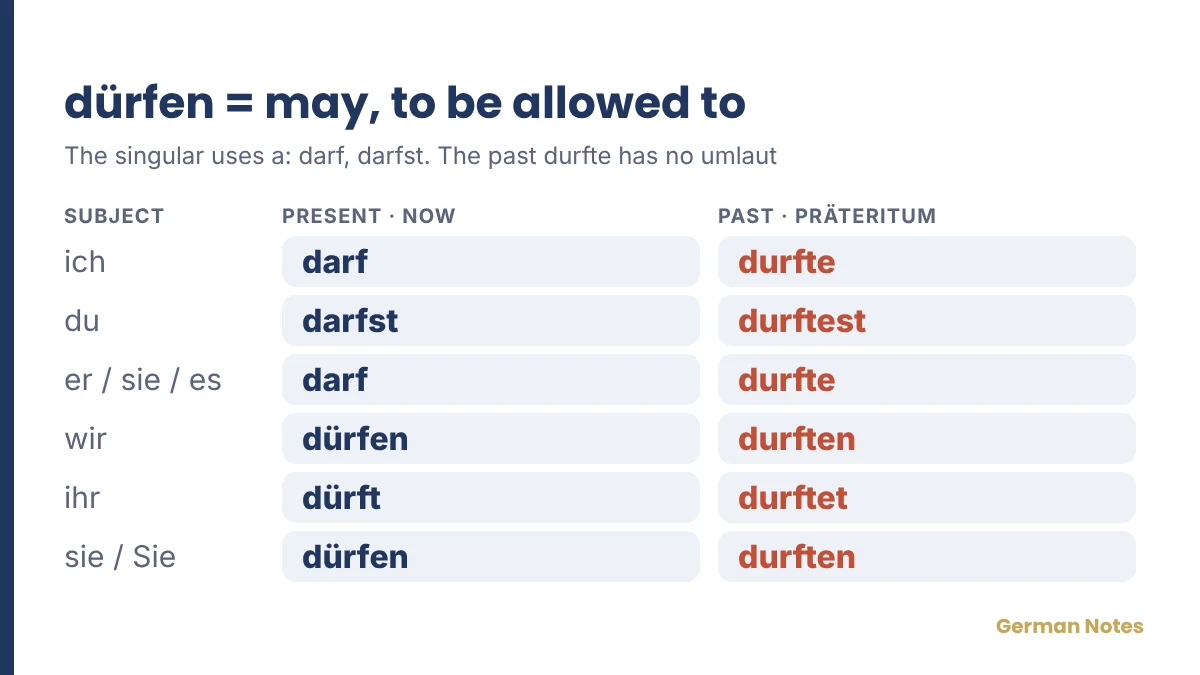
Dürfen means may or to be allowed to. In the present you say ich darf, du darfst, er/sie/es darf, wir dürfen, ihr dürft and sie/Sie dürfen. The simple past uses durfte. With another verb, the Perfekt uses haben and two infinitives: Ich habe bleiben dürfen means I was allowed to stay.
हिंदी में समझें
dürfen का मतलब है इजाज़त होना (may, be allowed to): Ich darf bleiben = मुझे रुकने की इजाज़त है। सवाल: Darf ich hier sitzen? = क्या मैं यहाँ बैठ सकता हूँ? ध्यान दें: Du darfst nicht gehen = तुम नहीं जा सकते (मना है)।
Contents
- Dürfen conjugation chart at a glance
- Dürfen conjugation in the present tense
- How do you ask permission with darf ich?
- Where does the other verb go?
- Nicht dürfen or nicht müssen?
- What is the simple past of dürfen?
- How do you form the Perfekt of dürfen?
- Durfte or dürfte?
- What are the common mistakes with dürfen?
- Practice: fill in the form of dürfen
- Frequently asked questions
Dürfen conjugation chart at a glance
Here are the present, the simple past and the Konjunktiv II in one table. Use it for a quick check. The Perfekt works differently, so it has its own section below.
| Subject | Present | Präteritum | Konjunktiv II |
|---|---|---|---|
| ich | darf | durfte | dürfte |
| du | darfst | durftest | dürftest |
| er / sie / es | darf | durfte | dürfte |
| wir | dürfen | durften | dürften |
| ihr | dürft | durftet | dürftet |
| sie / Sie | dürfen | durften | dürften |
Dürfen conjugation in the present tense
The singular uses darf-, and the plural keeps dürf-. Ich and er/sie/es share darf, with no -e or -t. Du adds -st. Learn ihr dürft with its umlaut, so you don't mix it up with darfst.
| Subject | Form | Example |
|---|---|---|
| ich | darf | Ich darf bleiben. = I am allowed to stay. |
| du | darfst | Du darfst gehen. = You may leave. |
| er / sie / es | darf | Sie darf mitkommen. = She is allowed to come along. |
| wir | dürfen | Wir dürfen anfangen. = We may start. |
| ihr | dürft | Ihr dürft spielen. = You are allowed to play. |
| sie / Sie | dürfen | Sie dürfen eintreten. = They may enter. / You may enter. |
Compare Du darfst hier sitzen (You may sit here) with Ihr dürft hier sitzen (You all may sit here). The pronoun decides which form you need. For er, it's darf: Er darf hier sitzen. = He may sit here.
Formal Sie takes dürfen, for one person or several. Sie dürfen jetzt eintreten is a polite way to invite a visitor in. At the start of a sentence, Sie can also mean they, so the situation tells you which one is meant. In the middle of a sentence, formal Sie keeps its capital letter.
If your keyboard can't type ü, write duerfen and duerft. Just leaving out the dots gives you the wrong spelling. Darf and darfst have no umlaut, so they don't need a substitute.
हिंदी में समझें
एकवचन में a: ich darf, du darfst, er darf। बहुवचन में ü: wir dürfen, ihr dürft, sie dürfen। er darft ग़लत है। keyboard पर ü न हो तो duerfen लिखें।
How do you ask permission with darf ich?
Darf ich hier sitzen? means May I sit here? Put darf first, then ich, and leave sitzen at the end. German doesn't need a word for the English do in this question.
- Darf ich das Fenster öffnen? = May I open the window?
- Dürfen wir ein Foto machen? = May we take a photo?
- Darf ich Ihnen helfen? = May I help you?
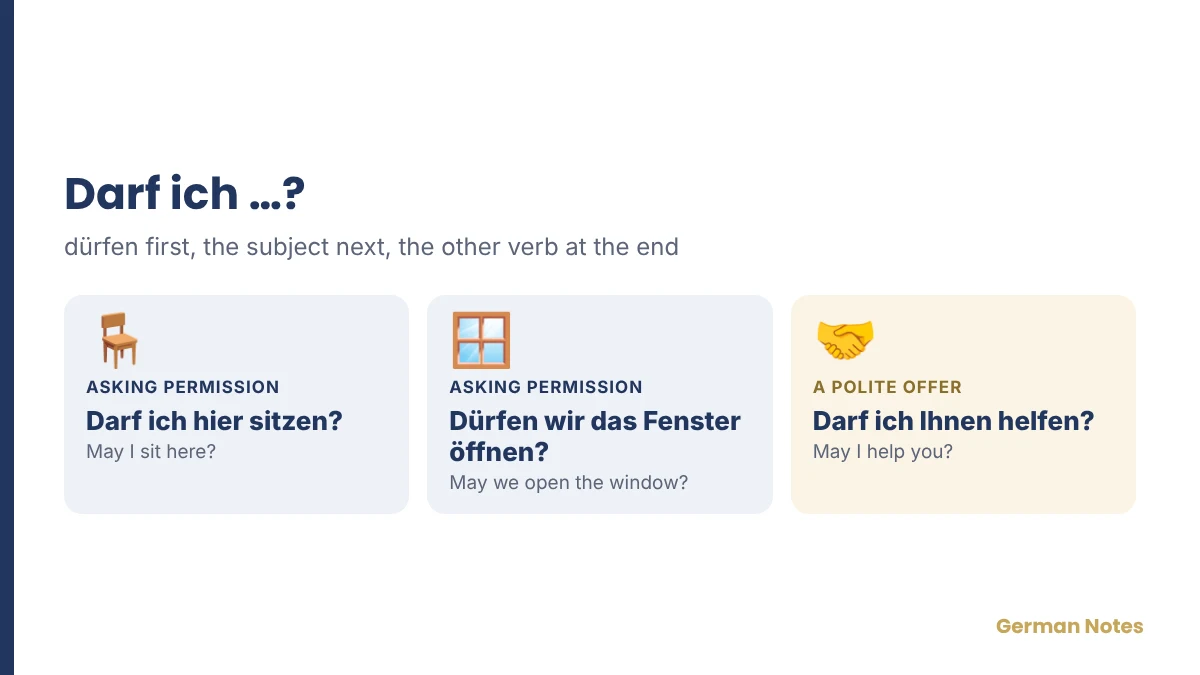
The last question is a polite offer. You can use dürfen both to ask whether something is allowed and to ask politely before you do something. A short answer can repeat the verb: Ja, das dürfen Sie. = Yes, you may.
With a question word, that word comes first: Wann dürfen wir anfangen? = When may we start? Wo darf ich parken? = Where am I allowed to park? It's still about permission, even though the question asks about a time or a place.
हिंदी में समझें
इजाज़त माँगने के लिए Darf ich ...?: Darf ich hier sitzen? = क्या मैं यहाँ बैठ सकता हूँ? Darf ich Ihnen helfen? = क्या मैं आपकी मदद कर सकता हूँ? जवाब: Ja, das dürfen Sie = हाँ, ज़रूर।
Where does the other verb go?
In a normal statement, the form of dürfen comes second. The action verb stays in the infinitive at the end, without zu.
- Wir dürfen heute früher nach Hause gehen. = We are allowed to go home earlier today.
Heute dürfen wir früher nach Hause gehen means the same. Heute takes the first place, so wir comes after dürfen. A longer phrase can come first too: Nach dem Kurs dürfen wir den Raum benutzen. = After the course, we are allowed to use the room.
A separable verb stays in one piece at the end. Compare Ich mache das Fenster auf (I open the window) with Ich darf das Fenster aufmachen (I am allowed to open the window). After darf, write aufmachen as one word, and don't add zu.
For the pattern all modal verbs share, see the A1 lesson on müssen, dürfen and sollen. Practise with your own everyday situations: asking to open a window, use a room or leave early.
हिंदी में समझें
dürfen दूसरे स्थान पर, असली verb आख़िर में, बिना zu: Wir dürfen heute früher nach Hause gehen = आज हम जल्दी घर जा सकते हैं। अलग होने वाले verbs जुड़े रहते हैं: Ich darf das Fenster aufmachen।
Nicht dürfen or nicht müssen?
Du darfst nicht gehen means You must not leave or You are not allowed to leave. Du musst nicht gehen means You don't have to leave. The first one forbids leaving; the second says it isn't necessary.
| German | English | Meaning |
|---|---|---|
| Du darfst gehen. | You may leave. | Permission |
| Du darfst nicht gehen. | You must not leave. | No permission |
| Du musst gehen. | You have to leave. | Necessity |
| Du musst nicht gehen. | You don't have to leave. | No necessity |
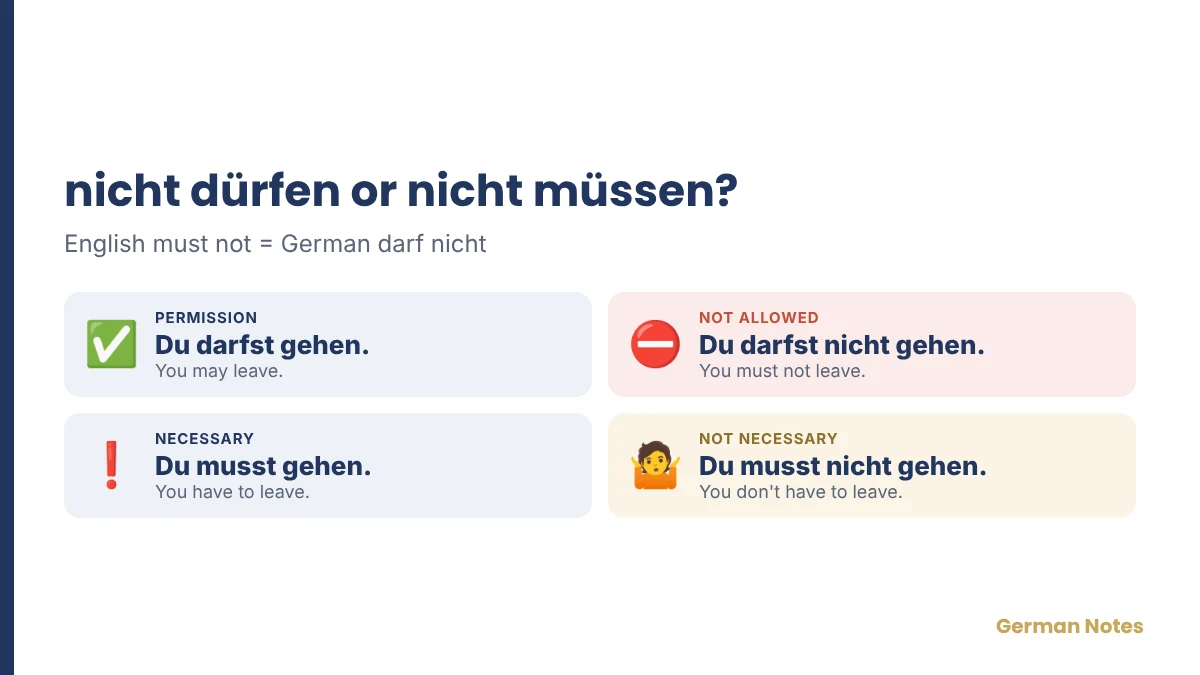
This is a classic translation trap, because English uses must not to forbid something. If you translate those words one by one as musst nicht, you change the meaning. Learn the negative phrases as whole units: nicht dürfen for not allowed, nicht müssen for not necessary.
Können is usually about ability or possibility: Ich kann schwimmen. = I can swim. Ich darf hier schwimmen means I am allowed to swim here. Someone can know how to swim and still not be allowed to swim in a particular place. In everyday speech, können can also ask for permission, but dürfen makes it clear that permission is what you mean.
Before you choose, check whether the sentence gives permission, forbids something or takes away a duty. The müssen conjugation guide and the können conjugation guide cover the other two verbs.
हिंदी में समझें
सबसे ज़रूरी अंतर: Du darfst nicht gehen = तुम नहीं जा सकते (मना है)। Du musst nicht gehen = तुम्हें जाने की ज़रूरत नहीं। English के must not के लिए darf nicht लगाएँ, muss nicht नहीं। Ich kann schwimmen = मुझे तैरना आता है, Ich darf hier schwimmen = मुझे यहाँ तैरने की इजाज़त है।
What is the simple past of dürfen?
Use durfte to say that someone was allowed to do something. All the simple-past forms have a plain u, with no umlaut.
| Subject | Präteritum | Example |
|---|---|---|
| ich | durfte | Ich durfte bleiben. = I was allowed to stay. |
| du | durftest | Du durftest mitkommen. = You were allowed to come along. |
| er / sie / es | durfte | Er durfte spielen. = He was allowed to play. |
| wir | durften | Wir durften anfangen. = We were allowed to start. |
| ihr | durftet | Ihr durftet gehen. = You were allowed to leave. |
| sie / Sie | durften | Sie durften warten. = They were allowed to wait. / You were allowed to wait. |
Gestern durfte ich früher gehen means Yesterday I was allowed to leave earlier. It tells you the permission was there, not whether the speaker actually left early. If that matters, add another sentence: Ich bin aber bis sechs geblieben. = But I stayed until six.
For something that wasn't allowed, make the sentence negative: Wir durften dort keine Fotos machen. = We were not allowed to take photos there. Here keine goes with the noun Fotos. In Wir durften nicht fotografieren (We were not allowed to take photographs), nicht goes with the action.
हिंदी में समझें
durfte = इजाज़त थी: Ich durfte bleiben = मुझे रुकने की इजाज़त थी। इसमें Umlaut नहीं। मना था: Wir durften dort keine Fotos machen = हमें वहाँ फ़ोटो लेने की इजाज़त नहीं थी।
How do you form the Perfekt of dürfen?
With another infinitive, the Perfekt is haben plus the main verb's infinitive plus dürfen. Ich habe bleiben dürfen means I was allowed to stay. The final dürfen is a replacement infinitive, called Ersatzinfinitiv.
| Subject | Perfekt |
|---|---|
| ich | Ich habe bleiben dürfen. |
| du | Du hast bleiben dürfen. |
| er / sie / es | Er hat bleiben dürfen. |
| wir | Wir haben bleiben dürfen. |
| ihr | Ihr habt bleiben dürfen. |
| sie / Sie | Sie haben bleiben dürfen. |
Each sentence means ... was allowed to stay or ... were allowed to stay, with the subject that matches the German pronoun. Change haben for the subject and leave bleiben dürfen as it is at the end.
Dictionaries also list gedurft. You only need it when dürfen has no other verb with it: Das habe ich nicht gedurft. = I wasn't allowed to do that. With another verb, use Ich habe bleiben dürfen, not Ich habe bleiben gedurft.
The shorter Ich durfte bleiben works well for the past too. You don't have to use the longer Perfekt just because you're speaking. Learn to recognise both, then practise them with the same verb.
हिंदी में समझें
Perfekt में दूसरा verb हो तो आख़िर में दो infinitive: Ich habe bleiben dürfen = मुझे रुकने की इजाज़त मिली थी। दूसरा verb न हो तो gedurft: Das habe ich nicht gedurft। आसान रूप: Ich durfte bleiben।
Durfte or dürfte?
Durfte is the simple past: Ich durfte gehen means I was allowed to leave. Dürfte is the Konjunktiv II and can make a request for permission softer: Dürfte ich kurz telefonieren? = May I make a quick phone call? That question is about permission now, not in the past.
Dürfte can also express a careful guess: Das dürfte reichen. = That should be enough. This is about probability, not permission, so don't translate every dürfte as was allowed to. The context decides.
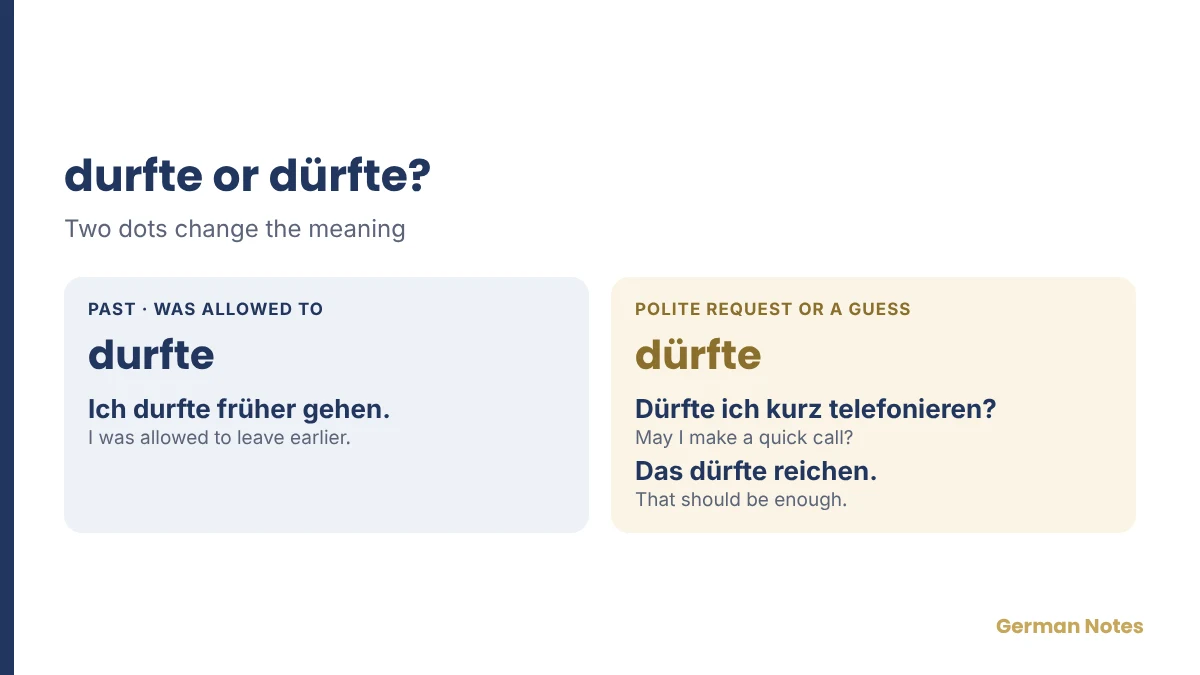
The Konjunktiv II forms are ich dürfte, du dürftest, er/sie/es dürfte, wir dürften, ihr dürftet and sie/Sie dürften. The umlaut is the only visible difference from the simple past.
Keep the u in durfte and the ü in dürfte. Two dots change the meaning.
हिंदी में समझें
durfte (बिना बिंदु) = इजाज़त थी: Ich durfte gehen। dürfte (दो बिंदु) = विनम्र अनुरोध: Dürfte ich kurz telefonieren? = क्या मैं एक छोटा सा फ़ोन कर सकता हूँ? या अंदाज़ा: Das dürfte reichen = यह काफ़ी होना चाहिए।
What are the common mistakes with dürfen?
| Learner error | Correction and reason |
|---|---|
| Er darft hier sitzen. | Er darf hier sitzen. = He may sit here. er/sie/es has no ending. |
| Ihr darft spielen. | Ihr dürft spielen. = You are allowed to play. The ihr form keeps the ü. |
| Ich darf zu bleiben. | Ich darf bleiben. = I am allowed to stay. No zu after dürfen. |
| Du musst nicht rauchen. (meaning not allowed) | Du darfst nicht rauchen. = You must not smoke. Not allowed is nicht dürfen. |
| Ich habe bleiben gedurft. | Ich habe bleiben dürfen. = I was allowed to stay. With another infinitive, use dürfen. |
हिंदी में समझें
आम ग़लतियाँ: er darft नहीं, er darf। ihr darft नहीं, ihr dürft। dürfen के बाद zu नहीं। मना करने के लिए muss nicht नहीं, darf nicht। Perfekt में gedurft नहीं, dürfen।
Practice: fill in the form of dürfen
Choose the form that fits the subject and the meaning.
- Ich ___ hier sitzen. = I am allowed to sit here.
- Du ___ mitkommen. = You are allowed to come along.
- Ihr ___ anfangen. = You may start.
- Gestern ___ wir früher gehen. = Yesterday we were allowed to leave earlier. (Simple past.)
- Ich habe bleiben ___. = I was allowed to stay. (Perfekt.)
- Du ___ nicht gehen. = You don't have to leave.
- Du ___ nicht gehen. = You must not leave.
- ___ ich kurz telefonieren? = May I make a quick call? (Polite, Konjunktiv II.)
Answers
- darf
- darfst
- dürft
- durften
- dürfen
- musst
- darfst
- Dürfte
Now turn sentence 1 into a question: Darf ich hier sitzen? Then answer it once with permission and once without: Ja, du darfst hier sitzen. Nein, du darfst hier nicht sitzen.
Frequently asked questions
How do you conjugate dürfen in the present tense?
ich darf, du darfst, er/sie/es darf, wir dürfen, ihr dürft and sie/Sie dürfen. The singular uses a; the plural uses ü. Ich and er/sie/es share darf.
What does darf ich mean?
Darf ich means may I in a question asking for permission. Darf ich hier sitzen? means May I sit here? The action verb goes to the end in the infinitive.
Does nicht dürfen mean do not have to?
No. Nicht dürfen means not be allowed to or must not. For do not have to, use nicht müssen. Du darfst nicht gehen forbids leaving; Du musst nicht gehen says leaving isn't necessary.
What is the Perfekt of dürfen?
With another infinitive, use haben plus that infinitive and dürfen: Ich habe bleiben dürfen means I was allowed to stay. Gedurft can occur when dürfen stands without another infinitive.
What is the difference between durfte and dürfte?
Durfte is the simple past and reports permission in the past. Dürfte is Konjunktiv II; it makes a request softer or expresses a careful guess. Compare Ich durfte gehen (I was allowed to leave) with Dürfte ich gehen? (May I leave?).
Does dürfen take zu?
No. The other verb follows dürfen as a bare infinitive at the end: Ich darf bleiben, not Ich darf zu bleiben.
Related lessons and practice
To practise asking for permission in conversation, check GermanNotes demo availability.
For reference: Duden's dürfen conjugation table and IDS grammis on the replacement infinitive.