Quick answer
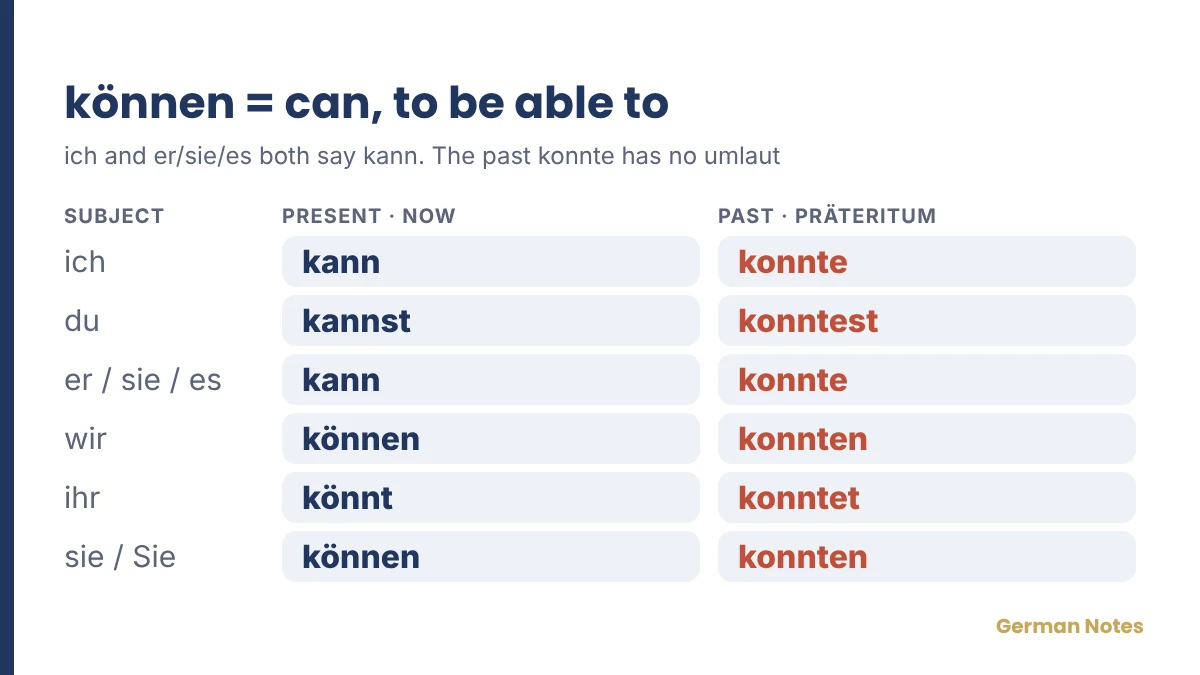
Können means can or to be able to. In the present you say ich kann, du kannst, er/sie/es kann, wir können, ihr könnt and sie/Sie können. The simple past uses konnte. With another verb, the Perfekt uses haben and two infinitives: Ich habe schlafen können means I was able to sleep.
हिंदी में समझें
können का मतलब है सकना (can): Ich kann schwimmen = मैं तैर सकता हूँ। ich और er/sie/es दोनों के साथ kann आता है। बीते समय में konnte: Ich konnte nicht schlafen = मैं सो नहीं सका। दूसरा verb हमेशा वाक्य के आख़िर में रहता है।
Contents
- Können conjugation chart at a glance
- Können conjugation in the present tense
- Where does the other verb go?
- How do you ask questions and make polite requests with können?
- What is the simple past of können?
- How do you form the Perfekt of können?
- Konnte or könnte?
- Können, kennen or wissen?
- What are the common mistakes with können?
- Practice: fill in the form of können
- Frequently asked questions
Können conjugation chart at a glance
This table puts the present, the simple past and the Konjunktiv II side by side. Use it for a quick check. The Perfekt works differently, so it has its own section below.
| Subject | Present | Präteritum | Konjunktiv II |
|---|---|---|---|
| ich | kann | konnte | könnte |
| du | kannst | konntest | könntest |
| er / sie / es | kann | konnte | könnte |
| wir | können | konnten | könnten |
| ihr | könnt | konntet | könntet |
| sie / Sie | können | konnten | könnten |
Können conjugation in the present tense
In the singular, the stem is kann. Ich and er/sie/es add no ending, and du adds -st. The plural keeps the ö. Learn ihr könnt on its own: it ends in -t and keeps the umlaut.
| Subject | Form | Example |
|---|---|---|
| ich | kann | Ich kann schwimmen. = I can swim. |
| du | kannst | Du kannst hier warten. = You can wait here. |
| er / sie / es | kann | Sie kann gut zeichnen. = She can draw well. |
| wir | können | Wir können morgen kommen. = We can come tomorrow. |
| ihr | könnt | Ihr könnt anfangen. = You can start. |
| sie / Sie | können | Sie können helfen. = They can help. / You can help. |
Compare Er kann schwimmen (He can swim) with Du kannst schwimmen (You can swim). The usual third-person -t doesn't apply here, so write er kann. Er kannt and er könnt are wrong.
In the middle of a sentence, lowercase sie can mean she or they, and the verb tells you which. Sie kann is about one woman. Sie können can mean they can or formal you can, depending on the context and the capital letter. At the start of a sentence, both begin with a capital.
If your keyboard can't type ö, write koennen. Konnen without the umlaut isn't standard German, even if that's what you typed into a search engine. Keep the real forms in your notes.
हिंदी में समझें
ich kann और er kann एक जैसे हैं, इनमें कोई ending नहीं लगती। du kannst में -st लगता है। wir, sie, Sie के साथ können, और ihr के साथ könnt। er kannt ग़लत है। अगर keyboard पर ö न हो तो koennen लिखें।
Where does the other verb go?
In a normal statement, the form of können comes second. The other verb stays in the infinitive at the end of the sentence, without zu.
- Ich kann heute länger bleiben. = I can stay longer today.
- Meine Schwester kann sehr gut kochen. = My sister can cook very well.
- Wir können den Termin verschieben. = We can reschedule the appointment.
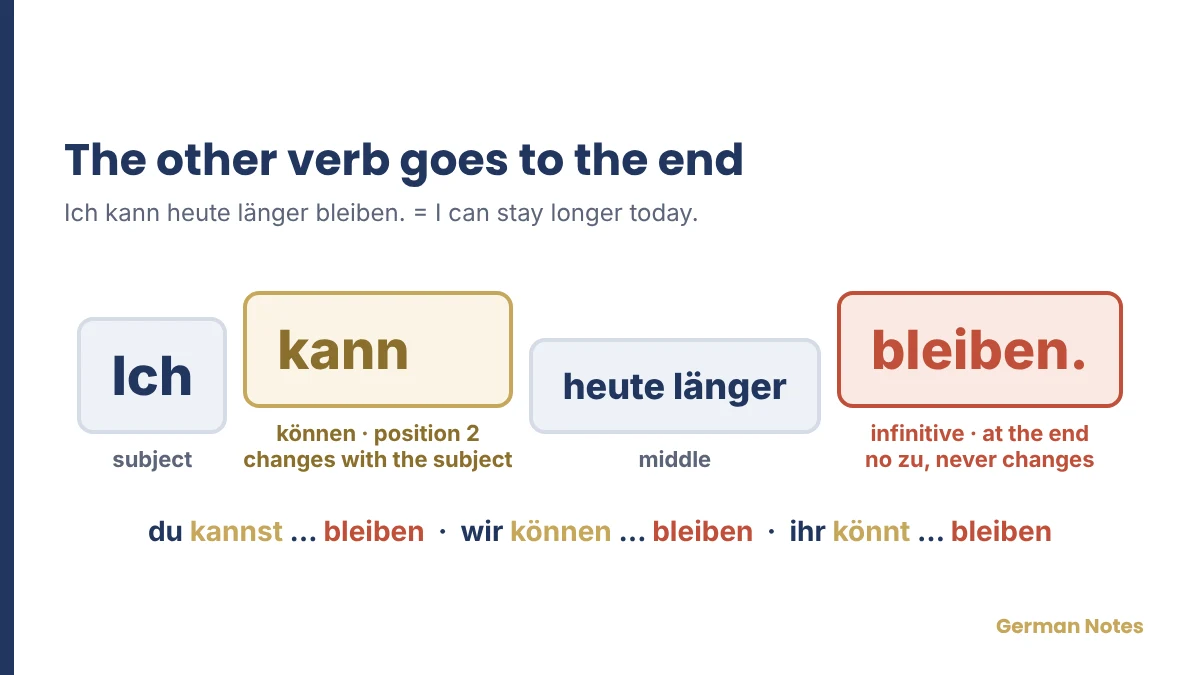
The first position can hold several words. In Meine Schwester kann sehr gut kochen, the whole subject Meine Schwester fills it. If you start with a time phrase, the subject comes after können: Morgen kann ich kommen. = Tomorrow I can come.
A separable verb stays in one piece at the end. Compare Ich stehe früh auf (I get up early) with Ich kann früh aufstehen (I can get up early). The auf doesn't split off after können.
Können can describe a skill you've learned or something that's possible. Ich kann schwimmen is about a skill. Wir können morgen kommen says that coming tomorrow is possible. The forms are the same for both meanings.
हिंदी में समझें
können दूसरे स्थान पर और असली काम वाला verb आख़िर में, बिना zu के: Ich kann heute länger bleiben = मैं आज देर तक रुक सकता हूँ। अलग होने वाले verbs भी आख़िर में जुड़े रहते हैं: Ich kann früh aufstehen।
Modal verbs share this pattern. For the overview, see the A1 modal verbs lesson; this guide sticks to können itself. For verb endings in general, see the German verb conjugation guide, and compare the helper verbs in the sein, haben and werden guides.
How do you ask questions and make polite requests with können?
A yes-or-no question starts with können: Kannst du mich hören? = Can you hear me? The subject follows kannst, and hören stays at the end. German doesn't need a word for the English do.
With a question word, that word goes first: Wann können wir anfangen? = When can we start? Warum kann sie nicht kommen? = Why can't she come?
Können Sie das bitte wiederholen? means Can you please repeat that? It's a useful formal request. Könnten Sie das bitte wiederholen? uses the Konjunktiv II and sounds softer: Could you please repeat that? Both ask for something now. The second one isn't about the past.
Kann ich hier sitzen? can ask whether sitting here is possible or allowed. For permission, dürfen is clearer: Darf ich hier sitzen? = May I sit here? Pick the verb that matches what you want to ask.
हिंदी में समझें
सवाल में können पहले: Kannst du mich hören? = क्या तुम मुझे सुन सकते हो? विनम्र तरीक़ा: Könnten Sie das bitte wiederholen? = क्या आप कृपया दोहरा सकते हैं? इजाज़त माँगनी हो तो dürfen: Darf ich hier sitzen? = क्या मैं यहाँ बैठ सकता हूँ?
What is the simple past of können?
Use konnte for something you were able to do or something that was possible. All the simple-past forms have a plain o, with no umlaut.
| Subject | Präteritum | Example |
|---|---|---|
| ich | konnte | Ich konnte nicht schlafen. = I could not sleep. |
| du | konntest | Du konntest kommen. = You were able to come. |
| er / sie / es | konnte | Er konnte helfen. = He was able to help. |
| wir | konnten | Wir konnten bleiben. = We were able to stay. |
| ihr | konntet | Ihr konntet anfangen. = You were able to start. |
| sie / Sie | konnten | Sie konnten warten. = They could wait. / You could wait. |
The other verb stays in the infinitive: Gestern konnte ich nicht kommen. = Yesterday I could not come. Konnte is a handy short past form, both when you speak and when you write.
To say that you actually managed to do something, say it directly. In English, I could repair the bike can be unclear. Ich habe das Fahrrad repariert means I repaired the bike and leaves no doubt.
हिंदी में समझें
konnte = सका/सकी (बीता समय): Ich konnte nicht schlafen = मैं सो नहीं सका। इसमें Umlaut नहीं होता। दूसरा verb फिर भी आख़िर में: Gestern konnte ich nicht kommen = कल मैं नहीं आ सका।
How do you form the Perfekt of können?
When können goes with another verb, the Perfekt is haben plus the main verb's infinitive plus können. That final können takes the place of the participle gekonnt. In German grammar this is called the Ersatzinfinitiv, the replacement infinitive.
| Subject | Perfekt sentence |
|---|---|
| ich | Ich habe schlafen können. |
| du | Du hast schlafen können. |
| er / sie / es | Er hat schlafen können. |
| wir | Wir haben schlafen können. |
| ihr | Ihr habt schlafen können. |
| sie / Sie | Sie haben schlafen können. |
Each sentence means ... was able to sleep or ... were able to sleep, with the subject that matches the German pronoun. The formal Sie sentence means You were able to sleep.
Look at the end: schlafen können. Standard German says Ich habe nicht schlafen können (I was unable to sleep), not Ich habe nicht schlafen gekonnt. Only haben changes with the subject; the two verbs at the end stay infinitives.
Gekonnt does exist, but only when können has no other verb with it: Das habe ich früher gekonnt. = I used to be able to do that. Here das points back to the skill. Learn this apart from the two-infinitive pattern, so that a dictionary entry like hat gekonnt doesn't confuse you.
Check whether there's another infinitive in the sentence. If there is, use können at the end. If there isn't, use gekonnt.
हिंदी में समझें
Perfekt में दूसरा verb हो तो gekonnt नहीं, आख़िर में können ही आता है: Ich habe schlafen können = मैं सो पाया। अगर दूसरा verb न हो, तब gekonnt: Das habe ich früher gekonnt = यह मैं पहले कर पाता था।
Konnte or könnte?
Konnte is the simple past, and könnte is the Konjunktiv II. One pair of dots changes both the form and the meaning.
| German | English | Use |
|---|---|---|
| Ich konnte gestern kommen. | I was able to come yesterday. | Something possible in the past |
| Ich könnte morgen kommen. | I could come tomorrow. | A possibility you're suggesting |
| Könntest du mir helfen? | Could you help me? | A polite request |
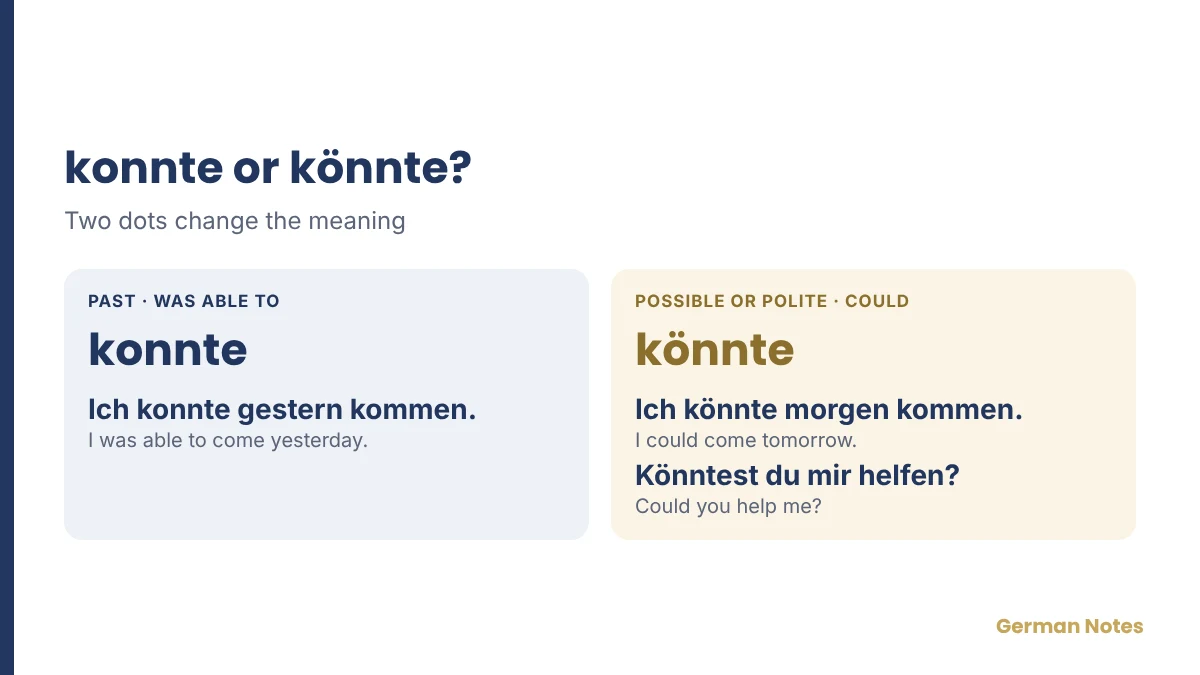
The full Konjunktiv II set is ich könnte, du könntest, er/sie/es könnte, wir könnten, ihr könntet and sie/Sie könnten. You'll use these forms for suggestions and requests.
Don't choose konnte just because the English sentence says could. First decide whether you mean a past situation or a suggestion for now. The meaning of the whole sentence tells you which form you need.
हिंदी में समझें
konnte (बिना बिंदु) = सका, बीते समय में: Ich konnte gestern kommen = मैं कल आ सका। könnte (दो बिंदु) = सकता हूँ / सकता था, सुझाव या विनम्र अनुरोध: Könntest du mir helfen? = क्या तुम मेरी मदद कर सकते हो? English के could को देखकर तय न करें, पूरा मतलब देखें।
Können, kennen or wissen?
The English word know can lead to three different German verbs. Können often means knowing how to do something: Ich kann Auto fahren. = I can drive. Kennen is about being familiar with someone or something: Ich kenne den Weg. = I know the way. Wissen is about facts and information: Ich weiß, wo der Bahnhof ist. = I know where the station is.
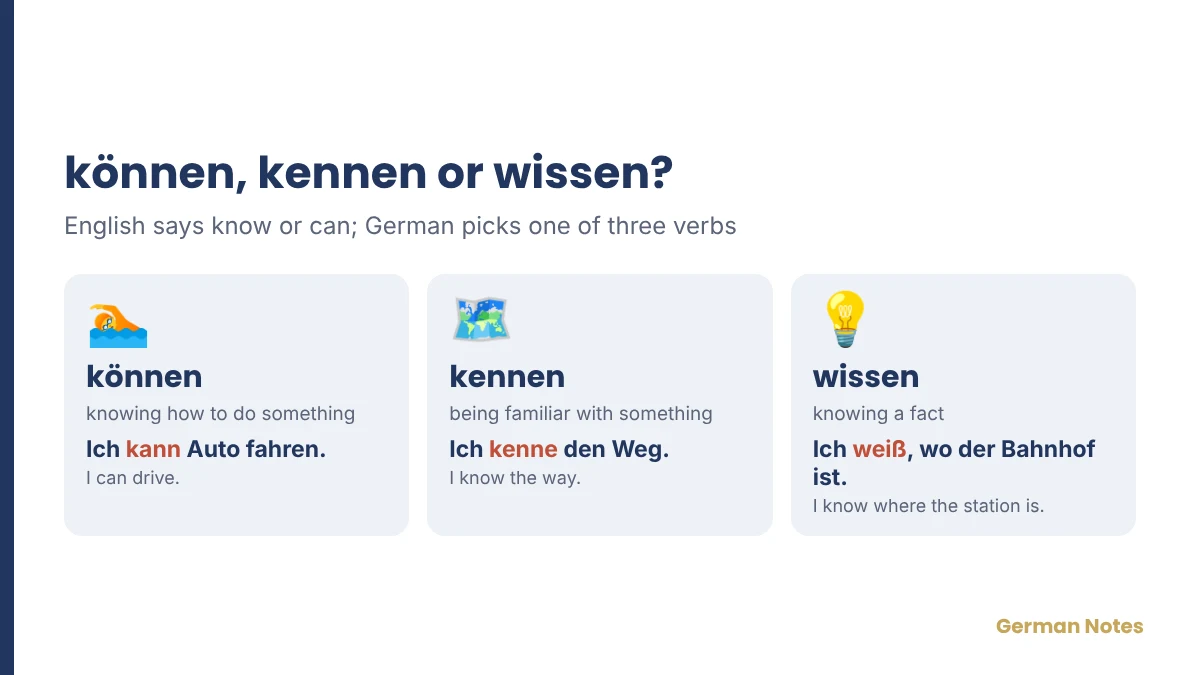
You can also say Ich kann Deutsch, meaning I know German or I can speak German. As a beginner, Ich kann ein bisschen Deutsch sprechen (I can speak a little German) makes it clear which skill you mean.
हिंदी में समझें
English के know के लिए जर्मन में तीन verbs हैं। हुनर: Ich kann Auto fahren = मुझे गाड़ी चलानी आती है। जान-पहचान: Ich kenne den Weg = मुझे रास्ता पता है। जानकारी: Ich weiß, wo der Bahnhof ist = मुझे पता है कि स्टेशन कहाँ है।
What are the common mistakes with können?
| Learner error | Correction and reason |
|---|---|
| Du kann helfen. | Du kannst helfen. = You can help. The du form ends in -st. |
| Er kannt schwimmen. | Er kann schwimmen. = He can swim. er/sie/es has no ending. |
| Ich kann zu kommen. | Ich kann kommen. = I can come. No zu after können. |
| Ich kann früh auf stehen. / Ich kann früh stehen auf. | Ich kann früh aufstehen. = I can get up early. The separable verb stays together at the end. |
| Ich habe nicht schlafen gekonnt. | Ich habe nicht schlafen können. = I was unable to sleep. With another infinitive, use können. |
| Konnten Sie das bitte wiederholen? (polite request) | Könnten Sie das bitte wiederholen? = Could you please repeat that? Requests use könnte. |
हिंदी में समझें
आम ग़लतियाँ: du kann नहीं, du kannst। er kannt नहीं, er kann। können के बाद zu नहीं लगता। Perfekt में gekonnt नहीं, können: Ich habe nicht schlafen können। विनम्र अनुरोध में könnten, konnten नहीं।
Practice: fill in the form of können
Choose the form that fits the subject and the meaning in brackets.
- Ich ___ schwimmen. = I can swim.
- Du ___ hier bleiben. = You can stay here.
- Ihr ___ jetzt anfangen. = You can start now.
- Gestern ___ wir nicht kommen. = Yesterday we could not come. (Simple past.)
- Sie hat nicht schlafen ___. = She was unable to sleep. (Perfekt.)
- ___ Sie das bitte wiederholen? = Could you please repeat that? (Konjunktiv II.)
Answers
- kann
- kannst
- könnt
- konnten
- können
- Könnten
Now change sentence 2 to er, then to wir. You should get Er kann hier bleiben and Wir können hier bleiben. Say each sentence out loud with the infinitive at the end.
Frequently asked questions
What does können mean in German?
Können is a modal verb meaning can or to be able to. It names an ability or a possibility, and the other verb stays in the infinitive at the end: Ich kann schwimmen = I can swim.
What does ich kann mean?
Ich kann means I can or I am able to. Add an infinitive to name the action: Ich kann schwimmen means I can swim. In a short answer such as Ja, ich kann, the action is understood from the context.
Is it du kann or du kannst?
Use du kannst. Kann belongs to ich and er/sie/es. Du kannst helfen means You can help, while Er kann helfen means He can help.
What is the Perfekt of können?
With another infinitive, use haben plus that infinitive and können: Ich habe schlafen können means I was able to sleep. Without another infinitive, gekonnt is possible: Das habe ich früher gekonnt means I used to be able to do that.
Does können take zu?
No. Können takes a bare infinitive. Say Ich kann kommen, meaning I can come, not Ich kann zu kommen. Können changes with the subject, while kommen stays in the infinitive.
What is the difference between konnte and könnte?
Konnte reports past ability or possibility. Könnte is Konjunktiv II and expresses a tentative possibility or a polite request. Compare Ich konnte kommen (I was able to come) with Ich könnte kommen (I could come).
Related lessons and practice
If you'd like feedback on your own sentences with können, check GermanNotes demo availability.
For reference: Duden's können conjugation table and IDS grammis on können.