Quick answer
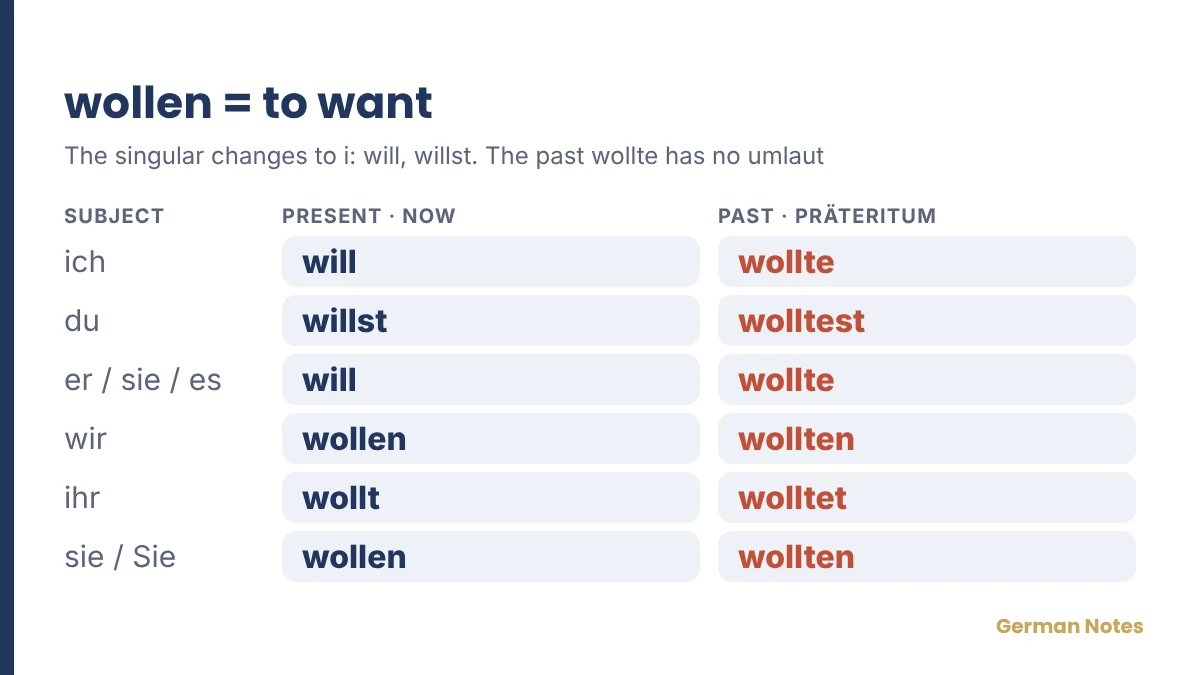
Wollen means to want or to intend. In the present you say ich will, du willst, er/sie/es will, wir wollen, ihr wollt and sie/Sie wollen. The simple past uses wollte. With another verb, the Perfekt uses haben and two infinitives: Ich habe gehen wollen means I wanted to leave.
हिंदी में समझें
wollen का मतलब है चाहना (want): Ich will bleiben = मैं रुकना चाहता हूँ। ध्यान दें: जर्मन will का मतलब English वाला will (भविष्य) नहीं, बल्कि "चाहता हूँ" है। बीते समय में wollte: Ich wollte bleiben = मैं रुकना चाहता था।
Contents
- Wollen conjugation chart at a glance
- Wollen conjugation in the present tense
- Where does the other verb go?
- Does German will mean English will?
- How do you ask questions and say no with wollen?
- What is the simple past of wollen?
- How do you form the Perfekt of wollen?
- Wollen or möchten?
- What are the common mistakes with wollen?
- Practice: fill in the form of wollen
- Frequently asked questions
Wollen conjugation chart at a glance
Here are the present, the simple past and the Perfekt with another verb in one table. Use it for a quick check, and read on for examples.
| Subject | Present | Präteritum | Perfekt (with another verb) |
|---|---|---|---|
| ich | will | wollte | habe … gehen wollen |
| du | willst | wolltest | hast … gehen wollen |
| er / sie / es | will | wollte | hat … gehen wollen |
| wir | wollen | wollten | haben … gehen wollen |
| ihr | wollt | wolltet | habt … gehen wollen |
| sie / Sie | wollen | wollten | haben … gehen wollen |
Wollen conjugation in the present tense
In the singular, the vowel changes to i: ich will, du willst, er/sie/es will. The plural uses woll-. Ich and er/sie/es share the same form, with no -e or -t added.
| Subject | Form | Example |
|---|---|---|
| ich | will | Ich will bleiben. = I want to stay. |
| du | willst | Du willst gehen. = You want to leave. |
| er / sie / es | will | Er will kochen. = He wants to cook. |
| wir | wollen | Wir wollen helfen. = We want to help. |
| ihr | wollt | Ihr wollt anfangen. = You want to start. |
| sie / Sie | wollen | Sie wollen bezahlen. = They want to pay. / You want to pay. |
Willst goes with du, and wollt goes with ihr. Compare Du willst einen Film sehen (You want to watch a film) with Ihr wollt einen Film sehen (You all want to watch a film). The form tells you whether the speaker is talking to one friend or to several.
Formal Sie takes wollen, whether you're talking to one person or a group, and it keeps its capital S in the middle of a sentence: Was wollen Sie trinken? = What do you want to drink? Lowercase sie can mean she or they, so check the verb: sie will means she wants, and sie wollen means they want.
हिंदी में समझें
एकवचन में i: ich will, du willst, er will। बहुवचन में woll-: wir wollen, ihr wollt, sie wollen। sie will = वह (स्त्री) चाहती है, sie wollen = वे चाहते हैं। आदर से Was wollen Sie trinken? = आप क्या पीना चाहेंगे?
Where does the other verb go?
In a normal statement, the form of wollen comes second and the other verb goes to the end. That last verb stays in the infinitive, without zu.
- Ich will am Wochenende ausschlafen. = I want to sleep in at the weekend.
- Wir wollen eine Wohnung mieten. = We want to rent a flat.
- Lena will ihre Schwester besuchen. = Lena wants to visit her sister.
The subject doesn't have to come first. Am Wochenende will ich ausschlafen starts with a time phrase, so ich comes after will. The whole phrase Am Wochenende counts as the first position, so counting single words gives you the wrong rule.
A separable verb stays in one piece after wollen. In Ich rufe dich an (I call you), an moves to the end. With wollen, say Ich will dich anrufen (I want to call you). Don't split anrufen, and don't add zu.
Wollen can also take a noun instead of another verb: Ich will einen neuen Rucksack. = I want a new backpack. For the pattern that all modal verbs share, see the A1 modal verbs lesson.
हिंदी में समझें
wollen दूसरे स्थान पर, दूसरा verb आख़िर में, बिना zu: Ich will am Wochenende ausschlafen = मैं वीकेंड पर देर तक सोना चाहता हूँ। अलग होने वाले verbs जुड़े रहते हैं: Ich will dich anrufen। बिना verb के भी: Ich will einen neuen Rucksack = मुझे नया बैग चाहिए।
Does German will mean English will?
No. Ich will gehen means I want to leave, not I will leave. German will is a present form of wollen and talks about a wish or a plan you have.
| German | English |
|---|---|
| Ich will morgen abreisen. | I want to leave tomorrow. |
| Ich werde morgen abreisen. | I will leave tomorrow. |
| Ich reise morgen ab. | I am leaving tomorrow. |
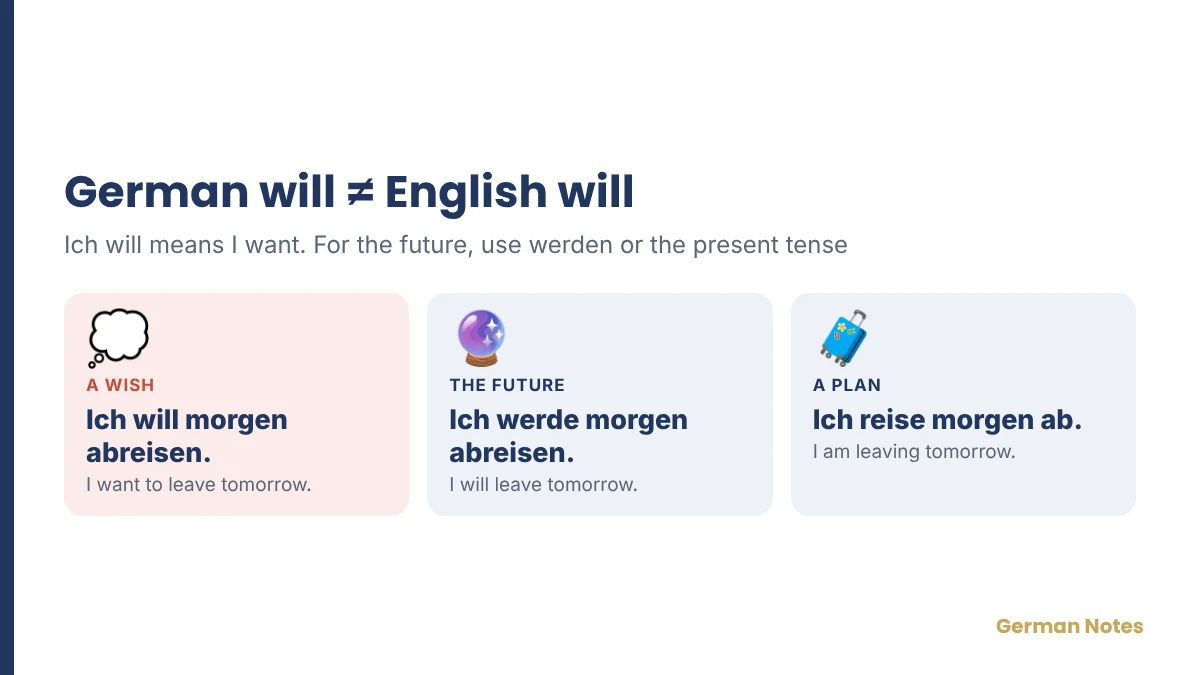
The first sentence says what you want. The other two can describe a trip in the future. German often uses the present tense with a time phrase when it's clear the event is in the future, so you don't need werden for every English will. Translating it with German will, though, changes the meaning.
Before you translate English will, decide whether you're talking about a wish or about what will happen. Only the wish takes wollen.
हिंदी में समझें
सबसे बड़ी ग़लती: English के will को जर्मन will से बदलना। Ich will morgen abreisen = मैं कल जाना चाहता हूँ। Ich werde morgen abreisen = मैं कल जाऊँगा। भविष्य के लिए werden या सिर्फ़ present: Ich reise morgen ab।
For the future tense with werden, see the werden conjugation guide.
How do you ask questions and say no with wollen?
For a yes-or-no question, start with wollen: Willst du mitkommen? = Do you want to come along? The subject follows willst, and mitkommen stays at the end. With a question word, that word goes first: Wann wollt ihr losfahren? = When do you want to set off?
Wollen wir eine Pause machen? means Shall we take a break? It's a way to suggest doing something together. The verb is still wollen with wir, even though English says shall.
Ich will heute nicht arbeiten means I don't want to work today. It's about what you want. Ich muss heute nicht arbeiten means I don't have to work today, which is about a duty that's gone. The two sentences answer different questions. The müssen conjugation guide covers the second one.
To say no to a noun with ein, use kein: Ich will keinen Kaffee. = I don't want any coffee. Kaffee is masculine and the object is in the accusative, which gives keinen. With an action, say Ich will keinen Kaffee trinken (I don't want to drink any coffee).
हिंदी में समझें
सवाल में wollen पहले: Willst du mitkommen? = क्या तुम साथ चलना चाहते हो? Wollen wir eine Pause machen? = चलो थोड़ा आराम करें? Ich will heute nicht arbeiten = आज मेरा काम करने का मन नहीं है। Ich will keinen Kaffee = मुझे कॉफ़ी नहीं चाहिए।
What is the simple past of wollen?
Use wollte for something you wanted or planned in the past. The stem is woll-, and none of the forms has an umlaut.
| Subject | Präteritum | Example |
|---|---|---|
| ich | wollte | Ich wollte bleiben. = I wanted to stay. |
| du | wolltest | Du wolltest helfen. = You wanted to help. |
| er / sie / es | wollte | Sie wollte lesen. = She wanted to read. |
| wir | wollten | Wir wollten kochen. = We wanted to cook. |
| ihr | wolltet | Ihr wolltet gehen. = You wanted to leave. |
| sie / Sie | wollten | Sie wollten warten. = They wanted to wait. / You wanted to wait. |
Gestern wollte ich früh ins Bett gehen means Yesterday I wanted to go to bed early. It tells you about the plan, not whether it happened. If the outcome matters, add it: Aber ich musste noch arbeiten. = But I still had to work.
You'll also hear Ich wollte nur fragen ... (I just wanted to ask ...) at the start of a question someone is asking right now. Here wollte makes the question sound softer. The conversation tells you how to read it.
हिंदी में समझें
wollte = चाहता था: Ich wollte bleiben = मैं रुकना चाहता था। इससे यह पता नहीं चलता कि काम हुआ या नहीं। Ich wollte nur fragen ... = मैं बस पूछना चाहता था ..., यह अक्सर अभी का विनम्र सवाल होता है।
How do you form the Perfekt of wollen?
With another infinitive, use haben plus the main verb's infinitive plus wollen. Ich habe früher gehen wollen means I wanted to leave earlier. Both gehen and wollen stay infinitives at the end.
| Subject | Perfekt |
|---|---|
| ich | Ich habe gehen wollen. |
| du | Du hast gehen wollen. |
| er / sie / es | Er hat gehen wollen. |
| wir | Wir haben gehen wollen. |
| ihr | Ihr habt gehen wollen. |
| sie / Sie | Sie haben gehen wollen. |
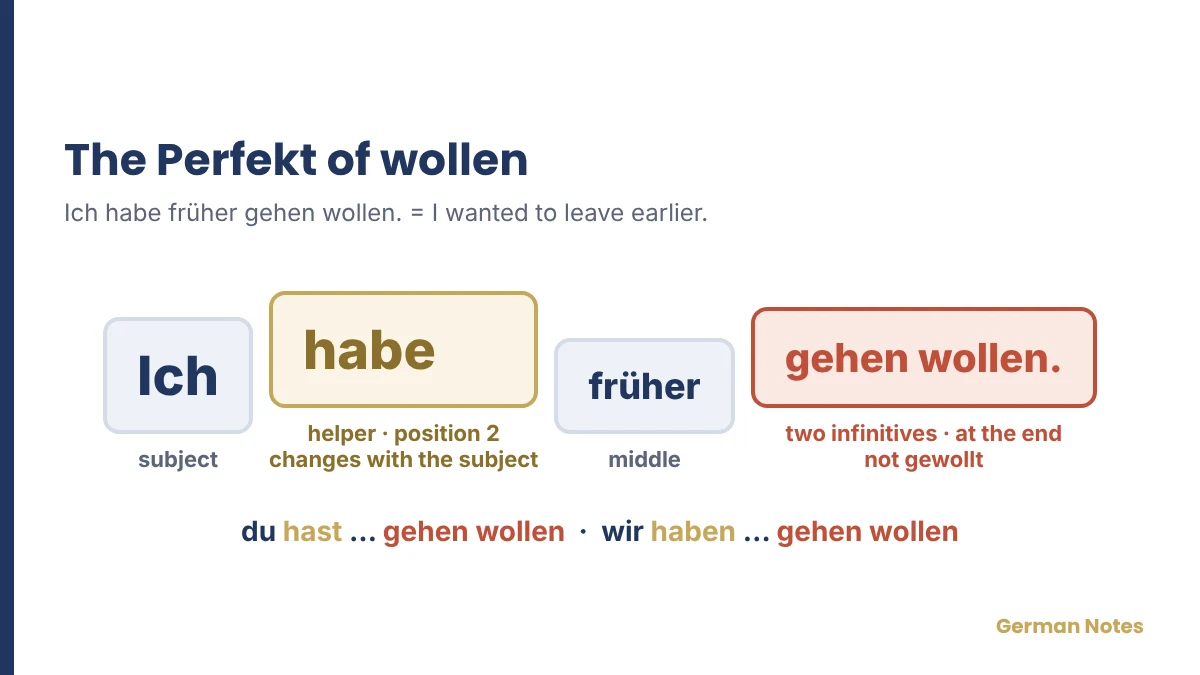
Each sentence means ... wanted to leave, with the subject that matches the German pronoun. Change haben to fit the subject and keep gehen wollen as it is. Using wollen here instead of a participle is called the Ersatzinfinitiv, the replacement infinitive.
Look for another infinitive before you choose the last word. Without one, use gewollt: Das habe ich nicht gewollt. = I didn't want that. With one, use wollen: Das habe ich nicht sagen wollen. = I didn't want to say that.
For a simple past statement, Ich wollte gehen is shorter, and it's fine in conversation. Knowing the Perfekt pattern helps when you meet longer sentences with two infinitives.
हिंदी में समझें
Perfekt में दूसरा verb हो तो आख़िर में दो infinitive: Ich habe gehen wollen = मैं जाना चाहता था। दूसरा verb न हो तो gewollt: Das habe ich nicht gewollt = मैं यह नहीं चाहता था। बोलचाल में आसान रूप Ich wollte gehen चलता है।
Wollen or möchten?
Ich will einen Tee means I want a tea and says what you want directly. Ich möchte einen Tee means I would like a tea and is the better choice when you order or ask for something politely. Adding bitte helps too: Ich möchte einen Tee, bitte. = I would like a tea, please.
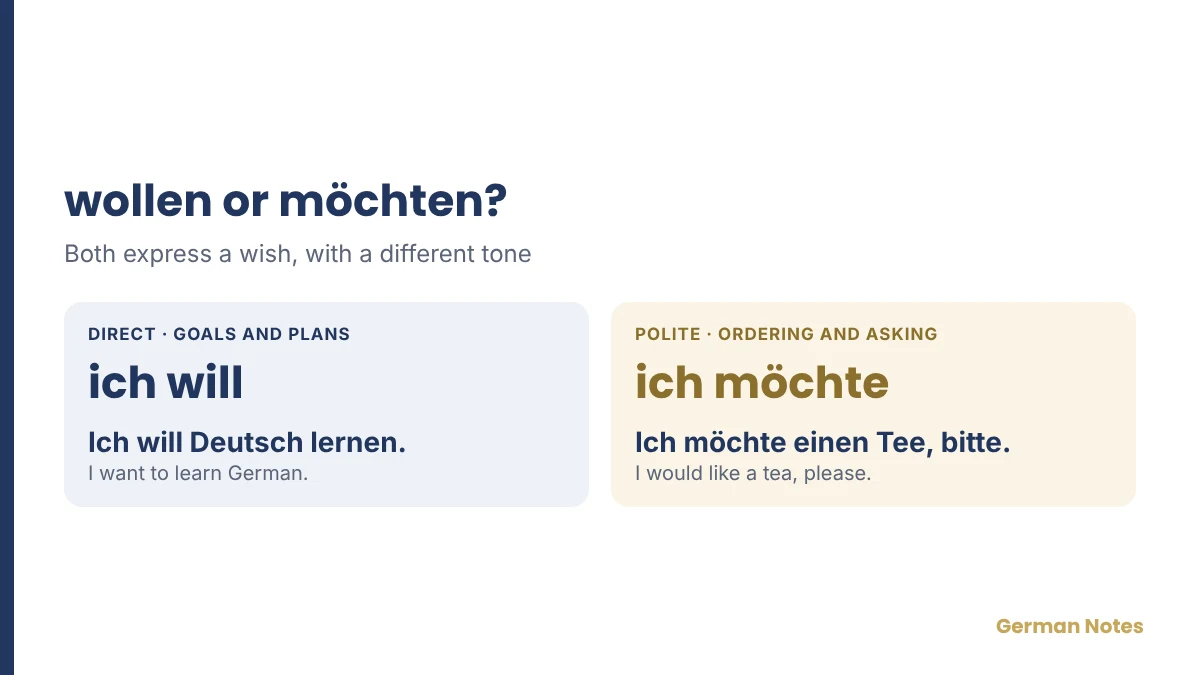
Wollen is normal when you talk about your own goals: Ich will nächstes Jahr Deutsch lernen. = I want to learn German next year. It isn't rude in itself. Tone and context matter most when your sentence asks someone else to do something for you.
Möchte comes from mögen, not from wollen. Don't put möchte into a wollen table. Learn it as a separate, more polite way to say what you want.
हिंदी में समझें
Ich will einen Tee = मुझे चाय चाहिए (सीधा)। Ich möchte einen Tee, bitte = मुझे एक चाय चाहिए, प्लीज़ (विनम्र)। दुकान या रेस्टोरेंट में möchte बोलें। अपने लक्ष्य के लिए will ठीक है: Ich will Deutsch lernen।
What are the common mistakes with wollen?
| Learner error | Correction and reason |
|---|---|
| Ich wolle bleiben. | Ich will bleiben. = I want to stay. The ich form is will. |
| Er willt kochen. | Er will kochen. = He wants to cook. er/sie/es has no ending. |
| Ich will zu lernen. | Ich will lernen. = I want to study. No zu after wollen. |
| Ich will morgen nach Berlin fahren. (meaning I will) | Ich werde morgen nach Berlin fahren. = I will go to Berlin tomorrow. German will means want. |
| Ich habe gehen gewollt. | Ich habe gehen wollen. = I wanted to leave. With another infinitive, use wollen. |
हिंदी में समझें
आम ग़लतियाँ: ich wolle नहीं, ich will। er willt नहीं, er will। wollen के बाद zu नहीं। भविष्य के लिए will नहीं, werde। Perfekt में gewollt नहीं, wollen।
Practice: fill in the form of wollen
Fill each gap using the subject and the English meaning.
- Ich ___ heute zu Hause bleiben. = I want to stay at home today.
- Du ___ einen Film sehen. = You want to watch a film.
- Ihr ___ morgen abreisen. = You want to leave tomorrow.
- Gestern ___ wir kochen. = Yesterday we wanted to cook. (Simple past.)
- Sie hat früher gehen ___. = She wanted to leave earlier. (Perfekt.)
- Das habe ich nicht ___. = I didn't want that.
Answers
- will
- willst
- wollt
- wollten
- wollen
- gewollt
Turn sentence 2 into a question: Willst du einen Film sehen? Then change it to ihr: Wollt ihr einen Film sehen? Keep sehen at the end both times.
Frequently asked questions
What does will mean in German?
Will is the present form of wollen for ich and er/sie/es. It means want or wants: Ich will gehen means I want to leave. It is not the usual German way to say the English future will.
When do I use willst and wollt?
Use willst with du and wollt with ihr. Du willst kommen means You want to come, said to one person informally. Ihr wollt kommen is said to several people informally.
What is the past tense of wollen?
The simple past forms are wollte, wolltest, wollte, wollten, wolltet and wollten. With another infinitive, the Perfekt uses haben plus two infinitives: Ich habe gehen wollen means I wanted to leave.
Is gewollt correct?
Yes, when wollen stands without another infinitive: Das habe ich gewollt means I wanted that. With another infinitive, use wollen at the end, as in Ich habe helfen wollen = I wanted to help.
Does wollen take zu before the other verb?
No. The other verb is a bare infinitive: Ich will lernen means I want to study. Write lernen at the end without zu, even though the English has to.
What is the difference between ich will and ich möchte?
Ich will states a wish directly and is normal for goals and plans: Ich will Deutsch lernen. Ich möchte means I would like and is the polite choice when you order or ask for something: Ich möchte einen Tee, bitte.
Related lessons and practice
To practise your own plans and requests with a teacher, check GermanNotes demo availability.
For reference: Duden's wollen conjugation table and IDS grammis on wollen and the replacement infinitive.