Quick answer
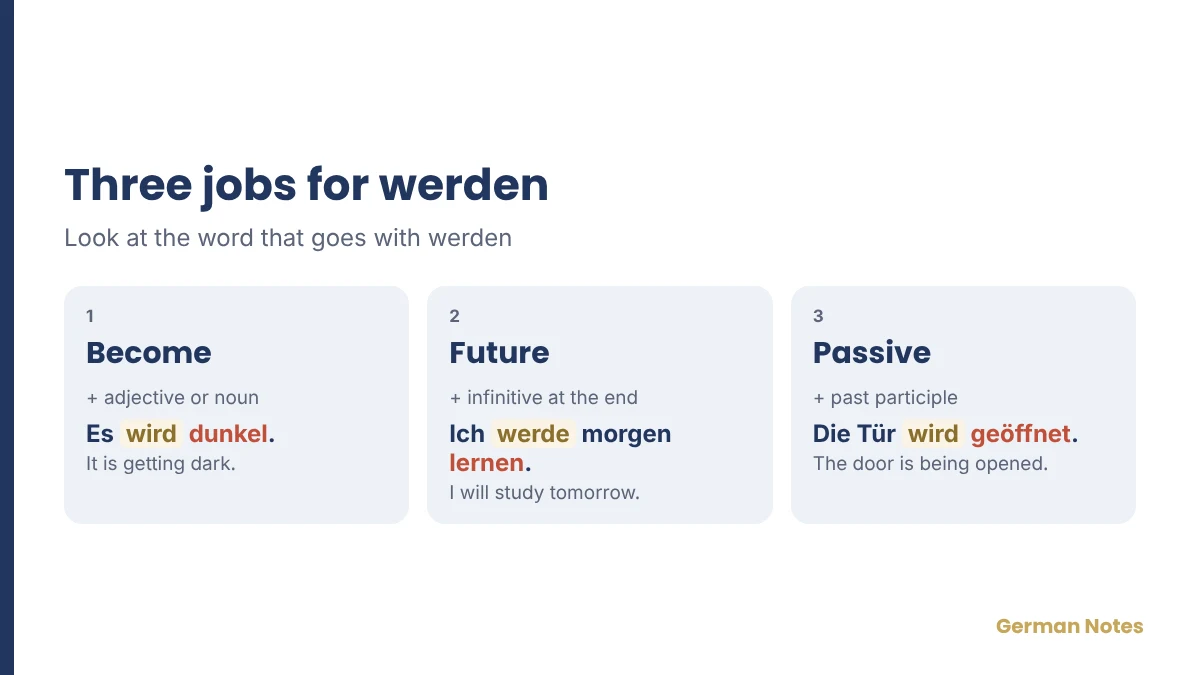
Werden means to become, and it also helps build the future tense and the passive. In the present you say ich werde, du wirst, er/sie/es wird, wir werden, ihr werdet and sie/Sie werden. For became, learn wurde and ist geworden. The words around werden tell you which job it's doing.
हिंदी में समझें
werden का मुख्य मतलब है बनना / हो जाना: Es wird dunkel = अँधेरा हो रहा है। यही verb भविष्य काल (Ich werde lernen = मैं पढ़ूँगा) और passive (Die Tür wird geöffnet = दरवाज़ा खोला जा रहा है) भी बनाता है। werden के साथ कौन सा शब्द है, उससे पता चलता है कि वह कौन सा काम कर रहा है।
Contents
- Werden conjugation chart: present, past and Perfekt at a glance
- Werden conjugation in the present tense
- How do you use werden to mean "become"?
- What is the simple past of werden?
- How do you form the Perfekt of werden?
- How do you form the future tense with werden?
- How does werden form the passive?
- Geworden or worden?
- What are the common mistakes with werden?
- Practice: fill in the form of werden
- Frequently asked questions
Werden conjugation chart: present, past and Perfekt at a glance
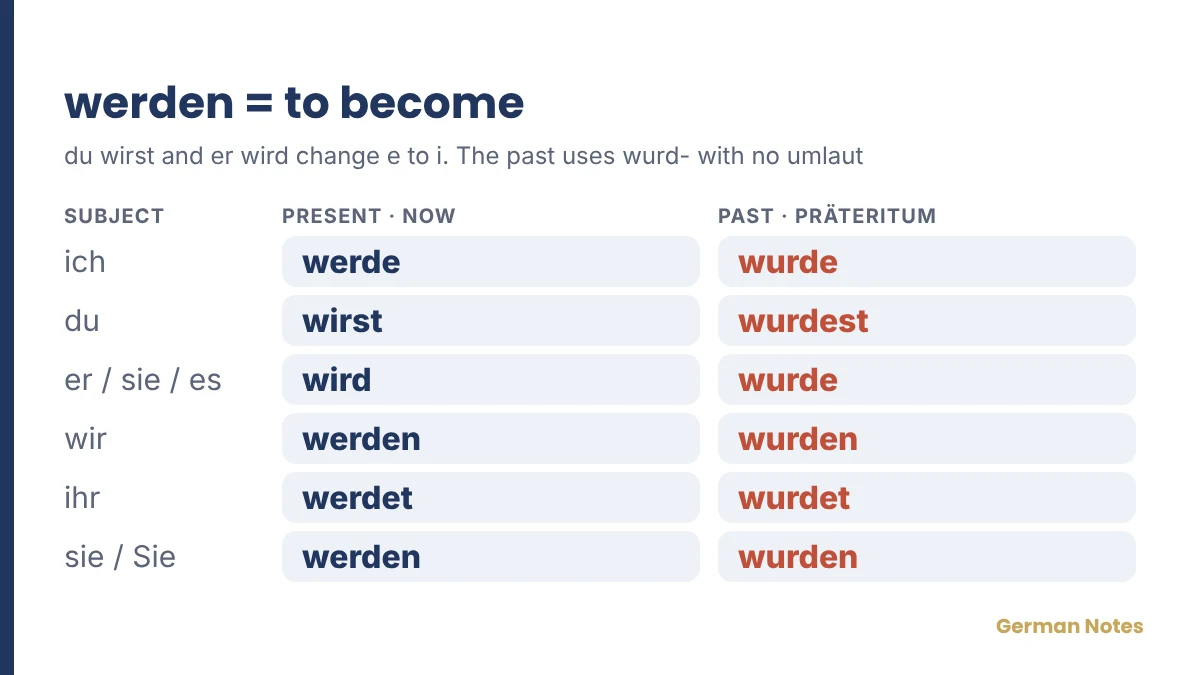
This table shows werden in the sense of become, in three tenses. Use it for a quick check. The future and the passive use the same present forms, and you'll find them further down.
| Subject | Present | Präteritum | Perfekt |
|---|---|---|---|
| ich | werde | wurde | bin geworden |
| du | wirst | wurdest | bist geworden |
| er / sie / es | wird | wurde | ist geworden |
| wir | werden | wurden | sind geworden |
| ihr | werdet | wurdet | seid geworden |
| sie / Sie | werden | wurden | sind geworden |
Werden conjugation in the present tense
Werden is irregular. In du wirst and er/sie/es wird the vowel changes from e to i, and the du form also drops the d. Learn those two forms on their own, then practise them with the plural forms.
| Subject | Form | Example |
|---|---|---|
| ich (I) | werde | Ich werde müde. = I am getting tired. |
| du (you, one friend) | wirst | Du wirst besser. = You are getting better. |
| er / sie / es (he / she / it) | wird | Es wird dunkel. = It is getting dark. |
| wir (we) | werden | Wir werden älter. = We are getting older. |
| ihr (you, several friends) | werdet | Ihr werdet müde. = You are getting tired. |
| sie / Sie (they / you, formal) | werden | Sie werden ruhiger. = They are becoming calmer. / You are becoming calmer. |
Werdet goes with ihr. Compare Ihr werdet müde (You are getting tired) with Wir werden müde (We are getting tired). The ending changes because the subject changes.
Werde doesn't always mean will. Ich werde müde is about getting tired, while Ich werde lernen means I will study. Read the rest of the sentence before you translate.
हिंदी में समझें
du wirst और er wird में e की जगह i आ जाता है, बाक़ी रूप e वाले हैं: ich werde, wir werden, ihr werdet। ध्यान रखें: Ich werde müde = मैं थक रहा हूँ, पर Ich werde lernen = मैं पढ़ूँगा। पूरा वाक्य देखकर ही मतलब समझें।
You can practise the present forms together with two other irregular verbs in the A1 lesson on helfen, mögen and werden. For verb endings in general, see the German verb conjugation guide, and compare werden with its neighbours in the sein conjugation guide and the haben conjugation guide.
How do you use werden to mean "become"?
Use werden when something changes into a new state or role. English often says get, grow or turn instead.
- Das Wasser wird kalt. = The water is getting cold.
- Meine Schwester wird Ärztin. = My sister is becoming a doctor.
- Unser Sohn wird morgen sechs. = Our son turns six tomorrow.
An adjective like kalt comes after werden with no ending. With a job on its own, German usually leaves out the article: Sie wird Ärztin. English needs a doctor, but German doesn't need eine here.
Sein describes a state, werden describes a change. Das Wasser ist kalt means The water is cold. Das Wasser wird kalt means it is getting cold.
हिंदी में समझें
sein = है (हालत), werden = हो रहा है / बन रहा है (बदलाव)। Das Wasser ist kalt = पानी ठंडा है। Das Wasser wird kalt = पानी ठंडा हो रहा है। पेशे के साथ ein/eine नहीं लगता: Sie wird Ärztin = वह डॉक्टर बन रही है।
What is the simple past of werden?
The everyday simple past is built on wurd-, with no umlaut. Ich wurde müde means I got tired, and Es wurde dunkel means It got dark.
| Subject | Präteritum | English (with müde) |
|---|---|---|
| ich | wurde | I got tired |
| du | wurdest | you got tired |
| er / sie / es | wurde | he / she / it got tired |
| wir | wurden | we got tired |
| ihr | wurdet | you got tired |
| sie / Sie | wurden | they got tired / you got tired |
The ich and er/sie/es forms are the same. With ihr, use wurdet: Ihr wurdet nach dem Essen müde. = You got tired after the meal.
Wurde also shows up in past passive sentences. Das Fenster wurde geöffnet means The window was opened. The participle geöffnet tells you it's a passive sentence, so don't read it as "the window became opened".
Würde is a different word. Ich würde helfen means I would help. The umlaut marks the Konjunktiv II, which you use for things that are imagined or polite. It isn't another spelling of wurde.
हिंदी में समझें
wurde = बन गया / हो गया: Es wurde dunkel = अँधेरा हो गया। ihr के साथ wurdet। और wurde और würde अलग हैं: Ich würde helfen = मैं मदद करता (अगर…)। दो बिंदु (Umlaut) से मतलब बदल जाता है।
How do you form the Perfekt of werden?
When werden means become, the Perfekt uses sein plus geworden. Change sein for the subject; geworden never changes.
| Subject | Perfekt | Example |
|---|---|---|
| ich | bin geworden | Ich bin müde geworden. = I got tired. |
| du | bist geworden | Du bist ruhiger geworden. = You have become calmer. |
| er / sie / es | ist geworden | Es ist kalt geworden. = It has become cold. |
| wir | sind geworden | Wir sind älter geworden. = We have grown older. |
| ihr | seid geworden | Ihr seid besser geworden. = You have improved. |
| sie / Sie | sind geworden | Sie sind müde geworden. = They got tired. / You got tired. |
In a normal statement, the sein form comes second and geworden goes to the end: Nach dem Essen bin ich müde geworden. = After the meal, I got tired. The whole phrase Nach dem Essen counts as the first position.
Both Ich wurde müde and Ich bin müde geworden work for the past. You'll hear the Perfekt more in conversation and see the simple past more in writing, but both appear in speech and in writing.
हिंदी में समझें
werden (बनना) का Perfekt = sein + geworden: Ich bin müde geworden = मैं थक गया। bin, bist, ist subject के साथ बदलते हैं, geworden वाक्य के आख़िर में आता है और नहीं बदलता। यहाँ haben नहीं लगता।
How do you form the future tense with werden?
For the Futur I, use a present form of werden plus an infinitive. In a normal statement, the infinitive goes to the end.
- Ich werde morgen lernen. = I will study tomorrow.
- Du wirst die Antwort finden. = You will find the answer.
- Wir werden später anrufen. = We will call later.
Only werden changes with the subject. The other verb stays in the infinitive: Ich werde lernen. For a yes-or-no question, werden comes first: Wirst du morgen arbeiten? = Will you work tomorrow?
German often uses the present tense for the future when the timing is clear. Morgen arbeite ich zu Hause means Tomorrow I am working from home. You don't need werden every time English talks about the future.
Werden plus an infinitive can also be a guess about now. Er wird zu Hause sein can mean He is probably at home. A time phrase and the conversation around it tell you whether it's a prediction or a guess.
हिंदी में समझें
भविष्य काल = werden + दूसरा verb (infinitive) वाक्य के आख़िर में: Ich werde morgen lernen = मैं कल पढ़ूँगा। बोलचाल में अक्सर सिर्फ़ present भी चलता है: Morgen arbeite ich zu Hause = कल मैं घर से काम करूँगा।
How does werden form the passive?
For the process passive, combine werden with the past participle of another verb. The sentence is about what happens to the subject.
- Die Tür wird geöffnet. = The door is being opened.
- Der Brief wird geschrieben. = The letter is being written.
Compare a future sentence with the same verb: Sie wird den Brief schreiben. = She will write the letter. Schreiben is an infinitive and geschrieben is a past participle, and that one difference changes the whole construction.
To say who does the action, use von: Der Brief wird von Anna geschrieben. = The letter is being written by Anna. If it doesn't matter who does it, or you don't know, leave that part out.
A present passive with wird isn't automatically about the future. Die Tür wird geöffnet describes the opening. Die Tür ist geöffnet describes the result: The door is open.
हिंदी में समझें
Passive = werden + Partizip 2: Die Tür wird geöffnet = दरवाज़ा खोला जा रहा है। करने वाले को बताना हो तो von: Der Brief wird von Anna geschrieben = चिट्ठी अन्ना के द्वारा लिखी जा रही है। Infinitive (schreiben) = भविष्य, Partizip (geschrieben) = passive।
Geworden or worden?
Use geworden for a change of state or role. Use worden after another verb's participle in the Perfekt of the passive.
| Construction | Example | Meaning |
|---|---|---|
| Become: sein + geworden | Sie ist Ärztin geworden. | She became a doctor. |
| Passive: sein + participle + worden | Sie ist gefragt worden. | She was asked. |
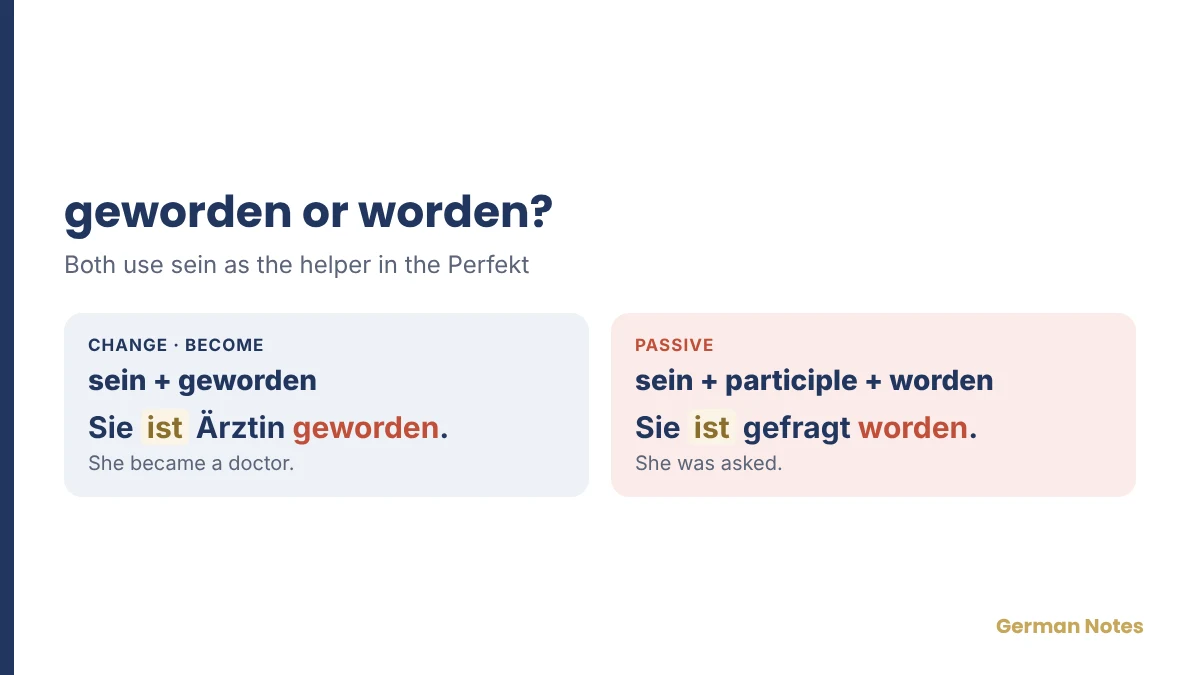
In the second sentence, gefragt carries the action and worden marks the passive. It isn't gefragt geworden. Both patterns use sein as the helper.
Compare the two endings: müde geworden describes a change, and gefragt worden describes what happened to someone.
हिंदी में समझें
बदलाव के लिए geworden: Sie ist Ärztin geworden = वह डॉक्टर बन गई। Passive के लिए worden: Sie ist gefragt worden = उससे पूछा गया। दोनों में helper sein है।
What are the common mistakes with werden?
| Learner error | Correction and reason |
|---|---|
| Du werdest müde. | Du wirst müde. = You are getting tired. Werdest exists in the Konjunktiv I, but it isn't the normal present form. |
| Ihr werden müde. | Ihr werdet müde. = You are getting tired. The ihr ending is -et. |
| Ich habe müde geworden. | Ich bin müde geworden. = I got tired. Werden meaning become takes sein in the Perfekt. |
| Der Brief ist geschrieben geworden. | Der Brief ist geschrieben worden. = The letter was written. The passive needs worden. |
| Ich würde müde. (to say what happened) | Ich wurde müde. = I got tired. Würde is for things that are imagined. |
| Ich werde lerne. | Ich werde lernen. = I will study. The second verb stays in the infinitive. |
हिंदी में समझें
आम ग़लतियाँ: du werdest नहीं, du wirst। ihr werden नहीं, ihr werdet। Ich habe … geworden नहीं, Ich bin … geworden। Passive में geworden नहीं, worden। और जो हुआ उसके लिए wurde, würde नहीं।
Practice: fill in the form of werden
Complete each sentence with the form or participle it needs.
- Du ___ müde. = You are getting tired.
- Ihr ___ morgen lernen. = You will study tomorrow.
- Gestern ___ es dunkel. = It got dark yesterday. (Simple past.)
- Ich ___ müde geworden. = I got tired. (Complete the Perfekt.)
- Sie ist Ärztin ___. = She became a doctor.
- Der Brief ist geschrieben ___. = The letter was written.
- Wir werden morgen ___. = We will work tomorrow. (Use arbeiten.)
- ___ du später anrufen? = Will you call later?
Answers
- wirst
- werdet
- wurde
- bin
- geworden
- worden
- arbeiten
- Wirst
Before you move on, explain to yourself why the participles in sentences 5 and 6 are different. Then practise the present forms with the helfen, mögen and werden exercises.
Frequently asked questions
How do you conjugate werden in the present tense?
ich werde, du wirst, er/sie/es wird, wir werden, ihr werdet and sie/Sie werden. Wirst and wird have an i; the other forms keep the e.
What does wird mean in German?
Wird is the er/sie/es form of werden. Es wird dunkel means It is getting dark. With an infinitive it forms the future: Er wird lernen = He will study. With a past participle it forms the passive: Die Tür wird geöffnet = The door is being opened.
Does werden mean become or will?
It can mean either. Ich werde müde means I am getting tired. Ich werde lernen means I will study. Werden also forms the process passive with a past participle, as in Ich werde gefragt = I am being asked.
What is the Perfekt of werden?
For become, use sein plus geworden: ich bin geworden, du bist geworden, er/sie/es ist geworden, wir sind geworden, ihr seid geworden and sie/Sie sind geworden. In a passive sentence with another participle, use worden instead.
What is the difference between wurde and würde?
Wurde is the simple past: Ich wurde müde means I got tired. Würde is Konjunktiv II: Ich würde helfen means I would help. The umlaut changes the meaning.
When do you use werdet?
Werdet is the present form for ihr, the informal plural you. Ihr werdet müde means You are getting tired. Ihr werdet lernen means You will study.
Related lessons and practice
Write three sentences: one about a change, one about a plan for the future and one about something being done. Underline the word that goes with werden: an adjective or noun, an infinitive or a participle. If you'd like to practise with a teacher, check GermanNotes demo availability.
For reference: Duden's tables for werden as a main verb and werden as a helping verb. For the future and the passive, see IDS grammis on auxiliary verbs.