Quick answer
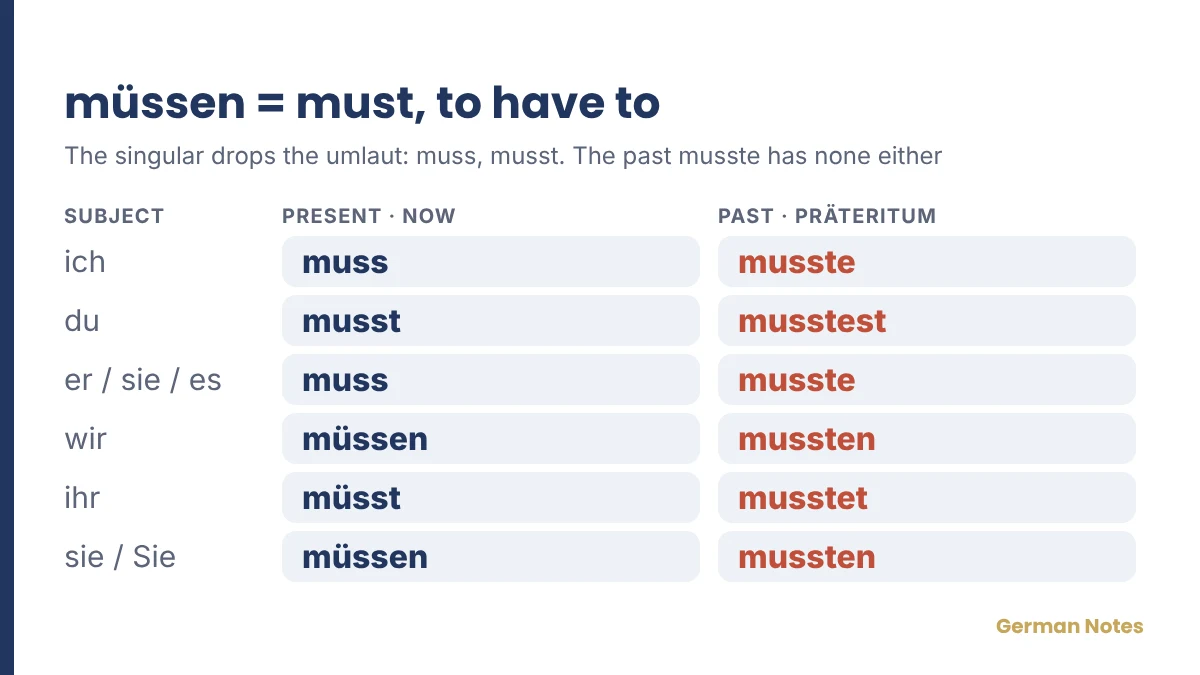
Müssen means must or to have to. In the present you say ich muss, du musst, er/sie/es muss, wir müssen, ihr müsst and sie/Sie müssen. The simple past uses musste. With another verb, the Perfekt uses haben and two infinitives: Ich habe arbeiten müssen means I had to work.
हिंदी में समझें
müssen का मतलब है करना पड़ना / ज़रूरी होना (must, have to): Ich muss lernen = मुझे पढ़ना है। ich और er/sie/es दोनों के साथ muss। बीते समय में musste: Ich musste arbeiten = मुझे काम करना पड़ा। ध्यान दें: Du musst nicht kommen = तुम्हें आने की ज़रूरत नहीं है, "मत आओ" नहीं।
Contents
- Müssen conjugation chart at a glance
- Müssen conjugation in the present tense
- Where does the other verb go?
- How do you ask questions with muss ich and musst du?
- What is the simple past of müssen?
- How do you form the Perfekt of müssen?
- Nicht müssen or nicht dürfen?
- Muss or muß?
- What are the common mistakes with müssen?
- Practice: fill in the form of müssen
- Frequently asked questions
Müssen conjugation chart at a glance
This table puts the present, the simple past and the Konjunktiv II side by side. Use it for a quick check. The Perfekt works differently, so it has its own section below.
| Subject | Present | Präteritum | Konjunktiv II |
|---|---|---|---|
| ich | muss | musste | müsste |
| du | musst | musstest | müsstest |
| er / sie / es | muss | musste | müsste |
| wir | müssen | mussten | müssten |
| ihr | müsst | musstet | müsstet |
| sie / Sie | müssen | mussten | müssten |
Müssen conjugation in the present tense
The singular drops the umlaut: ich muss, du musst, er/sie/es muss. The plural keeps the ü. Ich and er/sie/es share muss, without the usual -e or -t ending.
| Subject | Form | Example |
|---|---|---|
| ich (I) | muss | Ich muss lernen. = I have to study. |
| du (you, one friend) | musst | Du musst warten. = You have to wait. |
| er / sie / es (he / she / it) | muss | Sie muss arbeiten. = She has to work. |
| wir (we) | müssen | Wir müssen gehen. = We have to go. |
| ihr (you, several friends) | müsst | Ihr müsst zuhören. = You have to listen. |
| sie / Sie (they / you, formal) | müssen | Sie müssen bezahlen. = They have to pay. / You have to pay. |
Musst goes with du. For er, sie or es, use muss: Er muss warten. = He has to wait. English must never changes, but German müssen does, so check the pronoun before you pick the form.
Maybe you searched for mussen conjugation without the umlaut. The German spelling is müssen. If your keyboard can't type ü, write muessen instead of just leaving out the dots.
हिंदी में समझें
ich muss और er muss एक जैसे हैं, du musst में -st। एकवचन में Umlaut नहीं (muss, musst), बहुवचन में है (wir müssen, ihr müsst)। er musst ग़लत है। keyboard पर ü न हो तो muessen लिखें।
For a comparison with related modal verbs, see the A1 lesson on müssen, dürfen and sollen. The können conjugation guide covers another modal verb with the same patterns.
Where does the other verb go?
In a normal statement, the form of müssen comes second. The other verb stays in the infinitive at the end, and there's no zu in between.
- Ich muss heute früh aufstehen. = I have to get up early today.
- Wir müssen die Rechnung bezahlen. = We have to pay the bill.
- Anna muss am Samstag arbeiten. = Anna has to work on Saturday.
A separable verb stays in one piece after müssen. You may know Ich stehe früh auf (I get up early), where auf moves to the end. After a modal verb it's Ich muss früh aufstehen.
A time phrase can take the first place: Heute muss ich arbeiten. = Today I have to work. Muss is still second, and ich comes after it. Second place means the second part of the sentence, not always the second word: Am Montag muss ich arbeiten. = On Monday I have to work.
Müssen can describe a need or a duty. It can also mean you're sure about something: Das muss der richtige Bus sein. = That must be the right bus. Here the speaker is drawing a conclusion. Nobody is telling the bus what to do.
हिंदी में समझें
müssen दूसरे स्थान पर, असली verb आख़िर में, बिना zu: Ich muss heute früh aufstehen = मुझे आज जल्दी उठना है। Das muss der richtige Bus sein = यह सही बस ही होगी (अंदाज़ा)।
How do you ask questions with muss ich and musst du?
For a yes-or-no question, start with müssen. The subject comes next, and the main verb stays at the end.
- Muss ich heute kommen? = Do I have to come today?
- Musst du morgen arbeiten? = Do you have to work tomorrow?
- Müssen wir umsteigen? = Do we have to change trains?
With a question word, that word goes first: Wann muss ich kommen? = When do I have to come? Warum musst du gehen? = Why do you have to go?
German has no extra word for the English do in these questions. Muss ich is just the verb followed by its subject. You can answer the first question with Ja, du musst heute kommen (Yes, you have to come today) or Nein, du musst heute nicht kommen (No, you don't have to come today).
हिंदी में समझें
सवाल में müssen पहले: Muss ich heute kommen? = क्या मुझे आज आना है? जवाब: Ja, du musst heute kommen (हाँ, आना है) या Nein, du musst heute nicht kommen (नहीं, आने की ज़रूरत नहीं)।
What is the simple past of müssen?
Use musste to say that someone had to do something. The whole simple past has a plain u, with no umlaut.
| Subject | Präteritum | Example |
|---|---|---|
| ich | musste | Ich musste arbeiten. = I had to work. |
| du | musstest | Du musstest warten. = You had to wait. |
| er / sie / es | musste | Er musste gehen. = He had to go. |
| wir | mussten | Wir mussten lernen. = We had to study. |
| ihr | musstet | Ihr musstet bezahlen. = You had to pay. |
| sie / Sie | mussten | Sie mussten umsteigen. = They had to change trains. / You had to change trains. |
The other verb stays in the infinitive: Gestern musste ich lange warten. = Yesterday I had to wait a long time. You can use this short past form both when you speak and when you write.
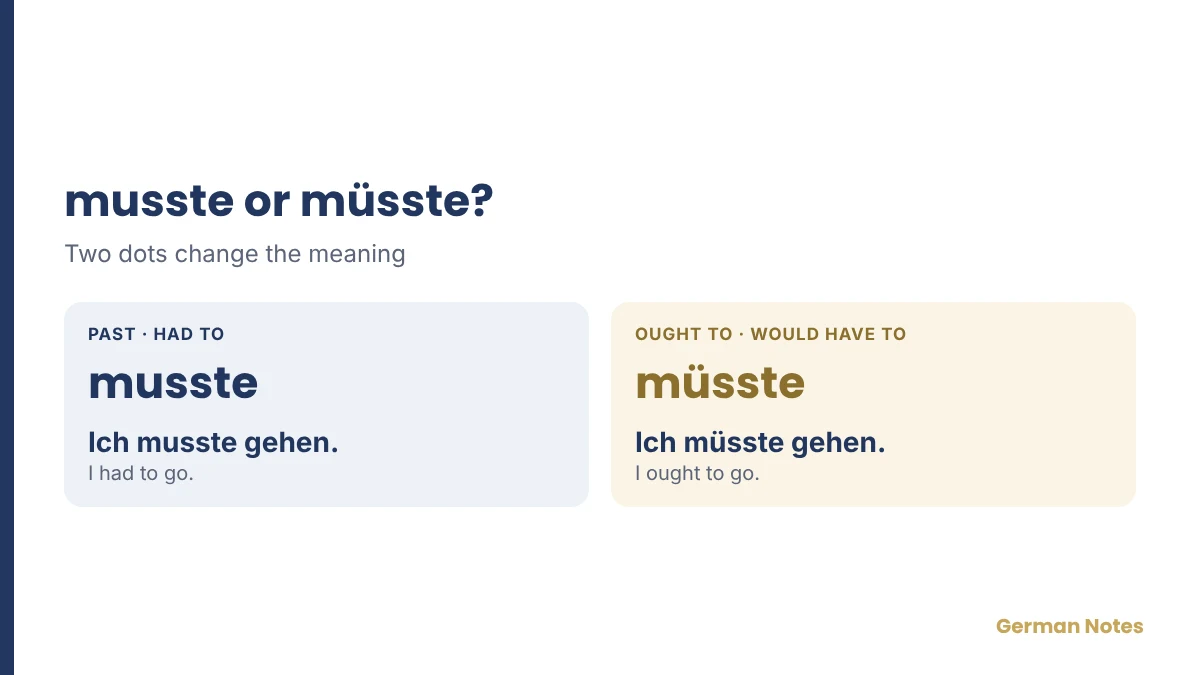
Don't mix up musste and müsste. Ich musste gehen reports something from the past: I had to go. Ich müsste gehen is Konjunktiv II and can mean I ought to go or I would have to go, depending on the context.
हिंदी में समझें
musste = करना पड़ा (बीता समय): Ich musste arbeiten = मुझे काम करना पड़ा। müsste (दो बिंदु) = करना चाहिए / करना पड़ेगा: Ich müsste gehen = मुझे जाना चाहिए। एक Umlaut से मतलब बदल जाता है।
How do you form the Perfekt of müssen?
With another infinitive, the standard Perfekt is a present form of haben plus the main verb's infinitive plus müssen. Using müssen instead of the participle gemusst is called the Ersatzinfinitiv, the replacement infinitive.
| Subject | Perfekt | English |
|---|---|---|
| ich | Ich habe arbeiten müssen. | I had to work. |
| du | Du hast arbeiten müssen. | You had to work. |
| er / sie / es | Sie hat arbeiten müssen. | She had to work. |
| wir | Wir haben arbeiten müssen. | We had to work. |
| ihr | Ihr habt arbeiten müssen. | You had to work. |
| sie / Sie | Sie haben arbeiten müssen. | They had to work. / You had to work. |
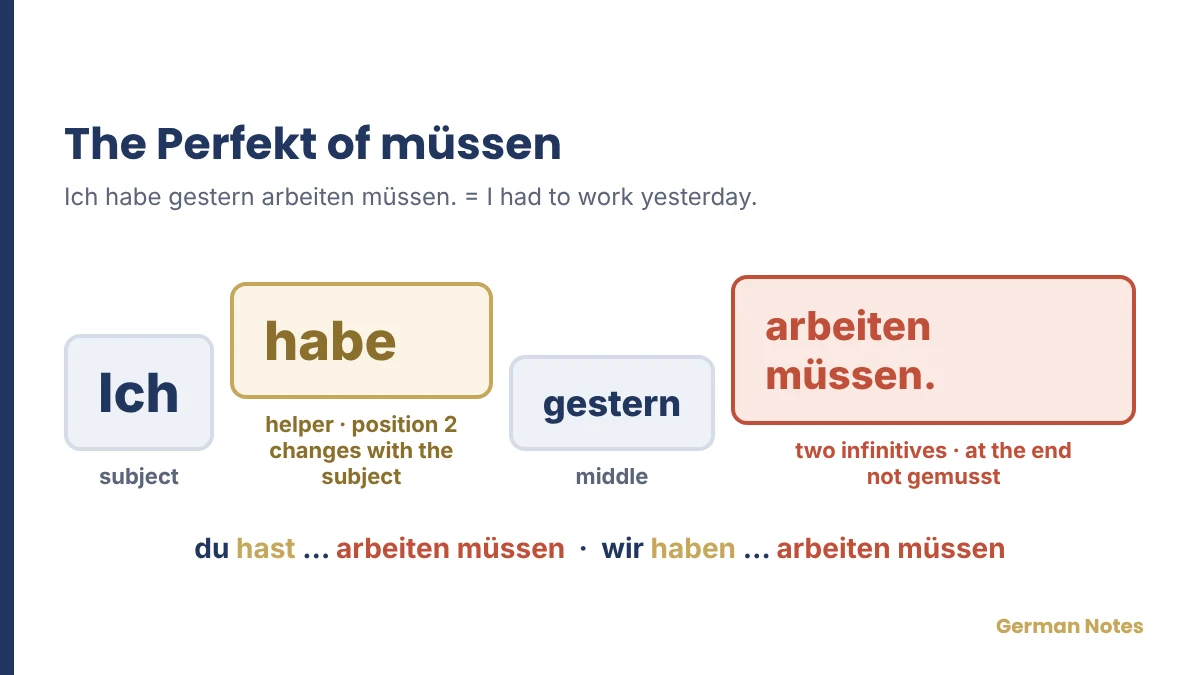
The order at the end matters: arbeiten müssen, not müssen arbeiten. Other information can go between haben and the two infinitives: Ich habe gestern lange arbeiten müssen. = I had to work for a long time yesterday.
Check whether there's another infinitive in the sentence. If there is, use müssen at the end. If there isn't, use gemusst: Ich habe das gemusst. = I had to do that.
Many verb tables only show ich habe gemusst, which doesn't teach you the common pattern with another verb. For a sentence like I had to work, learn Ich habe arbeiten müssen. In everyday conversation, Ich musste arbeiten is often the simpler choice, but it's worth recognising the Perfekt when you read or hear longer stories.
हिंदी में समझें
Perfekt में दूसरा verb हो तो gemusst नहीं, आख़िर में दो infinitive: Ich habe arbeiten müssen = मुझे काम करना पड़ा। दूसरा verb न हो तो gemusst: Ich habe das gemusst। बोलचाल में अक्सर आसान रूप Ich musste arbeiten चलता है।
Nicht müssen or nicht dürfen?
Du musst nicht kommen means You don't have to come. Coming isn't necessary, but nobody is stopping you. For You must not come, German says Du darfst nicht kommen.
| German | English | What it means |
|---|---|---|
| Du musst kommen. | You have to come. | Coming is necessary. |
| Du musst nicht kommen. | You don't have to come. | Coming is optional. |
| Du darfst nicht kommen. | You must not come. | Coming is not allowed. |
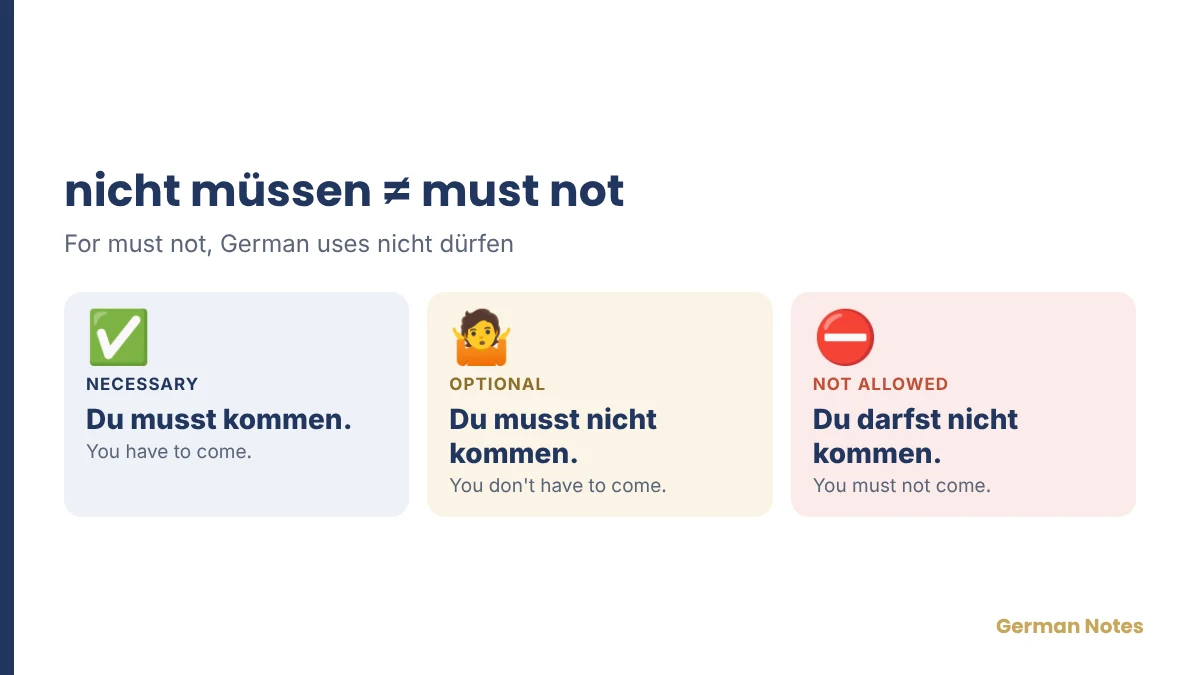
This one is easy to get wrong if you translate English must not word by word. Nicht müssen takes away the need, and nicht dürfen takes away the permission. Adding nicht to müssen doesn't give you the German for must not.
हिंदी में समझें
सबसे ज़रूरी अंतर: Du musst nicht kommen = तुम्हें आने की ज़रूरत नहीं है (आ सकते हो)। Du darfst nicht kommen = तुम नहीं आ सकते / मत आओ (मना है)। English के must not के लिए nicht dürfen लगाएँ।
Muss or muß?
Write muss in today's standard German. Muß is the older spelling, and you may still see it in older books or quotations. In your own writing, use muss, musst and musste.
The short u in muss is followed by ss. Keep the umlaut in the plural forms müssen and müsst, but not in muss or musst. If typing ü is hard, write muessen and muesst. Muss needs no substitute, because it has no umlaut.
हिंदी में समझें
आज की जर्मन में muss लिखें, muß पुरानी spelling है। muss और musst में Umlaut नहीं होता, सिर्फ़ müssen और müsst में होता है।
What are the common mistakes with müssen?
| Learner error | Correction and reason |
|---|---|
| Ich müsse arbeiten. | Ich muss arbeiten. = I have to work. Müsse is a Konjunktiv I form, not the normal present. |
| Er musst gehen. | Er muss gehen. = He has to go. Musst is the du form. |
| Ich muss zu lernen. | Ich muss lernen. = I have to study. No zu after müssen. |
| Ich habe arbeiten gemusst. | Ich habe arbeiten müssen. = I had to work. With another infinitive, use müssen. |
| Du musst nicht rauchen. (meaning not allowed) | Du darfst nicht rauchen. = You must not smoke. Nicht müssen only means don't have to. |
हिंदी में समझें
आम ग़लतियाँ: er musst नहीं, er muss। müssen के बाद zu नहीं। Perfekt में gemusst नहीं, müssen। और मना करने के लिए nicht müssen नहीं, nicht dürfen।
Practice: fill in the form of müssen
Fill each gap with the form that fits the subject and the English meaning.
- Ich ___ heute lernen. = I have to study today.
- Du ___ warten. = You have to wait.
- Ihr ___ leise sein. = You have to be quiet.
- Gestern ___ wir arbeiten. = Yesterday we had to work. (Simple past.)
- Ich habe früh aufstehen ___. = I had to get up early.
- ___ ich bezahlen? = Do I have to pay?
- Du ___ nicht kommen. = You don't have to come.
- Du ___ nicht kommen. = You must not come.
Answers
- muss
- musst
- müsst
- mussten
- müssen
- Muss
- musst
- darfst
Now change sentence 2 from du to er and then to ihr. For more practice with obligation and permission, try the müssen, dürfen and sollen exercises.
Frequently asked questions
How do you conjugate müssen in the present tense?
ich muss, du musst, er/sie/es muss, wir müssen, ihr müsst and sie/Sie müssen. The singular forms drop the umlaut; the plural forms keep it.
Does nicht müssen mean must not?
No. Nicht müssen means do not have to. Du musst nicht gehen means You do not have to go. For You must not go, say Du darfst nicht gehen.
What is the Perfekt of müssen?
With another infinitive, use haben plus two infinitives: Ich habe arbeiten müssen means I had to work. Without another infinitive, gemusst is possible, as in Ich habe das gemusst: I had to do that.
Is muss or muß correct?
Muss is the current standard spelling. Muß is the older spelling, which you may still see in older texts and quotations. Use muss in your own writing.
What is the difference between musste and müsste?
Musste is the simple past: Ich musste gehen means I had to go. Müsste is Konjunktiv II and expresses a softer or conditional necessity, such as I ought to go. The context decides the best English translation.
Does müssen take zu?
No. The other verb follows müssen as a bare infinitive at the end: Ich muss lernen, not Ich muss zu lernen.
Related lessons and practice
Write a sentence about something you have to do today, then change it to yesterday. Add a question that starts with Muss ich and answer it with nicht müssen. If you'd like to practise with a teacher, check GermanNotes demo availability.
For reference: Duden's müssen conjugation table and IDS grammis on the replacement infinitive.