Quick answer
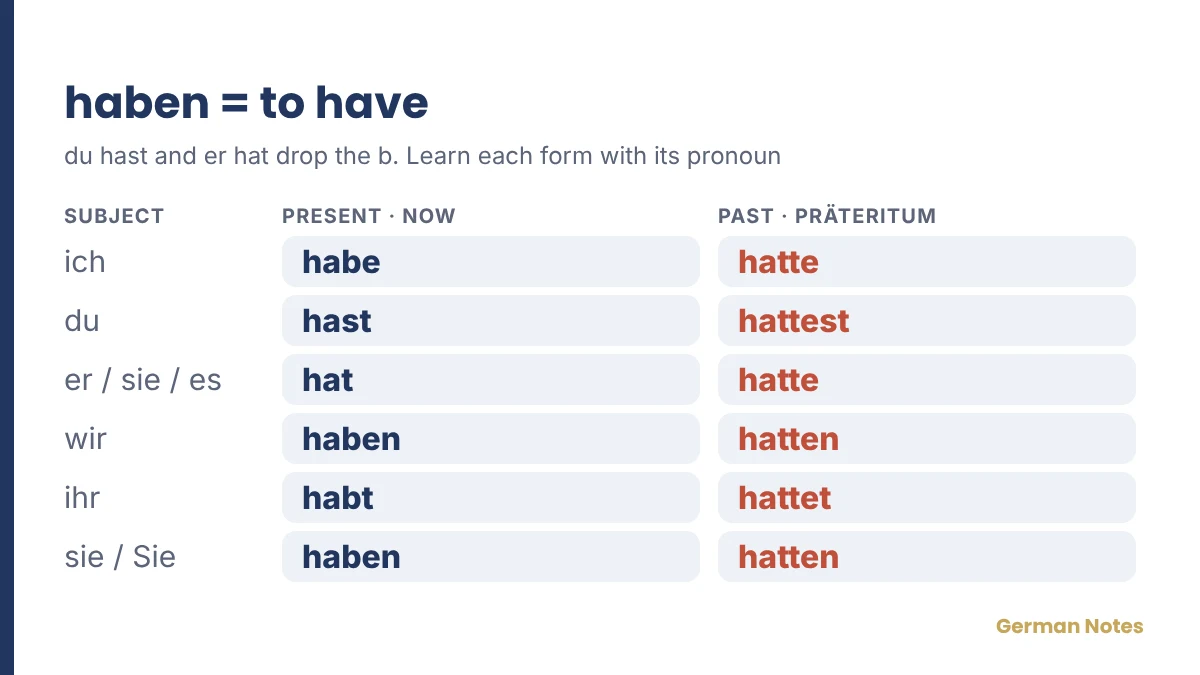
Haben means to have. In the present you say ich habe, du hast, er/sie/es hat, wir haben, ihr habt and sie/Sie haben. For the past, learn hatte and habe gehabt. You'll also meet haben in the Perfekt of many other verbs, as in Ich habe gelernt. = I studied.
हिंदी में समझें
haben का मतलब है पास होना (to have): Ich habe Zeit = मेरे पास समय है। वर्तमान में ich habe, du hast, er hat, और बीते समय में ich hatte (मेरे पास था)। haben दूसरे verbs का Perfekt बनाने में भी मदद करता है: Ich habe gelernt = मैंने पढ़ाई की।
Contents
- Haben conjugation chart: present, past and Perfekt at a glance
- Haben conjugation in the present tense
- How do you use haben in everyday sentences?
- What is the simple past of haben?
- How do you form the Perfekt of haben?
- When is haben a helping verb?
- How do you give instructions with haben?
- Where does habe go in questions?
- What are the common mistakes with haben?
- Practice: fill in the form of haben
- Frequently asked questions
Haben conjugation chart: present, past and Perfekt at a glance
Here are all three tenses in one table. Use it for a quick check, and read on for examples and the reasons behind each form.
| Subject | Present | Präteritum | Perfekt |
|---|---|---|---|
| ich | habe | hatte | habe gehabt |
| du | hast | hattest | hast gehabt |
| er / sie / es | hat | hatte | hat gehabt |
| wir | haben | hatten | haben gehabt |
| ihr | habt | hattet | habt gehabt |
| sie / Sie | haben | hatten | haben gehabt |
The subject stays the same and only the tense changes: Ich habe Zeit. = I have time. Ich hatte Zeit. = I had time. Ich habe Zeit gehabt. = I had time.
Haben conjugation in the present tense
Haben is irregular, though only a little. Two forms lose the b from the stem: du hast and er/sie/es hat. The ihr form keeps it: ihr habt.
| Subject | Form | Example |
|---|---|---|
| ich (I) | habe | Ich habe Zeit. = I have time. |
| du (you, one friend) | hast | Du hast einen Schlüssel. = You have a key. |
| er / sie / es (he / she / it) | hat | Sie hat eine Frage. = She has a question. |
| wir (we) | haben | Wir haben heute Unterricht. = We have a lesson today. |
| ihr (you, several friends) | habt | Ihr habt Glück. = You are lucky. |
| sie (they) | haben | Sie haben zwei Kinder. = They have two children. |
| Sie (you, formal) | haben | Sie haben einen Termin. = You have an appointment. |
Learn each form together with its pronoun. Chanting habe, hast, hat helps you remember the order, but ich habe, du hast, sie hat also tells you which form goes where.
The last two rows look the same at the start of a sentence. Only the context tells you whether Sie haben means they have or formal you have. Inside a sentence, formal Sie keeps its capital S: Heute haben Sie Zeit. = You have time today.
हिंदी में समझें
du hast और er hat में b ग़ायब हो जाता है, बाक़ी रूपों में रहता है: ich habe, wir haben, ihr habt। sie haben = उनके पास है, Sie haben = आपके पास है (आदर से)। और sie hat = उसके (स्त्री) पास है।
If you want a refresher on subjects and endings, the A1 verb conjugation lesson covers the basics. The German verb conjugation guide compares haben with regular verbs, and the sein conjugation guide covers its partner verb.
How do you use haben in everyday sentences?
Most of the time, haben is about things you own or have with you. The thing you have is the direct object, so it's in the accusative case. You can see this with masculine nouns: der Schlüssel becomes einen Schlüssel.
- Ich habe einen Schlüssel. = I have a key. (masculine)
- Ich habe eine Tasche. = I have a bag. (feminine, eine stays the same)
- Wir haben ein Auto. = We have a car. (neuter)
Some everyday phrases use haben where English uses be. Learn them as whole expressions, so you don't translate word by word:
- Ich habe Hunger. = I am hungry.
- Hast du Durst? = Are you thirsty?
- Das Kind hat Angst. = The child is afraid.
- Wir haben Glück. = We are lucky.
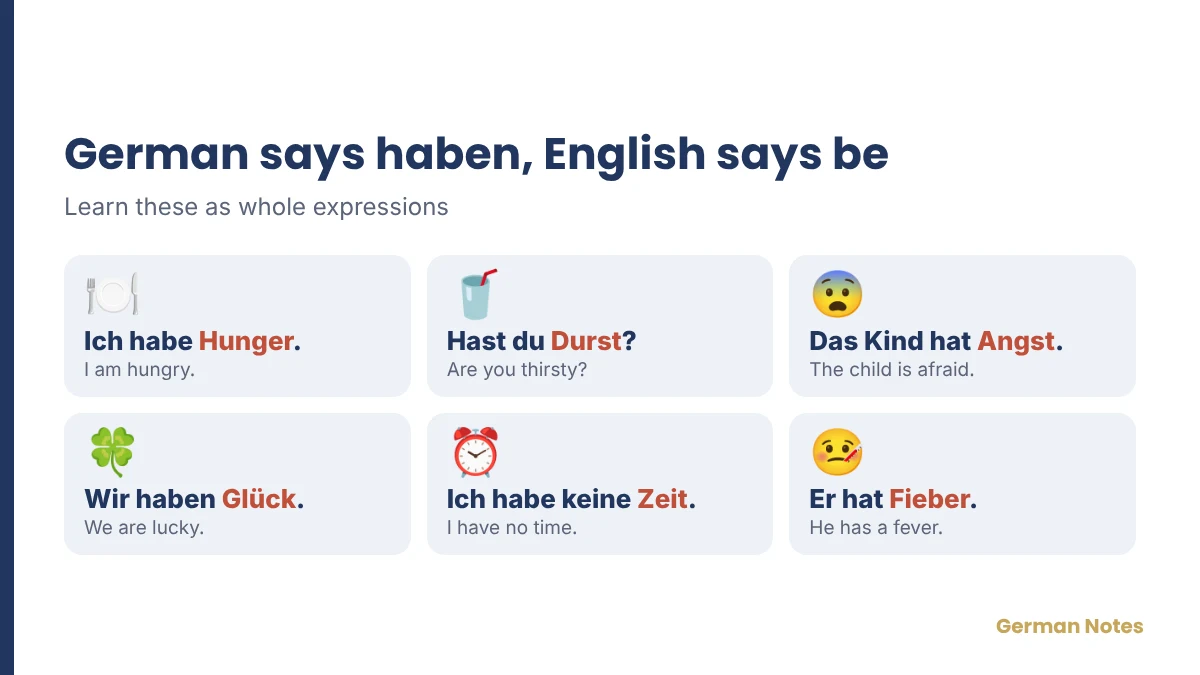
Zeit works the same way: Ich habe keine Zeit. = I have no time. Keine makes the noun negative, and with a masculine noun it takes an ending: Ich habe keinen Schlüssel. = I don't have a key.
Age is the exception many learners trip over. German uses sein here: Ich bin zwanzig Jahre alt. = I am twenty years old. That holds even if your first language talks about age with have.
हिंदी में समझें
हिंदी की तरह जर्मन में भी भूख-प्यास "है" नहीं होती, "पास" होती है: Ich habe Hunger = मुझे भूख लगी है, Ich habe Durst = मुझे प्यास लगी है, Ich habe Angst = मुझे डर लग रहा है। पर उम्र के लिए sein: Ich bin 20 Jahre alt।
What is the simple past of haben?
The Präteritum (simple past) of haben is built on hatt-. Germans use it all the time when they talk about the past, in conversation as well as in writing. Ich hatte Zeit means I had time. The ich and er/sie/es forms are the same.
| Subject | Präteritum | Example |
|---|---|---|
| ich | hatte | Ich hatte gestern frei. = I had the day off yesterday. |
| du | hattest | Du hattest recht. = You were right. |
| er / sie / es | hatte | Er hatte Hunger. = He was hungry. |
| wir | hatten | Wir hatten Besuch. = We had visitors. |
| ihr | hattet | Ihr hattet eine Frage. = You had a question. |
| sie / Sie | hatten | Sie hatten Zeit. = They had time. / You had time. |
Watch the extra letters in du hattest and ihr hattet. If you write du hatte or ihr hatten, the reader can't tell who you mean.
For a short story about yesterday, you can mix haben and sein in the simple past: Ich hatte einen Termin. Danach war ich zu Hause. = I had an appointment. Afterwards, I was at home. The lesson on the past tense of sein and haben gives you more practice with this pair.
One small dot changes the meaning. Ich hatte Zeit says that you had time. Ich hätte gern einen Tee means I would like a tea. The umlaut in hätte turns it into a polite wish.
हिंदी में समझें
hatte = था/थी (पास): Ich hatte Zeit = मेरे पास समय था। du hattest और ihr hattet में अक्षर ज़्यादा हैं, इन्हें ध्यान से लिखें। और hatte और hätte अलग हैं: Ich hätte gern einen Tee = मुझे एक चाय चाहिए (विनम्र तरीक़े से)।
How do you form the Perfekt of haben?
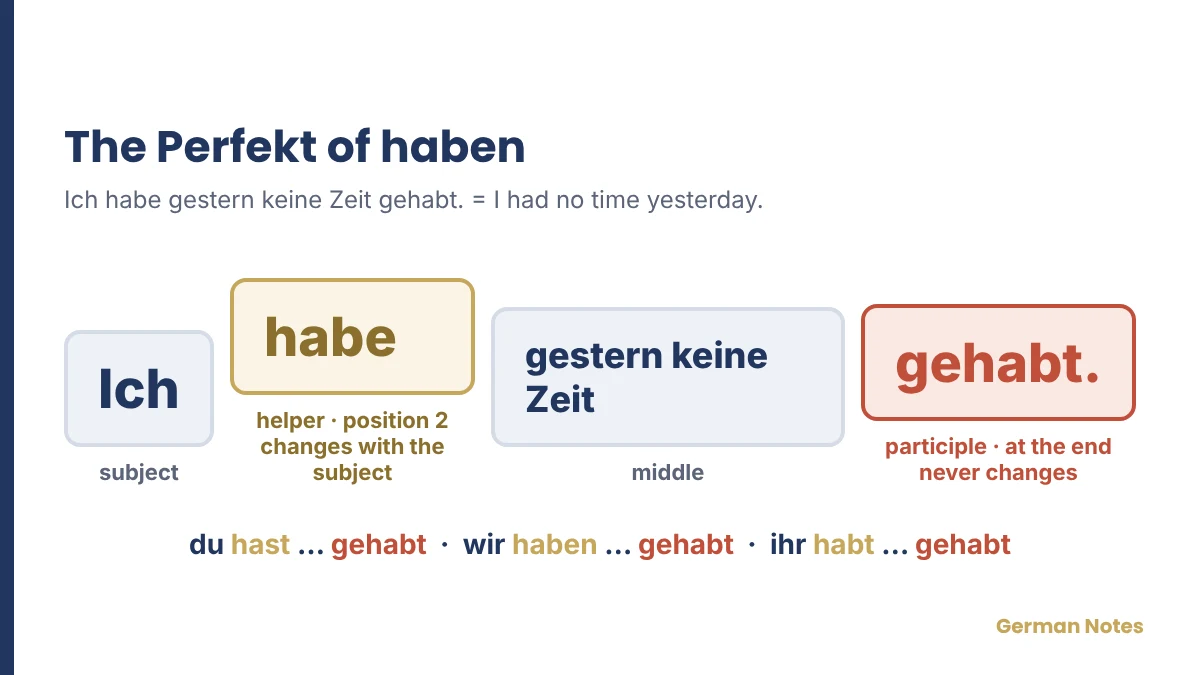
The Perfekt of haben has two parts: a present form of haben and the past participle gehabt. In a normal statement, the haben form sits in second place and gehabt usually goes to the end.
| Subject | Perfekt | English |
|---|---|---|
| ich | habe gehabt | I had / have had |
| du | hast gehabt | you had / have had |
| er / sie / es | hat gehabt | he / she / it had / has had |
| wir | haben gehabt | we had / have had |
| ihr | habt gehabt | you had / have had |
| sie / Sie | haben gehabt | they had / have had; you had / have had |
- Ich habe gestern keine Zeit gehabt. = I had no time yesterday.
- Wir haben viel Glück gehabt. = We were very lucky.
Both hatte and habe gehabt are correct when you talk about the past. Hatte is shorter, and you'll hear it in many everyday sentences. You'll also hear gehabt, depending on the region, the speaker and the situation. English often translates both with a simple past, so don't pick the German tense by copying the English one.
हिंदी में समझें
Perfekt = haben का वर्तमान रूप + gehabt। Ich habe keine Zeit gehabt = मेरे पास समय नहीं था। gehabt वाक्य के आख़िर में आता है और कभी नहीं बदलता। Ich hatte keine Zeit और Ich habe keine Zeit gehabt दोनों सही हैं।
When is haben a helping verb?
In Ich habe Zeit, haben carries the meaning have. In Ich habe gelernt, it helps another verb form the Perfekt, and gelernt brings the action: learning.
- Ich habe die Hausaufgaben gemacht. = I did the homework.
- Du hast lange gearbeitet. = You worked for a long time.
- Wir haben Deutsch gelernt. = We studied German.
Put haben in the form that matches the subject, then add the participle of the other verb. You don't need gehabt as well. Ich habe gelernt is already a complete sentence.
Many verbs build their Perfekt with haben, but some use sein. Compare Ich habe gearbeitet (I worked) with Ich bin gekommen (I came). Learn the helper with each new participle. A rule based only on movement won't cover every verb; the sein conjugation guide explains which verbs take sein.
हिंदी में समझें
Ich habe Zeit में haben का मतलब है "पास होना"। Ich habe gelernt में habe सिर्फ़ बीता समय बनाता है और काम gelernt बताता है: मैंने पढ़ाई की। यहाँ gehabt नहीं लगता। ज़्यादातर verbs haben लेते हैं, पर कुछ (जैसे kommen, gehen) sein लेते हैं।
How do you give instructions with haben?
The imperative of haben comes up mostly in a few fixed phrases. Say Hab (or Habe) to one friend, Habt to several friends and Haben Sie in formal speech.
- Hab keine Angst! = Don't be afraid! (To one person, informal.)
- Habt Geduld! = Be patient! (To several people, informal.)
- Haben Sie keine Angst! = Don't be afraid! (Formal.)
हिंदी में समझें
किसी को हिम्मत देनी हो तो: एक दोस्त से Hab keine Angst! (डरो मत!), कई दोस्तों से Habt Geduld! (सब्र रखो!), और आदर से Haben Sie keine Angst!
Where does habe go in questions?
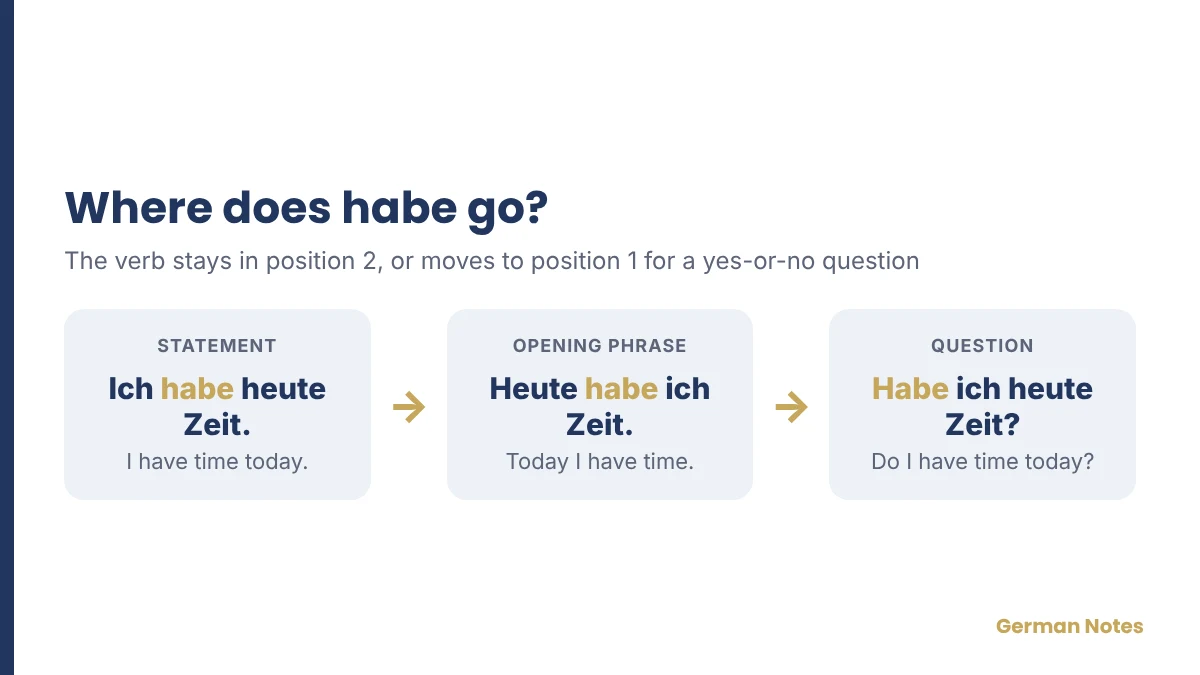
For a yes-or-no question, put the verb first: Hast du Zeit? = Do you have time? German has no word for the English do in this kind of question.
Habe ich is simply the verb followed by its subject. You'll find it in questions like Habe ich einen Fehler gemacht? = Did I make a mistake? It also shows up when a sentence opens with a time phrase: Heute habe ich Zeit. = Today I have time. Heute takes the first place, so habe comes second and ich moves behind it.
With a question word, that word comes before the verb: Wann habt ihr Zeit? = When do you have time? In the Perfekt, the participle still goes to the end: Was hast du gemacht? = What did you do?
हिंदी में समझें
सवाल बनाने के लिए verb पहले: Hast du Zeit? = क्या तुम्हारे पास समय है? English के "do" जैसा कोई शब्द नहीं लगता। अगर वाक्य Heute से शुरू हो, तो verb दूसरे स्थान पर और subject उसके बाद: Heute habe ich Zeit।
What are the common mistakes with haben?
| Learner error | Correction and reason |
|---|---|
| Du habst Zeit. | Du hast Zeit. = You have time. The du form drops the b. |
| Ihr haben Zeit. | Ihr habt Zeit. = You have time. ihr needs habt. |
| Sie hat Zeit. (meaning they) | Sie haben Zeit. = They have time. hat belongs to singular she. |
| Ich bin Hunger. | Ich habe Hunger. = I am hungry. German uses haben with Hunger. |
| Ich habe gehaben. | Ich habe gehabt. = I had / have had. The participle is gehabt. |
| Ich habe 25 Jahre. | Ich bin 25 Jahre alt. = I am 25 years old. Age takes sein. |
When you check your own sentence, find the subject first, then the verb form that goes with it. In the Perfekt, also check the participle and where it sits.
हिंदी में समझें
सबसे आम ग़लतियाँ: du habst नहीं, du hast। ihr haben नहीं, ihr habt। gehaben नहीं, gehabt। और उम्र के लिए haben नहीं, sein: Ich bin 25 Jahre alt।
Practice: fill in the form of haben
The English meaning tells you which tense to use.
- Ich ___ eine Frage. = I have a question.
- ___ du einen Stift? = Do you have a pen?
- Ihr ___ gestern Glück. = You were lucky yesterday. (Simple past.)
- Wir ___ keine Zeit gehabt. = We had no time. (Perfekt.)
- Sie ___ zwei Kinder. = They have two children.
- Was ___ du gemacht? = What did you do?
- Heute ___ ich frei. = Today I have the day off.
- Er hat Hunger ___. = He was hungry. (Complete the Perfekt.)
Answers
- habe
- Hast
- hattet
- haben
- haben
- hast
- habe
- gehabt
Then try sentences 1 and 7 with wir instead of ich, and turn them into questions.
Frequently asked questions
What is the verb haben in German?
Haben is the German verb for to have. You use it for things you own or have with you, in set phrases such as Hunger haben, and to form the Perfekt of many verbs, as in Ich habe gelernt.
What does habe mean in German?
Habe is the ich form of haben in the present tense: Ich habe Zeit. = I have time. It is also the helper in Perfekt sentences such as Ich habe gelernt. = I studied.
What does habe ich mean in German?
Habe ich is the verb followed by its subject. You find it in yes-or-no questions and after an opening phrase: Habe ich Zeit? = Do I have time? Heute habe ich Zeit. = Today I have time.
What are the present-tense forms of haben?
ich habe, du hast, er/sie/es hat, wir haben, ihr habt and sie/Sie haben. Hast and hat drop the b, while habt keeps it.
Is haben regular or irregular?
Haben is irregular. Its present forms include hast and hat, its simple past is hatte, and its past participle is gehabt. Learn these forms together with the pronouns.
Should I use hatte or habe gehabt?
Both are correct for a past situation. Hatte is common in everyday speech and writing, and habe gehabt is also correct. Ich hatte keine Zeit and Ich habe keine Zeit gehabt can both mean I had no time.
What does sie haben mean?
Lowercase sie haben means they have. Capitalised Sie haben means formal you have. At the start of a sentence both begin with a capital, so the context decides. She has is sie hat.
Why does Ich habe gelernt use haben?
Lernen forms its Perfekt with the helping verb haben. Habe matches ich, and gelernt is the past participle. The sentence means I studied or I have studied, depending on the context.
Related lessons and practice
Write four sentences about your own day: something you have, something you had yesterday, a question for a friend and something you have done. Then check each verb against the charts above. For more practice, try the verb conjugation exercises or the sein and haben past-tense exercises. If you'd like to practise with a teacher, check GermanNotes demo availability.