Quick answer
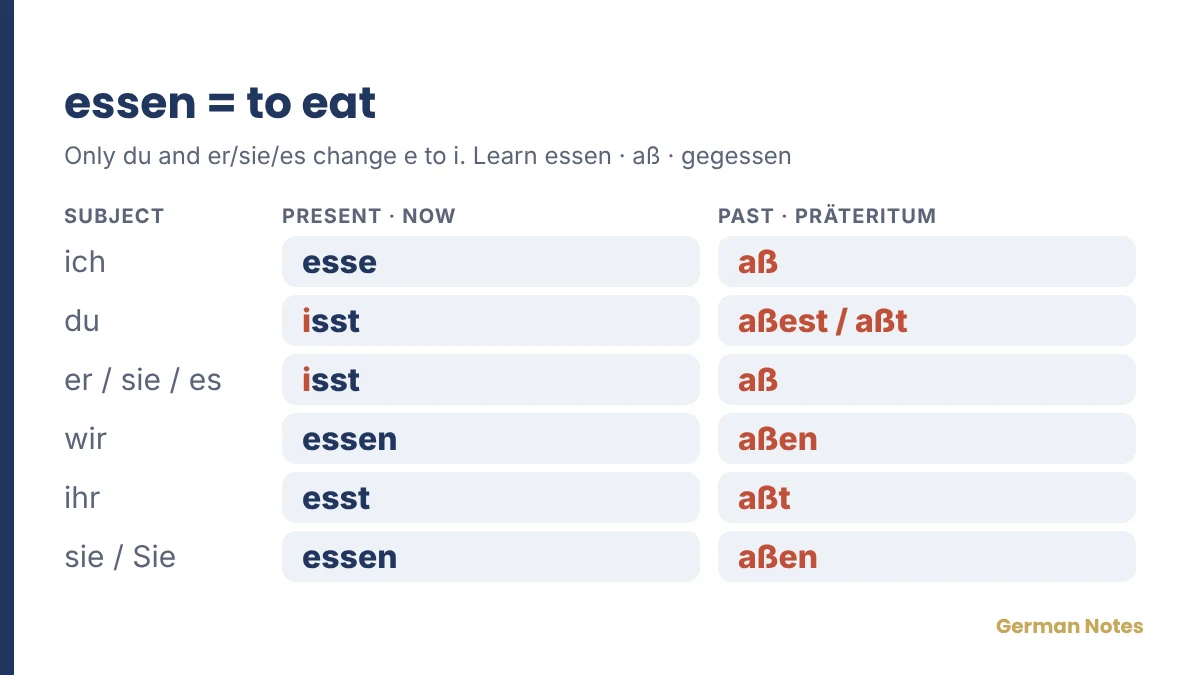
Essen means to eat. In the present you say ich esse, du isst, er/sie/es isst, wir essen, ihr esst and sie/Sie essen. The past forms to remember are aß and hat gegessen. Essen is irregular: with du and er/sie/es, the vowel changes from e to i in the present.
Start with a sentence you can use at the table: Was isst du? means What are you eating? To answer, switch back to esse: Ich esse Reis means I'm eating rice. German uses the same present form for I eat and I am eating; the situation tells you which English version fits.
हिंदी में समझें
essen का मतलब है खाना: Ich esse Reis = मैं चावल खा रहा हूँ। du isst और er isst में e की जगह i आता है। बीते समय में aß और habe gegessen: Ich habe schon gegessen = मैंने खा लिया है। तीनों रूप साथ याद करें: essen, aß, gegessen।
Contents
- Essen conjugation chart at a glance
- Essen conjugation in the present tense
- Why is it isst, but esst?
- How do you form the Perfekt of essen?
- What is the simple past of essen?
- All the main forms at a glance
- How do you give instructions with essen?
- Everyday examples with essen
- What are the common mistakes with essen?
- Practice: fill in the form of essen
- Frequently asked questions
Essen conjugation chart at a glance
Here are all three tenses in one table. Use it for a quick check, and read on for examples.
| Subject | Present | Präteritum | Perfekt |
|---|---|---|---|
| ich | esse | aß | habe gegessen |
| du | isst | aßest / aßt | hast gegessen |
| er / sie / es | isst | aß | hat gegessen |
| wir | essen | aßen | haben gegessen |
| ihr | esst | aßt | habt gegessen |
| sie / Sie | essen | aßen | haben gegessen |
Essen conjugation in the present tense
| Subject | Form | English |
|---|---|---|
| ich | esse | I eat / am eating |
| du | isst | you eat / are eating (one friend) |
| er / sie / es | isst | he / she / it eats / is eating |
| wir | essen | we eat / are eating |
| ihr | esst | you eat / are eating (several friends) |
| sie / Sie | essen | they eat / you eat (formal) |
Du isst and er isst are the same. Don't add another s to make issst. With ihr, the vowel stays e: Ihr esst früh means You eat early, said to more than one friend.
Compare Sie isst Suppe (She is eating soup) with Sie essen Suppe (They are eating soup, or formal You are eating soup). At the start of a sentence, the capital S can't tell you which one is meant, so look at the verb and the context.
You can use essen without saying what you eat: Wir essen um sieben means We eat at seven. When you do name the food, it's usually an accusative object: Ich esse einen Apfel means I'm eating an apple. Der Apfel becomes einen Apfel here.
हिंदी में समझें
ich esse, wir essen, ihr esst में e। du isst, er isst में i। Wir essen um sieben = हम सात बजे खाना खाते हैं। खाने की चीज़ accusative में: Ich esse einen Apfel = मैं एक सेब खा रहा हूँ।
Why is it isst, but esst?
Learn the singular change as a pair: du isst and er/sie/es isst. The other present forms keep the e of essen. This is a vowel change in the stem, so just changing the ending won't give you every correct form.
Try saying these two questions together: Was isst du? (What are you eating?) and Was esst ihr? (What are you all eating?). The first one is for one person, the second for a group.
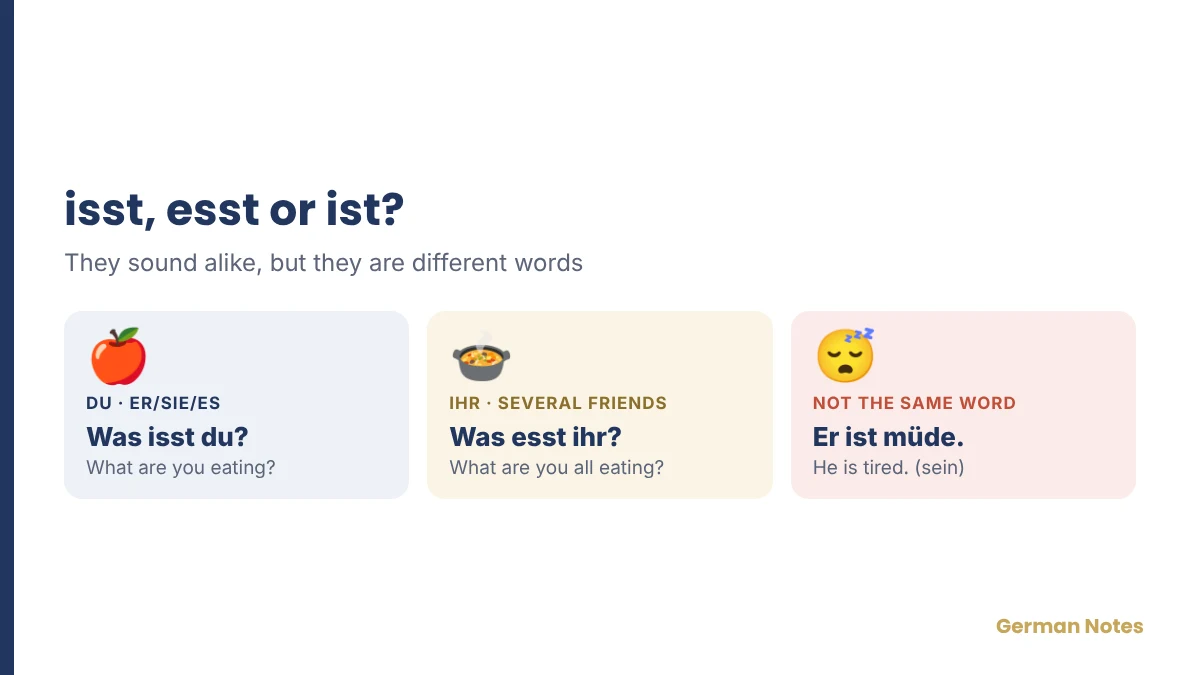
Don't mix up isst with ist, the form of sein that means is. In standard German they sound the same, but they're spelled differently and do different jobs. Er isst means He is eating. Er ist müde means He is tired.
हिंदी में समझें
Was isst du? = तुम क्या खा रहे हो? (एक व्यक्ति)। Was esst ihr? = तुम लोग क्या खा रहे हो? (कई लोग)। सावधान: isst (खाता है) और ist (है) सुनने में एक जैसे हैं: Er isst = वह खा रहा है, Er ist müde = वह थका हुआ है।
How do you form the Perfekt of essen?
To talk about a meal you've finished, use a form of haben with gegessen. In a normal sentence, haben changes with the subject and gegessen goes to the end: Ich habe schon gegessen means I have already eaten.
| Subject | Perfekt |
|---|---|
| ich | habe gegessen |
| du | hast gegessen |
| er / sie / es | hat gegessen |
| wir | haben gegessen |
| ihr | habt gegessen |
| sie / Sie | haben gegessen |
Gegessen doesn't change when the subject does. Compare Ich habe Reis gegessen (I ate rice) with Wir haben Reis gegessen (We ate rice). Only haben changes.
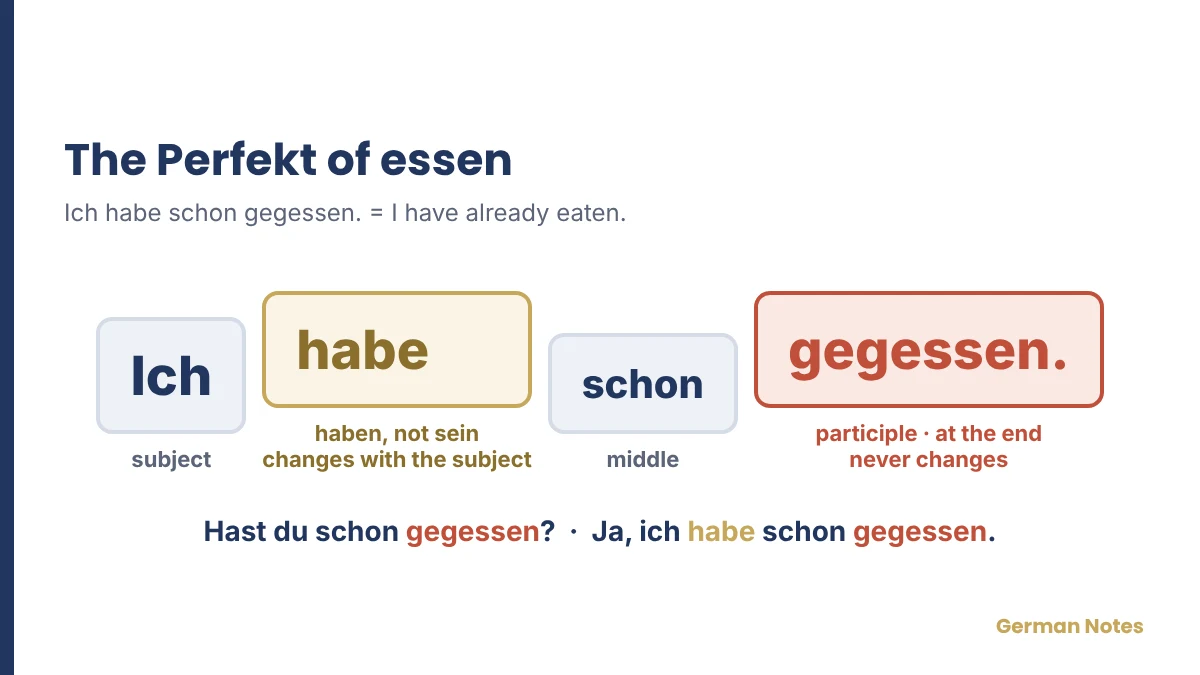
A yes-or-no question starts with haben: Hast du schon gegessen? means Have you eaten yet? A short answer could be Ja, ich habe schon gegessen (Yes, I've already eaten) or Nein, noch nicht (No, not yet).
In a clause starting with dass, both verb parts go to the end: Ich weiß, dass du schon gegessen hast means I know that you've already eaten. Here gegessen comes before hast.
हिंदी में समझें
essen का Perfekt haben से बनता है: Ich habe schon gegessen = मैंने खा लिया है। सबसे काम का सवाल: Hast du schon gegessen? = क्या तुमने खाना खा लिया? जवाब: Ja, ich habe schon gegessen या Nein, noch nicht।
What is the simple past of essen?
The simple past uses the stem aß-. You'll meet it mostly in written stories. For everyday talk about meals, the Perfekt forms above are the place to start.
| Subject | Präteritum |
|---|---|
| ich | aß |
| du | aßest / aßt |
| er / sie / es | aß |
| wir | aßen |
| ihr | aßt |
| sie / Sie | aßen |
Nach der Arbeit aß sie eine Suppe means After work, she ate a soup. You can describe the same thing with Nach der Arbeit hat sie eine Suppe gegessen. The tense changes, but not what she ate.
Duden lists both du aßest and du aßt. If you see either one in a text, you'll know it's the past of essen. For your own practice, choose one form and stick with it.
हिंदी में समझें
aß = खाया (किताबों और कहानियों में): Nach der Arbeit aß sie eine Suppe = काम के बाद उसने सूप खाया। बोलचाल में ज़्यादातर hat gegessen बोला जाता है।
All the main forms at a glance
| Form | German | English |
|---|---|---|
| Present | Ich esse gerade. | I am eating right now. |
| Präteritum | Ich aß zu Hause. | I ate at home. |
| Perfekt | Ich habe zu Hause gegessen. | I ate at home. |
| Plusquamperfekt | Ich hatte schon gegessen. | I had already eaten. |
| Future with werden | Ich werde später essen. | I will eat later. |
The Plusquamperfekt puts the meal before another past event: Als Ben ankam, hatte ich schon gegessen means When Ben arrived, I had already eaten. It's useful when the order of events matters.
You can also talk about the future with the present tense and a time word: Morgen essen wir zusammen means Tomorrow we'll eat together. You don't need werde in every sentence about a future meal. The werden conjugation guide explains the future with werden.
How do you give instructions with essen?
For one person you call du, use iss: Iss bitte langsam! means Please eat slowly! For a group of friends, use esst: Esst bitte weiter! means Please carry on eating! In formal speech, use essen Sie: Essen Sie bitte etwas! means Please eat something!
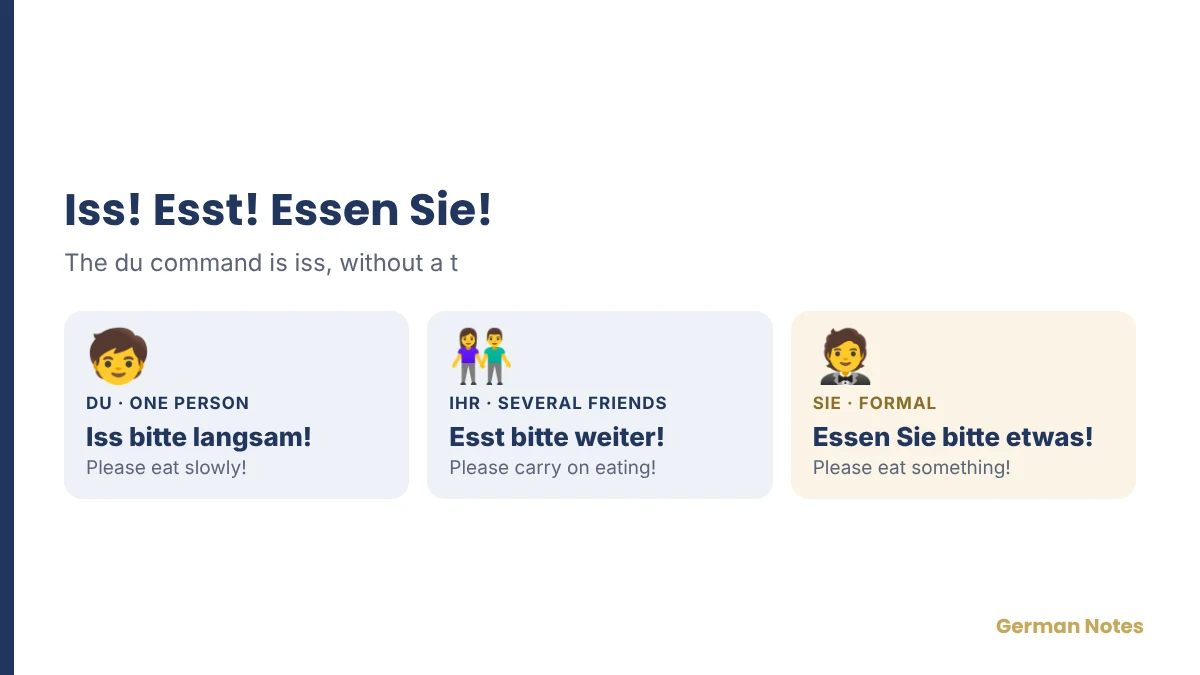
The du command is iss, with no t at the end. Keep it apart from the statement du isst. A question can sound friendlier in some situations: Möchtest du etwas essen? means Would you like something to eat?
हिंदी में समझें
आदेश: एक व्यक्ति से Iss bitte langsam! (आराम से खाओ!), यहाँ t नहीं लगता। कई दोस्तों से Esst bitte weiter!, आदर से Essen Sie bitte etwas! विनम्र पूछना हो तो: Möchtest du etwas essen? = कुछ खाओगे?
Everyday examples with essen
| German | English |
|---|---|
| Ich esse morgens ein Brötchen. | I eat a bread roll in the morning. |
| Meine Schwester isst keinen Fisch. | My sister doesn't eat fish. |
| Was esst ihr heute Abend? | What are you eating this evening? |
| Wir haben gestern zusammen gegessen. | We ate together yesterday. |
| Nach dem Spaziergang aßen die Kinder eine Banane. | After the walk, the children ate a banana. |
To say what you like to eat, gern is useful: Ich esse gern Gemüse means I like eating vegetables. Keep the structure and change the food: Ich esse gern Nudeln means I like eating pasta.
Essen can also come after another verb. Wir möchten jetzt essen means We would like to eat now. Möchten takes the ending, and essen stays in the infinitive. Compare Wir essen jetzt (We're eating now), where essen itself is the conjugated verb. The Möchten vs Mögen guide has more on möchten.
What are the common mistakes with essen?
| Learner error | Correction and reason |
|---|---|
| Du esst Reis. | Du isst Reis. = You eat rice. du takes the i. |
| Ihr isst Reis. | Ihr esst Reis. = You all eat rice. ihr keeps the e. |
| Ich bin gegessen. | Ich habe gegessen. = I have eaten. essen takes haben. |
| Ich habe geesst. | Ich habe gegessen. = I have eaten. The participle is gegessen. |
| Issst du jetzt? | Isst du jetzt? = Are you eating now? isst has two s, not three. |
| Isst bitte langsam! | Iss bitte langsam! = Please eat slowly! The du command has no t. |
When you revise, write essen, aß, gegessen together, then add the present pair du isst / er isst. That gives you a short list of the forms you can't make with regular endings.
हिंदी में समझें
आम ग़लतियाँ: du esst नहीं, du isst। ihr isst नहीं, ihr esst। Ich bin gegessen नहीं, Ich habe gegessen। geesst नहीं, gegessen। आदेश Iss!, Isst! नहीं।
Practice: fill in the form of essen
Fill each gap with the right form. The English tells you which tense to use.
- Du ___ einen Apfel. = You are eating an apple.
- Ihr ___ heute früh. = You all are eating early today.
- Ich habe schon ___. = I have already eaten.
- Gestern ___ wir im Garten. = Yesterday we ate in the garden. (Präteritum.)
- ___ bitte langsam! = Please eat slowly! (To one person.)
Answers
- isst
- esst
- gegessen
- aßen
- Iss
Now write a question about a meal and answer it twice, once for yourself with ich and once for two people with wir. For example, Was hast du gegessen? (What did you eat?) becomes Ich habe Suppe gegessen (I ate soup) and Wir haben Suppe gegessen (We ate soup).
Frequently asked questions
How do you conjugate essen in the present tense?
ich esse, du isst, er/sie/es isst, wir essen, ihr esst and sie/Sie essen. Only du and er/sie/es change the vowel from e to i in the present.
Is the Perfekt of essen formed with haben or sein?
With haben: ich habe gegessen, du hast gegessen, wir haben gegessen. Gegessen is the past participle and stays the same for every subject.
What is the difference between isst and esst?
Isst goes with du and er/sie/es. Esst goes with ihr, the informal plural you. Was isst du? asks one person what they are eating; Was esst ihr? asks a group.
What is the past tense of essen?
The Präteritum is ich aß, and the Perfekt is ich habe gegessen. Both can describe eating in the past. Learn the main forms together: essen, aß, gegessen.
What is the difference between isst and ist?
Isst comes from essen and means eats: Er isst means He is eating. Ist comes from sein and means is: Er ist müde means He is tired. They sound the same but are spelled differently.
What is the du command of essen?
Iss, without a t: Iss bitte langsam! means Please eat slowly! To several friends, say Esst bitte langsam!, and formally Essen Sie bitte langsam!
Related lessons and practice
For more beginner lessons, see the GermanNotes A1 course. If you're not sure which level to study next, try the free placement test.
For reference: Duden's essen conjugation table.
- German verb conjugation guide
- Haben conjugation guide
- Fahren conjugation guide
- Möchten vs Mögen
- A1 lesson: verb conjugation