Quick answer
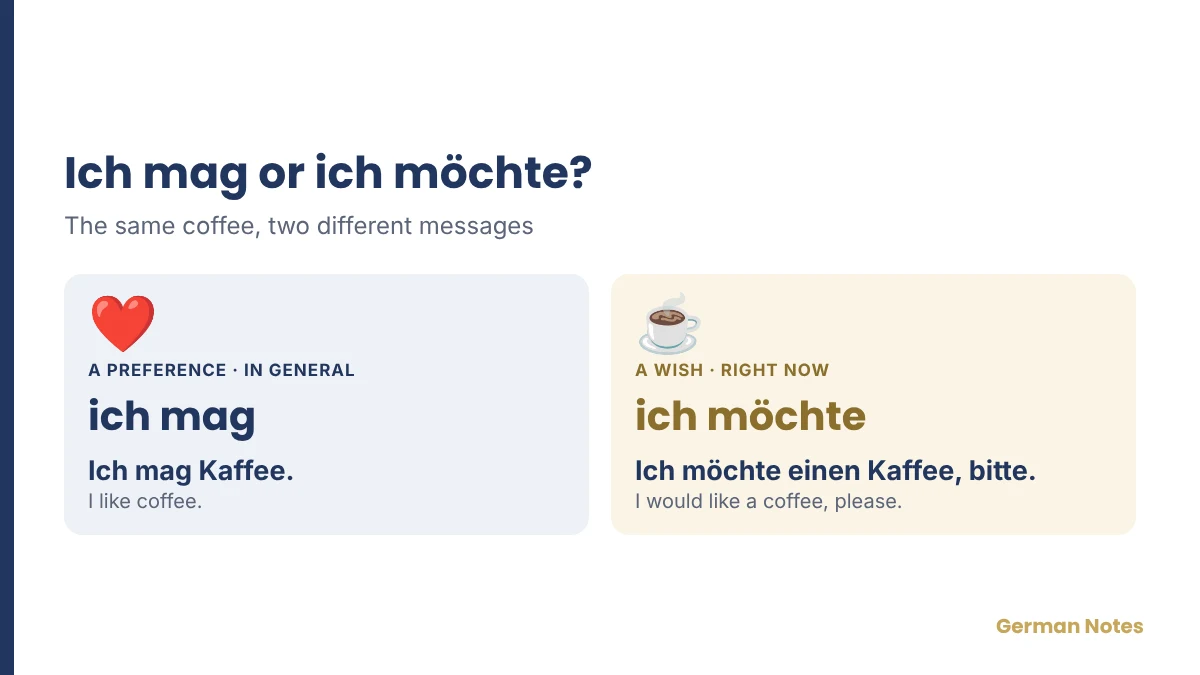
Möchten means would like, and mögen usually means to like. Say Ich mag Kaffee when you talk about what you like, and Ich möchte einen Kaffee when you order one. The möchte forms come from the Konjunktiv II of mögen, and you use them for a polite wish, usually about now or the future.
हिंदी में समझें
mögen = पसंद होना: Ich mag Kaffee = मुझे कॉफ़ी पसंद है। möchten = चाहिए (विनम्र तरीक़े से): Ich möchte einen Kaffee = मुझे एक कॉफ़ी चाहिए। दुकान या रेस्टोरेंट में ऑर्डर करते समय हमेशा möchte बोलें।
Contents
Mögen and möchten side by side
The table compares the present of mögen with the möchte forms you use for would like. These aren't two separate verbs that each have their own past forms; the section on the past explains why.
| Subject | mögen: like | möchten: would like |
|---|---|---|
| ich (I) | mag | möchte |
| du (you, one friend) | magst | möchtest |
| er / sie / es (he / she / it) | mag | möchte |
| wir (we) | mögen | möchten |
| ihr (you, several friends) | mögt | möchtet |
| sie / Sie (they / you, formal) | mögen | möchten |
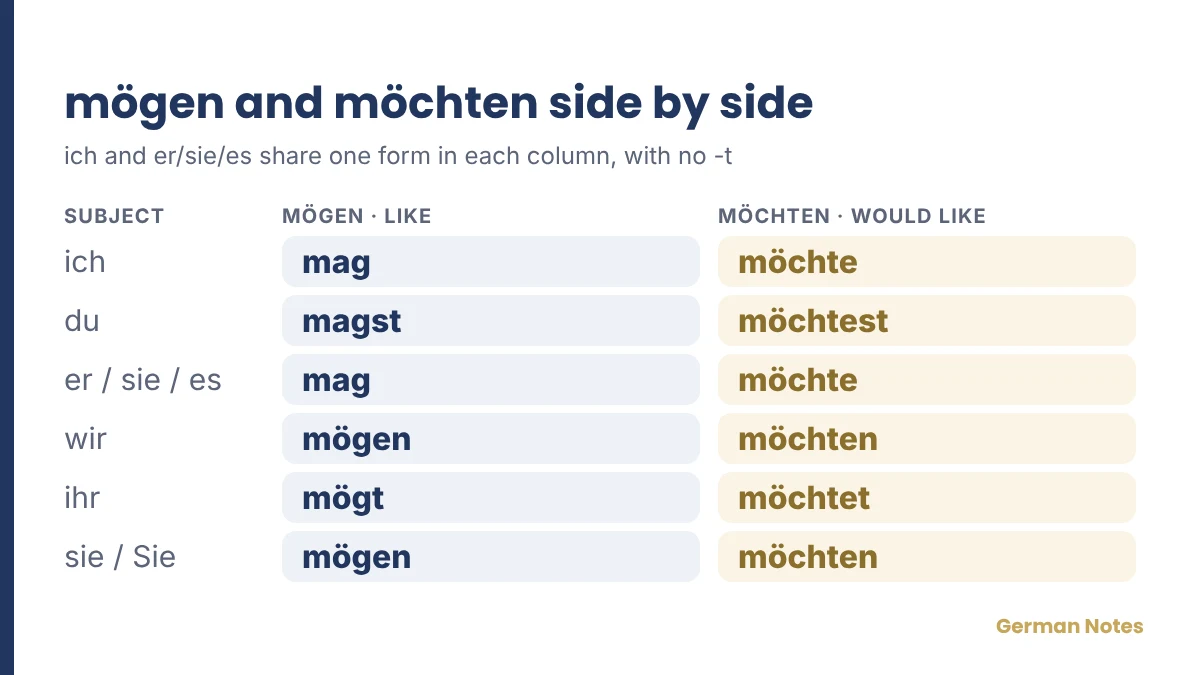
Ich and er/sie/es share the same form in each column. Say Er mag Tee (He likes tea) and Er möchte einen Tee (He would like a tea). Neither singular form takes a -t.
With du, the endings are magst and möchtest. With ihr, they're mögt and möchtet. The extra e in möchtet just makes it easier to say after cht.
Grammar books traditionally call möchte the Konjunktiv II of mögen. In everyday German, though, you'll mostly meet it as the normal way to say would like, so some courses teach möchte as a modal verb of its own. For your own sentences, remember what it means and use the forms in the right-hand column.
हिंदी में समझें
ich mag, er mag (बिना -t), du magst। ich möchte, er möchte, du möchtest। ihr के साथ mögt और möchtet। möchte असल में mögen से बनता है, पर रोज़मर्रा में इसे "would like" के लिए अलग से सीखा जाता है।
When do you use mögen?
Use mögen to say that you like a person, a thing or a kind of food. Whatever you like is usually an accusative object.
- Ich mag diesen Film. = I like this film.
- Wir mögen unsere Nachbarn. = We like our neighbours.
- Magst du Schokolade? = Do you like chocolate?
- Ich mag dich. = I like you.
In Ich mag diesen Film, the masculine noun Film takes diesen in the accusative. In Ich mag dich, dich is the accusative of du. Learn the whole phrase, and the case will start to feel familiar along with the verb.
For activities you enjoy, a verb plus gern often sounds more natural: Ich lese gern. = I like reading. Ich koche gern. = I like cooking. You don't need mögen in every English sentence with like.
Mögen has a few other uses as well, for example to say that someone is willing to do something or that something may be true, so like isn't its only translation. For an A1 preference, though, such as liking coffee or a film, mag is the form you need.
हिंदी में समझें
mögen से बताते हैं कि कोई चीज़ या व्यक्ति पसंद है: Ich mag diesen Film = मुझे यह फ़िल्म पसंद है। Ich mag dich = मुझे तुम पसंद हो। कोई काम पसंद हो तो gern: Ich lese gern = मुझे पढ़ना पसंद है।
When do you use möchten?
Use the möchte forms for something you would like to have or do. A noun can follow directly, or you can add another verb in the infinitive.
- Ich möchte ein Wasser. = I would like a water.
- Wir möchten einen Tisch reservieren. = We would like to reserve a table.
- Sie möchte Deutsch lernen. = She would like to learn German.
In a normal statement, the möchte form comes second and the other verb goes to the end: Morgen möchte ich zu Hause bleiben. = Tomorrow I would like to stay at home. There's no zu before bleiben.
A noun still needs the right case. Compare Ich möchte einen Kaffee with Ich möchte eine Suppe: I would like a coffee and I would like a soup. The masculine article changes to einen, and the feminine one stays eine.
Ich will einen Kaffee means I want a coffee and can sound quite direct as an order. Ich möchte einen Kaffee, bitte is the safer, polite choice when someone is serving you. Tone and situation matter too, and wollen isn't automatically rude. The wollen conjugation guide compares the two in more detail.
हिंदी में समझें
möchte के बाद सीधे चीज़ या आख़िर में दूसरा verb: Ich möchte ein Wasser = मुझे एक पानी चाहिए। Wir möchten einen Tisch reservieren = हम एक टेबल बुक करना चाहते हैं। Ich will einen Kaffee थोड़ा सीधा लगता है, Ich möchte einen Kaffee, bitte विनम्र है।
Möchtest du or möchten Sie?
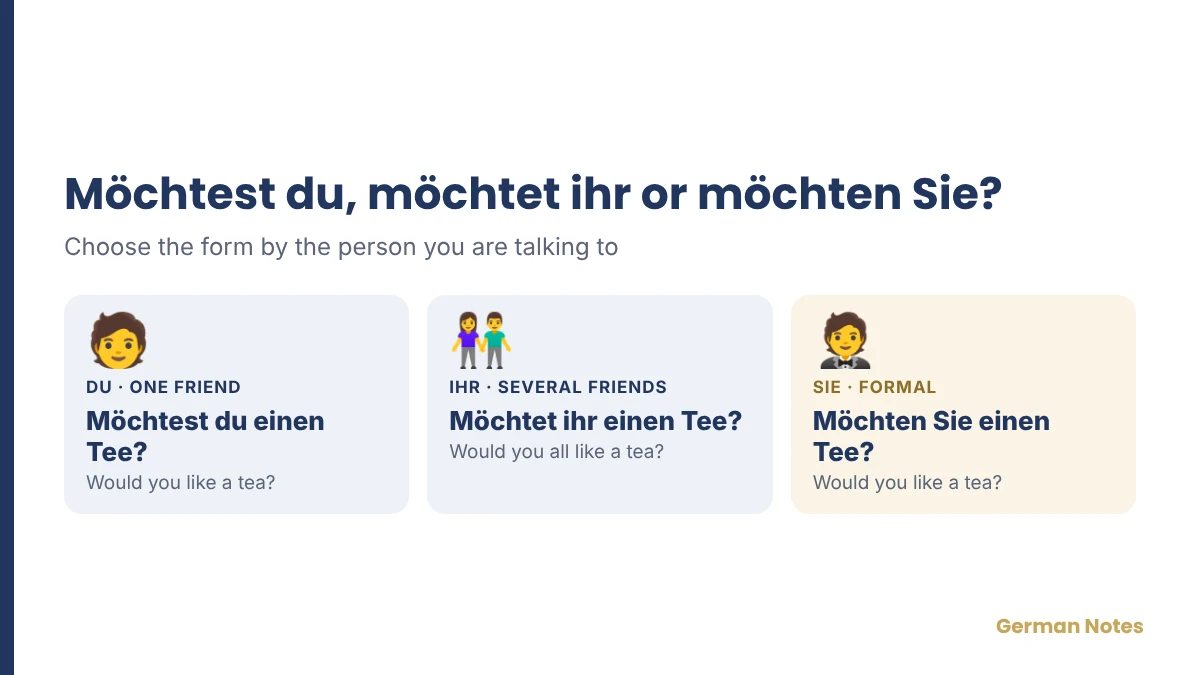
Möchtest goes with du, one person you know well. To ask a friend whether they'd like tea, say Möchtest du einen Tee? = Would you like a tea?
In formal situations, use Möchten Sie einen Tee? The verb is möchten whether you're talking to one person or several, and Sie keeps its capital S.
When you speak informally to a group, say Möchtet ihr einen Tee? = Would you all like a tea? The form depends on who you're talking to, not on how many cups you mention.
With a question word, that word comes first: Was möchtest du trinken? = What would you like to drink? The infinitive trinken stays at the end.
Choose the form by the person you're speaking to: du, ihr or Sie.
हिंदी में समझें
एक दोस्त से: Möchtest du einen Tee? कई दोस्तों से: Möchtet ihr einen Tee? आदर से (एक या कई लोग): Möchten Sie einen Tee? = क्या आप चाय लेंगे? form इस पर निर्भर है कि आप किससे बात कर रहे हैं।
How do you make requests in restaurants and offices?
These are complete sentences you can adapt. Adding bitte makes the request clear without changing the verb.
| Situation | German | English |
|---|---|---|
| Ordering food | Ich möchte die Suppe, bitte. | I would like the soup, please. |
| Asking to pay | Wir möchten bitte bezahlen. | We would like to pay, please. |
| Booking an appointment | Ich möchte einen Termin vereinbaren. | I would like to arrange an appointment. |
| Speaking to a colleague | Ich möchte kurz mit Ihnen sprechen. | I would like to speak with you briefly. |
| Offering a seat | Möchten Sie sich setzen? | Would you like to sit down? |
An offer with Möchten Sie asks what the other person wants. A request like Könnten Sie mir bitte helfen? asks them to do something for you: Could you please help me? For more on that second pattern, see the polite requests lesson and the können conjugation guide.
To turn down an offer, say Nein, danke, ich möchte nichts trinken. = No, thank you, I don't want anything to drink. That's about what you want right now. Ich mag keinen Kaffee (I don't like coffee) is about your taste in general.
हिंदी में समझें
रेस्टोरेंट में: Ich möchte die Suppe, bitte = मुझे सूप चाहिए, प्लीज़। बिल के लिए: Wir möchten bitte bezahlen। ऑफ़िस में: Ich möchte einen Termin vereinbaren = मैं अपॉइंटमेंट लेना चाहता हूँ। मना करना हो: Nein, danke, ich möchte nichts trinken।
Mochte, möchte and the past
The dots matter. Mochte without an umlaut is the simple past of mögen; in a sentence about what you like, it means liked. Möchte with an umlaut means would like.
| Meaning | German | English |
|---|---|---|
| Liking, now | Ich mag den Film. | I like the film. |
| Liking, simple past | Ich mochte den Film. | I liked the film. |
| Liking, Perfekt | Ich habe den Film gemocht. | I liked the film. / I have liked the film. |
| A wish, now | Ich möchte den Film sehen. | I would like to see the film. |
| A plan, in the past | Ich wollte den Film sehen. | I wanted to see the film. |
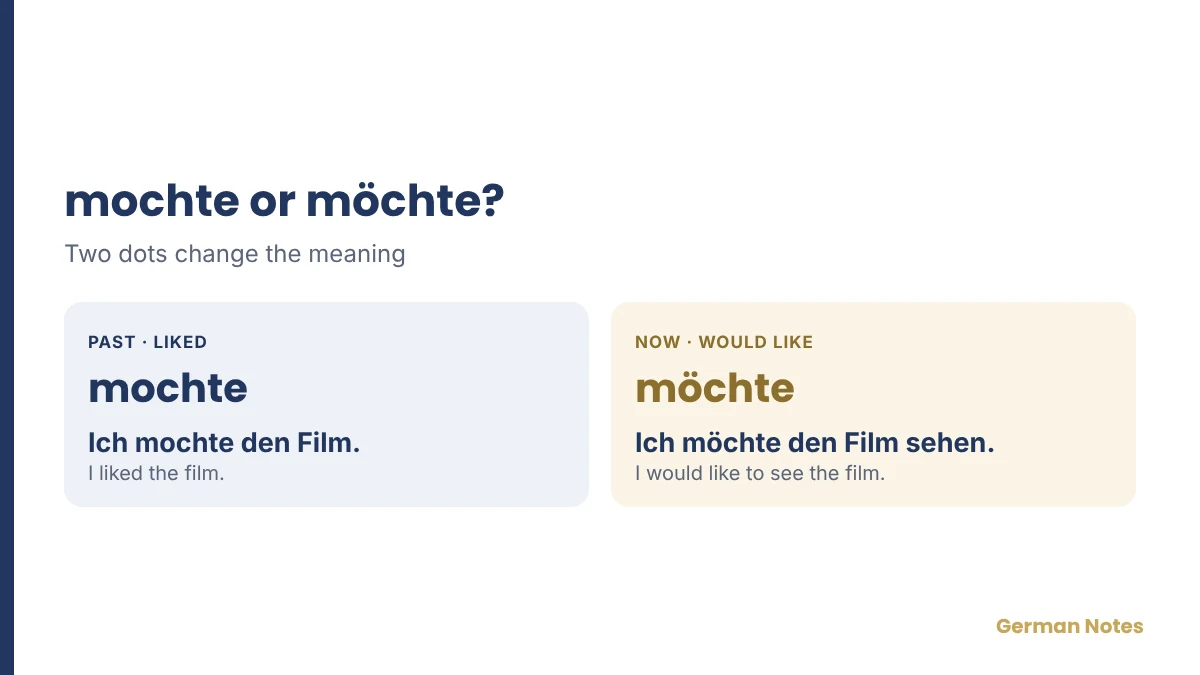
The simple past of mögen is ich mochte, du mochtest, er/sie/es mochte, wir mochten, ihr mochtet and sie/Sie mochten. For liked, the Perfekt uses haben and gemocht: Du hast den Film gemocht. = You liked the film.
Don't invent ich möchtete or ich habe gemöchtet. To talk about a wish or plan you had earlier, wollte is usually the practical choice: Gestern wollte ich einen Termin vereinbaren. = Yesterday I wanted to arrange an appointment. It gives the past meaning, though not the polite tone of möchte.
हिंदी में समझें
mochte (बिना बिंदु) = पसंद था: Ich mochte den Film = मुझे फ़िल्म पसंद आई थी। möchte (दो बिंदु) = चाहिए / चाहता हूँ। बीते समय में "चाहता था" के लिए wollte: Gestern wollte ich einen Termin vereinbaren। möchtete जैसा कोई शब्द नहीं है।
What are the common mistakes?
| Learner error | Correction and reason |
|---|---|
| Du möchte einen Tee. | Du möchtest einen Tee. = You would like a tea. The du form ends in -est. |
| Er magt Kaffee. | Er mag Kaffee. = He likes coffee. er/sie/es has no -t. |
| Ich möchte zu bezahlen. | Ich möchte bezahlen. = I would like to pay. No zu before the infinitive. |
| Ich mochte einen Kaffee. (as an order now) | Ich möchte einen Kaffee. = I would like a coffee. Without the dots it's the past. |
| Gestern möchtete ich gehen. | Gestern wollte ich gehen. = Yesterday I wanted to go. Möchtete doesn't exist. |
If you can't type ö, write oe: moechte, moechtest, moegen. Just leaving out the dots gives you different words, including the real past form mochte.
हिंदी में समझें
आम ग़लतियाँ: du möchte नहीं, du möchtest। er magt नहीं, er mag। möchte के बाद zu नहीं। ऑर्डर में mochte नहीं, möchte (दो बिंदु ज़रूरी हैं)। keyboard पर ö न हो तो oe लिखें।
Practice: mögen or möchten?
Choose the form that matches the meaning.
- Ich ___ Kaffee. = I like coffee.
- Du ___ einen Tee. = You would like a tea.
- Er ___ diesen Film. = He likes this film.
- ___ Sie bitte Platz nehmen? = Would you like to take a seat?
- Ihr ___ bezahlen. = You would like to pay.
- Früher ___ ich diesen Film. = I used to like this film.
- Ich habe den Film ___. = I liked the film. (Perfekt.)
- Was ___ du essen? = What would you like to eat?
Answers
- mag
- möchtest
- mag
- Möchten
- möchtet
- mochte
- gemocht
- möchtest
Now change sentence 8 from du to the formal Sie. For requests that ask someone to help or repeat something, try the polite requests exercises.
Frequently asked questions
What is the difference between mögen and möchten?
Mögen usually expresses liking: Ich mag Tee means I like tea. Möchten expresses a polite wish: Ich möchte einen Tee means I would like a tea. The möchte forms come from the Konjunktiv II of mögen.
What does möchtest mean?
Möchtest is the form for du, one person you address informally. Du möchtest means you would like. As a question, Möchtest du einen Kaffee? means Would you like a coffee?
How do I say I would like in German?
Use Ich möchte, followed by a noun or another verb in the infinitive. Ich möchte einen Tee means I would like a tea. Ich möchte bezahlen means I would like to pay.
Is mochte the same as möchte?
No. Mochte without an umlaut is the simple past of mögen and often means liked. Möchte with an umlaut means would like. Compare Ich mochte den Film (I liked the film) with Ich möchte den Film sehen (I would like to see the film).
Is möchten a separate verb from mögen?
Traditionally, the möchte forms are the Konjunktiv II of mögen. They are often taught as möchten because their everyday meaning is would like. Don't build a separate past tense such as möchtete from that label.
How do I say I wanted in the past instead of möchte?
Use wollte: Gestern wollte ich einen Termin vereinbaren means Yesterday I wanted to arrange an appointment. Forms like möchtete or gemöchtet don't exist.
Related lessons and practice
Write one sentence about a food you like and one that orders it politely. Then ask the same question to a friend and to someone you address with Sie. If you'd like to practise with a teacher, check GermanNotes demo availability.
For reference: Duden's mögen conjugation table, GfdS on möchten and mögen and IDS grammis on modal verbs.