Quick answer
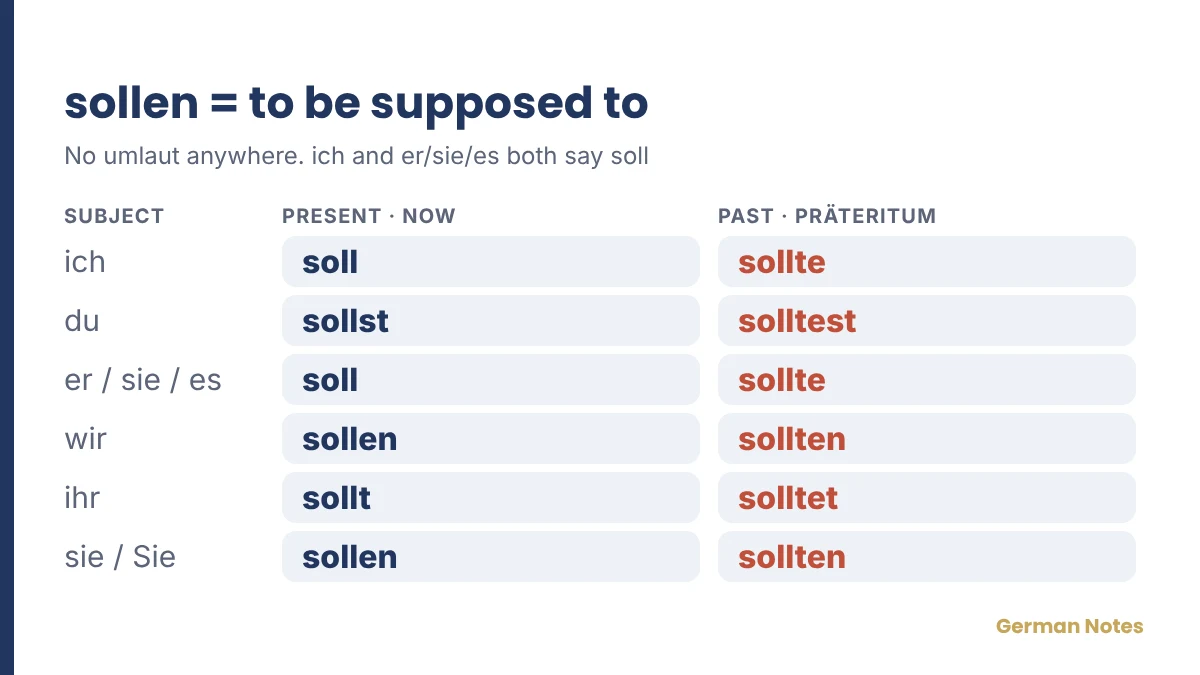
Sollen usually means to be supposed to. You use it to pass on an instruction or an expectation. In the present you say ich soll, du sollst, er/sie/es soll, wir sollen, ihr sollt and sie/Sie sollen. Sollte can mean that something was expected in the past, or it can give advice now. With another verb, the Perfekt uses haben plus two infinitives: Ich habe warten sollen. = I was supposed to wait.
हिंदी में समझें
sollen का मतलब है करना है (किसी के कहने पर) / चाहिए: Ich soll warten = मुझे इंतज़ार करना है (किसी ने कहा है)। सलाह के लिए sollte: Du solltest eine Pause machen = तुम्हें आराम करना चाहिए। sollen में कहीं Umlaut नहीं होता।
Contents
- Sollen conjugation chart at a glance
- Sollen conjugation in the present tense
- Where does the other verb go, and how do you ask questions?
- Soll or sollte for should?
- What is the simple past of sollen?
- How do you form the Perfekt of sollen?
- Sollen, müssen or dürfen?
- What are the common mistakes with sollen?
- Practice: fill in the form of sollen
- Frequently asked questions
Sollen conjugation chart at a glance
Here are the present, the simple past and the advice forms in one table. The past and the advice forms look the same, so the context decides what they mean.
| Subject | Present | Präteritum | Advice (Konjunktiv II) |
|---|---|---|---|
| ich | soll | sollte | sollte |
| du | sollst | solltest | solltest |
| er / sie / es | soll | sollte | sollte |
| wir | sollen | sollten | sollten |
| ihr | sollt | solltet | solltet |
| sie / Sie | sollen | sollten | sollten |
Sollen conjugation in the present tense
The stem stays soll- all the way through, with no umlaut. Ich and er/sie/es share soll, with no extra ending. Du adds -st, and ihr adds -t.
| Subject | Form | Example |
|---|---|---|
| ich | soll | Ich soll warten. = I am supposed to wait. |
| du | sollst | Du sollst anrufen. = You are supposed to call. |
| er / sie / es | soll | Er soll helfen. = He is supposed to help. |
| wir | sollen | Wir sollen zuhören. = We are supposed to listen. |
| ihr | sollt | Ihr sollt anfangen. = You are supposed to start. |
| sie / Sie | sollen | Sie sollen bleiben. = They are supposed to stay. / You are supposed to stay. |
Sollt goes with ihr, not with er. Compare Ihr sollt die Tür schließen (You all are supposed to close the door) with Er soll die Tür schließen (He is supposed to close the door). The singular form has no -t.
When you pass on a message, sollen shows what someone else wants done. Die Lehrerin sagt, wir sollen die Aufgabe wiederholen means The teacher says we are supposed to repeat the exercise. The instruction comes from the teacher. A direct command sounds like this: Wiederholt die Aufgabe! = Repeat the exercise!
Sollen can also pass on what people say: Das Restaurant soll gut sein. = The restaurant is said to be good. Here you're repeating a claim about the restaurant. Nobody is telling the restaurant what to do, and the forms stay the same.
हिंदी में समझें
sollen से हम किसी और का कहा हुआ आगे बताते हैं: Die Lehrerin sagt, wir sollen die Aufgabe wiederholen = टीचर कहती हैं कि हमें exercise दोहरानी है। Das Restaurant soll gut sein = सुना है कि रेस्टोरेंट अच्छा है। er soll (बिना -t), ihr sollt।
Where does the other verb go, and how do you ask questions?
In a normal statement, the form of sollen comes second. The action verb stays in the infinitive at the end, without zu.
- Ich soll die Unterlagen mitbringen. = I am supposed to bring the documents.
- Wir sollen morgen früher kommen. = We are supposed to come earlier tomorrow.
Morgen sollen wir früher kommen means the same. The time phrase takes the first place, so wir comes after sollen. Second place means the second part of the sentence, not always the second word.
For a yes-or-no question, put sollen first: Soll ich die Tür schließen? = Shall I close the door? You can use this to offer to do something, or to ask what the other person wants from you. With a question word: Wann soll ich kommen? = When should I come?
Soll ich ...? usually asks for instructions. Sollte ich ...? asks for advice or an opinion: Sollte ich früher kommen? = Should I come earlier? Both can be about the future, so sollte doesn't automatically make a question past tense.
हिंदी में समझें
sollen दूसरे स्थान पर, असली verb आख़िर में, बिना zu: Ich soll die Unterlagen mitbringen। सवाल: Soll ich die Tür schließen? = क्या मैं दरवाज़ा बंद कर दूँ? Sollte ich früher kommen? = क्या मुझे जल्दी आना चाहिए? (सलाह माँगना)
For examples with other modal verbs, see the A1 lesson on müssen, dürfen and sollen.
Soll or sollte for should?
For ordinary advice, sollte is usually the form you want: Du solltest eine Pause machen. = You should take a break. This is the Konjunktiv II. It recommends something, while soll passes on an instruction.
| German | English | Typical use |
|---|---|---|
| Du sollst die Datei speichern. | You are supposed to save the file. | An instruction or expectation |
| Du solltest die Datei speichern. | You should save the file. | Advice |
| Wir sollten jetzt gehen. | We should leave now. | A suggestion |
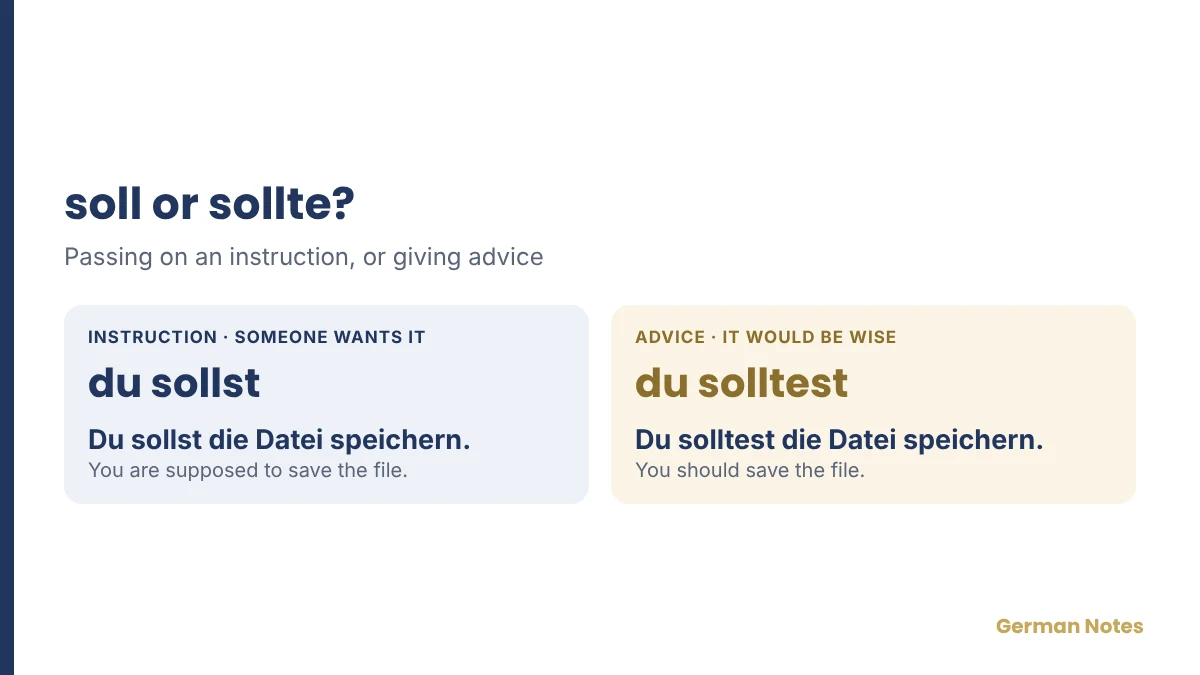
The advice forms are ich sollte, du solltest, er/sie/es sollte, wir sollten, ihr solltet and sie/Sie sollten. Sollten is just one form in the set. For you should with du, use solltest, not sollten.
A translation app may give you should for both soll and sollte, so look at the situation first. If you're repeating your manager's instruction, Ich soll die Datei schicken means I am supposed to send the file. If you think sending it would be a good idea, Ich sollte die Datei schicken means I should send the file.
Time words and the context tell you what sollte means: an expectation in the past, or advice for now.
हिंदी में समझें
soll = किसी ने कहा है: Ich soll die Datei schicken = मुझे फ़ाइल भेजनी है (बॉस ने कहा)। sollte = सलाह: Ich sollte die Datei schicken = मुझे फ़ाइल भेज देनी चाहिए। du के साथ solltest, sollten नहीं।
What is the simple past of sollen?
The simple-past forms look exactly like the advice forms, so the context tells you which one is meant. In a story about the past, Ich sollte um acht da sein can mean I was supposed to be there at eight.
| Subject | Präteritum | Example |
|---|---|---|
| ich | sollte | Ich sollte warten. = I was supposed to wait. |
| du | solltest | Du solltest anrufen. = You were supposed to call. |
| er / sie / es | sollte | Sie sollte helfen. = She was supposed to help. |
| wir | sollten | Wir sollten kommen. = We were supposed to come. |
| ihr | solltet | Ihr solltet bleiben. = You were supposed to stay. |
| sie / Sie | sollten | Sie sollten zuhören. = They were supposed to listen. / You were supposed to listen. |
Make the time clear when you practise: Gestern sollte ich das Paket abholen. = Yesterday I was supposed to collect the parcel. That tells you about the plan, not whether it happened. You can add what happened: Aber die Filiale war geschlossen. = But the branch was closed.
For advice now, the same form appears in a different context: Ich sollte jetzt das Paket abholen. = I should collect the parcel now.
Don't add an umlaut to make the advice form. Söllte doesn't exist. Standard German uses sollte for both the past and the advice.
हिंदी में समझें
sollte दो काम करता है। बीते समय में: Gestern sollte ich das Paket abholen = कल मुझे पार्सल लेना था। सलाह में: Ich sollte jetzt das Paket abholen = मुझे अभी पार्सल ले लेना चाहिए। समय के शब्द (gestern, jetzt) से मतलब पता चलता है।
How do you form the Perfekt of sollen?
With another infinitive, the Perfekt uses a form of haben, then the main verb's infinitive and sollen at the end. Ich habe warten sollen means I was supposed to wait. The final sollen is a replacement infinitive, called Ersatzinfinitiv in German grammar.
| Subject | Perfekt |
|---|---|
| ich | Ich habe warten sollen. |
| du | Du hast warten sollen. |
| er / sie / es | Er hat warten sollen. |
| wir | Wir haben warten sollen. |
| ihr | Ihr habt warten sollen. |
| sie / Sie | Sie haben warten sollen. |
Each sentence means ... was supposed to wait or ... were supposed to wait, with the subject that matches the German pronoun. Haben changes, and warten sollen stays the same.
Dictionaries also list the participle gesollt. With another infinitive, though, the standard form is sollen: Ich habe warten sollen, not Ich habe warten gesollt. For a past instruction, the shorter Ich sollte warten works well too.
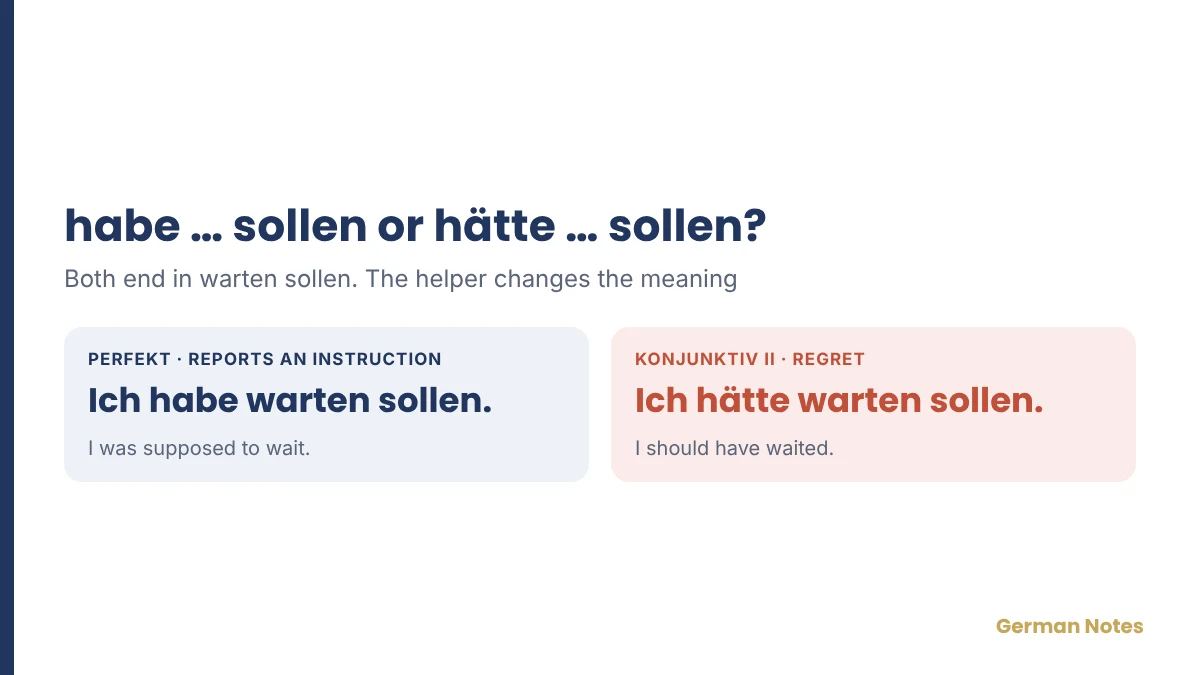
Keep this apart from Ich hätte warten sollen, which means I should have waited. Hätte is the Konjunktiv II of haben, and the sentence looks back on a choice you regret. Both sentences end with warten sollen, but habe and hätte change the meaning.
हिंदी में समझें
Ich habe warten sollen = मुझे इंतज़ार करना था (किसी ने कहा था)। Ich hätte warten sollen = मुझे इंतज़ार करना चाहिए था (पछतावा)। दोनों के आख़िर में warten sollen है, फ़र्क़ सिर्फ़ habe और hätte का है।
Sollen, müssen or dürfen?
Müssen is about necessity: Ich muss gehen. = I have to go. Sollen usually passes on an instruction or expectation: Ich soll gehen. = I am supposed to go. In real life both can describe the same situation; the difference is in what the speaker wants to stress. So don't treat it as a strict rule that müssen never comes from someone else's instruction.
With nicht, the difference becomes clear:
| German | English |
|---|---|
| Du sollst hier nicht parken. | You are not supposed to park here. |
| Du darfst hier nicht parken. | You are not allowed to park here. |
| Du musst hier nicht parken. | You don't have to park here. |
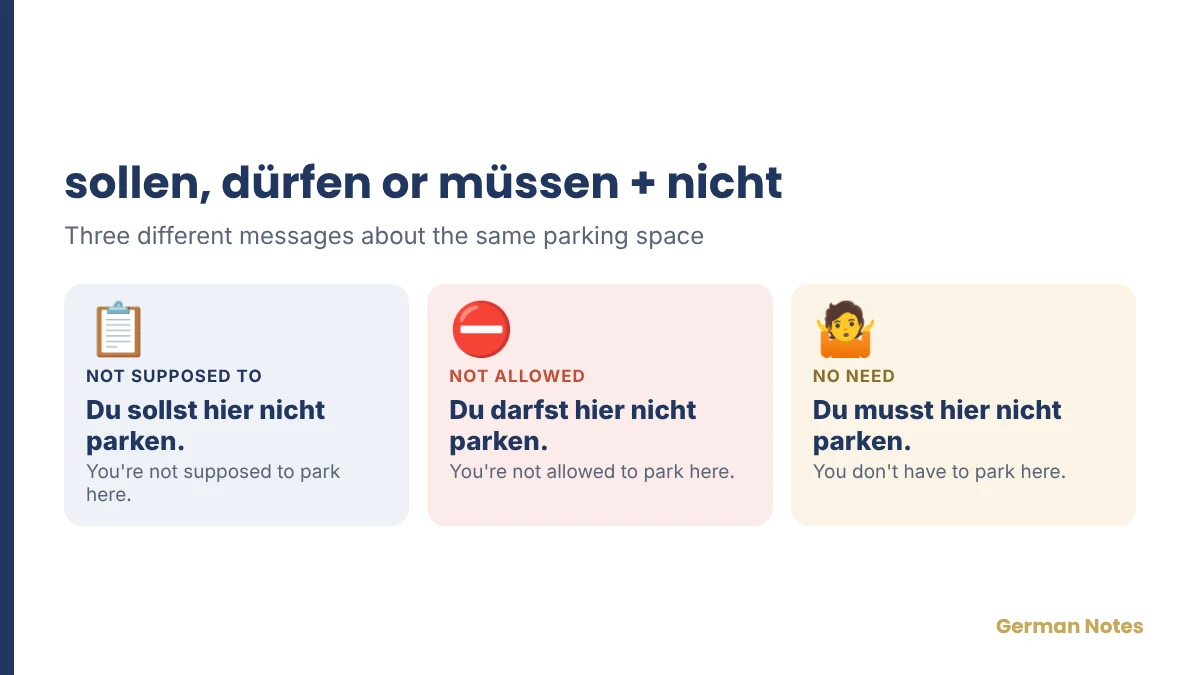
For gentle advice, say Du solltest hier nicht parken (You shouldn't park here), maybe with a reason, such as the space being needed for a delivery. Pick the form by asking yourself whether you're describing a rule, passing on an instruction or recommending something. The müssen conjugation guide explains nicht müssen in more detail.
हिंदी में समझें
Du sollst hier nicht parken = तुम्हें यहाँ पार्क नहीं करना है (किसी ने कहा है)। Du darfst hier nicht parken = यहाँ पार्क करना मना है। Du musst hier nicht parken = यहाँ पार्क करने की ज़रूरत नहीं है। सलाह: Du solltest hier nicht parken = यहाँ पार्क नहीं करना चाहिए।
What are the common mistakes with sollen?
| Learner error | Correction and reason |
|---|---|
| Er sollt kommen. | Er soll kommen. = He is supposed to come. Sollt belongs to ihr. |
| Ich soll zu warten. | Ich soll warten. = I am supposed to wait. No zu after sollen. |
| Du sollten gehen. | Du solltest gehen. = You should go. Match the ending to du. |
| Ich habe warten gesollt. | Ich habe warten sollen. = I was supposed to wait. With another infinitive, use sollen. |
| Ich habe früher anrufen sollen. (meaning regret) | Ich hätte früher anrufen sollen. = I should have called earlier. Regret needs hätte. |
One more trap: not every sollte is about the past. Du solltest jetzt lernen means You should study now. Read the time words and the context.
हिंदी में समझें
आम ग़लतियाँ: er sollt नहीं, er soll। sollen के बाद zu नहीं। du sollten नहीं, du solltest। Perfekt में gesollt नहीं, sollen। पछतावे के लिए habe नहीं, hätte: Ich hätte früher anrufen sollen।
Practice: fill in the form of sollen
Choose the form that fits the subject and the meaning.
- Ich ___ die Unterlagen mitbringen. = I am supposed to bring the documents.
- Ihr ___ jetzt anfangen. = You are supposed to start now.
- Du ___ eine Pause machen. = You should take a break. (Advice.)
- Gestern ___ wir warten. = Yesterday we were supposed to wait. (Simple past.)
- Ich habe anrufen ___. = I was supposed to call. (Perfekt.)
- Ich ___ früher anrufen sollen. = I should have called earlier.
Answers
- soll
- sollt
- solltest
- sollten
- sollen
- hätte
Now write a message that starts with Ich soll ... to pass on an instruction. Then give a friend some advice with Du solltest ....
Frequently asked questions
How do you conjugate sollen in the present tense?
ich soll, du sollst, er/sie/es soll, wir sollen, ihr sollt and sie/Sie sollen. The vowel stays o throughout, and ich and er/sie/es share the form soll.
Does sollten mean should?
Wir sollten can mean we should, as in Wir sollten gehen = We should leave. In a past context it can also mean we were supposed to. The form alone doesn't tell you which meaning is meant.
What is the difference between soll and sollte?
Soll is the present and usually passes on an instruction or expectation. Sollte can be the simple past or Konjunktiv II. Compare Ich soll warten (I am supposed to wait) with Ich sollte warten, which can mean I was supposed to wait or I should wait.
What is the Perfekt of sollen with another verb?
Use haben plus the main infinitive and sollen: Ich habe warten sollen means I was supposed to wait. The final sollen replaces the participle when there is another infinitive.
How do I say I should have called?
Say Ich hätte anrufen sollen. Hätte is a Konjunktiv II form of haben, and anrufen sollen stays at the end. Compare Ich habe anrufen sollen, which means I was supposed to call.
Does sollen take zu?
No. The other verb follows sollen as a bare infinitive at the end: Ich soll warten, not Ich soll zu warten.
Related lessons and practice
If you'd like to practise these differences out loud, check GermanNotes demo availability.
For reference: Duden's sollen conjugation table and IDS grammis on sollen and the replacement infinitive.