Quick answer
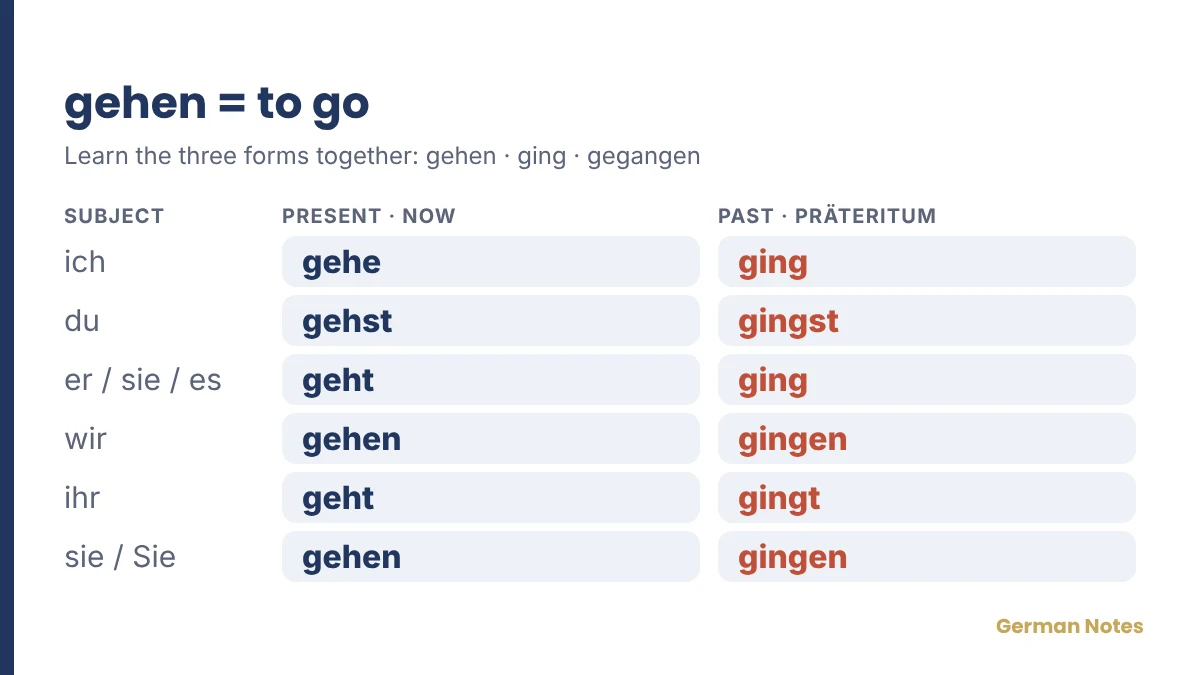
Gehen means to go, and it often describes walking or leaving. In the present you say ich gehe, du gehst, er/sie/es geht, wir gehen, ihr geht and sie/Sie gehen. The simple past uses ging. The Perfekt uses sein plus gegangen: Ich bin gegangen means I went or I have gone.
हिंदी में समझें
gehen का मतलब है जाना / पैदल जाना: Ich gehe nach Hause = मैं घर जा रहा हूँ। बीते समय में ging (गया) और bin gegangen (गया / जा चुका)। तीनों रूप साथ याद करें: gehen, ging, gegangen। Perfekt में हमेशा sein: Ich bin gegangen।
Contents
- Gehen conjugation chart at a glance
- Gehen conjugation in the present tense
- How do you ask questions with gehen?
- What is the simple past of gehen?
- How do you form the Perfekt of gehen?
- Gehen or fahren?
- Useful phrases with gehen
- What are the common mistakes with gehen?
- Practice: fill in the form of gehen
- Frequently asked questions
Gehen conjugation chart at a glance
Here are all three tenses in one table. Use it for a quick check, and read on for examples.
| Subject | Present | Präteritum | Perfekt |
|---|---|---|---|
| ich | gehe | ging | bin gegangen |
| du | gehst | gingst | bist gegangen |
| er / sie / es | geht | ging | ist gegangen |
| wir | gehen | gingen | sind gegangen |
| ihr | geht | gingt | seid gegangen |
| sie / Sie | gehen | gingen | sind gegangen |
Gehen conjugation in the present tense
The present uses the usual endings -e, -st, -t, -en, -t, -en, and the stem geh- never changes. The present looks regular, but the past forms ging and gegangen make gehen an irregular verb.
| Subject | Form | Example |
|---|---|---|
| ich | gehe | Ich gehe nach Hause. = I am going home. |
| du | gehst | Du gehst zur Arbeit. = You go to work. |
| er / sie / es | geht | Sie geht zum Bahnhof. = She is going to the station. |
| wir | gehen | Wir gehen in den Park. = We are going to the park. |
| ihr | geht | Ihr geht zu Fuß. = You are walking. |
| sie / Sie | gehen | Sie gehen ins Kino. = They are going to the cinema. / You are going to the cinema. |
Er and ihr both take geht, but they're different people. Er geht means he goes, and ihr geht means you go to several friends. Check the subject before you translate a short sentence.
German uses one present form for both I go and I am going. Ich gehe jeden Morgen spazieren means I go for a walk every morning. Ich gehe jetzt nach Hause means I am going home now. The time word makes the difference, so don't add bin before gehe.
In casual speech you'll hear Ich geh jetzt, without the final -e. For your notes and charts, learn the full form ich gehe. For the endings of other verbs, see the A1 verb conjugation lesson.
हिंदी में समझें
gehen के present के रूप सामान्य endings से बनते हैं: ich gehe, du gehst, er geht। Ich gehe nach Hause का मतलब "मैं घर जाता हूँ" भी है और "मैं घर जा रहा हूँ" भी। English की तरह Ich bin gehe मत बोलिए।
How do you ask questions with gehen?
In a normal statement, the verb comes second: Ich gehe heute früher nach Hause. = I am going home earlier today. You can also start with heute: Heute gehe ich früher nach Hause. When the time word comes first, the subject follows gehe.
A yes-or-no question starts with the verb: Gehst du heute zum Kurs? = Are you going to the course today? German doesn't need a word for the English do.
With a question word, that word goes first: Wohin gehst du? = Where are you going? Wann geht ihr nach Hause? = When are you going home? Wohin asks about where someone is heading, and wo asks where someone is. Keep the two apart.
After a modal verb, gehen stays in the infinitive at the end: Ich muss jetzt gehen. = I have to go now. Wir wollen ins Kino gehen. = We want to go to the cinema. Change the modal verb, not both verbs.
हिंदी में समझें
सवाल में verb पहले: Gehst du heute zum Kurs? = क्या तुम आज क्लास जा रहे हो? Wohin gehst du? = तुम कहाँ जा रहे हो? (wohin = किधर, wo = कहाँ है)। modal के बाद gehen आख़िर में: Ich muss jetzt gehen = मुझे अब जाना है।
What is the simple past of gehen?
The simple past, the Präteritum, changes the stem to ging-. You can't make it by adding -te to geh-.
| Subject | Präteritum | Example |
|---|---|---|
| ich | ging | Ich ging nach Hause. = I went home. |
| du | gingst | Du gingst zur Tür. = You went to the door. |
| er / sie / es | ging | Er ging zum Fenster. = He went to the window. |
| wir | gingen | Wir gingen in den Garten. = We went into the garden. |
| ihr | gingt | Ihr gingt zu Fuß. = You went on foot. |
| sie / Sie | gingen | Sie gingen ins Haus. = They went into the house. / You went into the house. |
Ich and er/sie/es share ging, and wir and sie/Sie share gingen. The ihr form is gingt, even if it feels less familiar than the others.
You'll see ging a lot in stories and written texts: Er öffnete die Tür und ging hinaus. = He opened the door and went out. In conversation about finished events, the Perfekt is more common, but you'll hear the simple past too. It depends on the speaker and the situation.
हिंदी में समझें
ging = गया/गई: Ich ging nach Hause = मैं घर गया। gehte नहीं बनता। ich ging, er ging एक जैसे, wir gingen, sie gingen एक जैसे, और ihr gingt। कहानियों और किताबों में ging बहुत आता है।
How do you form the Perfekt of gehen?
Gehen forms its Perfekt with sein. Put sein in the form that matches the subject, then add gegangen at the end. Practise bin gegangen as a pair, so you remember the helper too.
| Subject | Perfekt | English |
|---|---|---|
| ich | Ich bin gegangen. | I went / have gone. |
| du | Du bist gegangen. | You went / have gone. |
| er / sie / es | Sie ist gegangen. | She went / has gone. |
| wir | Wir sind gegangen. | We went / have gone. |
| ihr | Ihr seid gegangen. | You went / have gone. |
| sie / Sie | Sie sind gegangen. | They went / have gone; you went / have gone. |
English chooses between went and have gone depending on the situation. The German Perfekt doesn't always match the English present perfect.
- Ich bin gestern früh nach Hause gegangen. = I went home early yesterday.
- Wir sind nach dem Essen spazieren gegangen. = We went for a walk after eating.
- Seid ihr schon zum Bahnhof gegangen? = Have you already gone to the station?
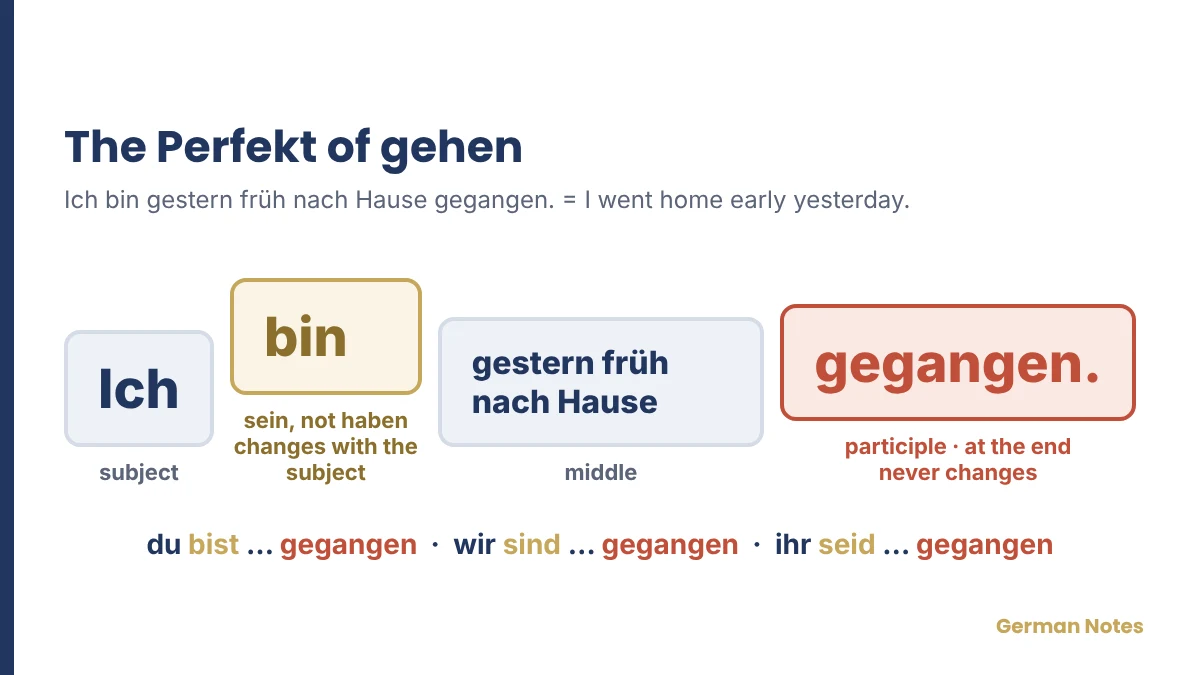
In the question, seid moves to the front while gegangen stays at the end. Don't write Ich habe gegangen: the helper for gehen is sein. And the participle is gegangen, never gegeht.
For something that happened even earlier, the same participle goes with the past of sein: Ich war schon gegangen. = I had already left. This is the Plusquamperfekt. You can spot it by war or another past form of sein instead of bin, bist or ist. The sein conjugation guide explains which verbs take sein in the Perfekt.
हिंदी में समझें
gehen का Perfekt sein से बनता है, haben से नहीं: Ich bin gegangen = मैं गया / जा चुका हूँ। bin, bist, ist subject के साथ बदलते हैं, gegangen आख़िर में रहता है। Ich habe gegangen और gegeht दोनों ग़लत हैं।
Gehen or fahren?
When it matters how you travel, gehen usually means going on foot and fahren means travelling by bus, train or car. Ich gehe zu Fuß zur Arbeit means I walk to work. Ich fahre mit dem Bus zur Arbeit means I go to work by bus.
| Situation | German | English |
|---|---|---|
| Walking | Ich gehe zum Bahnhof. | I am walking to the station. |
| Taking a train | Ich fahre mit dem Zug. | I am travelling by train. |
| Leaving | Ich gehe jetzt. | I am leaving now. |
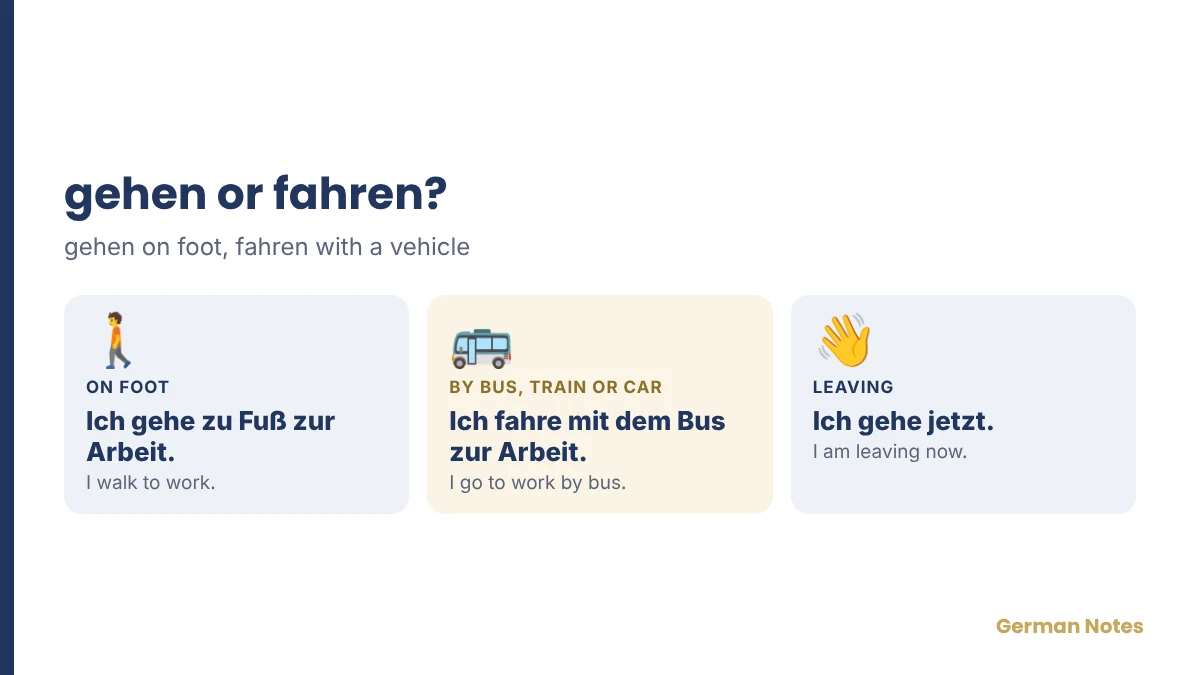
Gehen isn't only about footsteps, though. Ich gehe ins Kino can just mean you're going to the cinema, without saying how you get there. Ich gehe jetzt says you're leaving. When a sentence names a vehicle, pick the verb that fits: mit dem Bus fahren.
Add zu Fuß or the vehicle when you need to make it clear how you're travelling.
हिंदी में समझें
पैदल जाने के लिए gehen: Ich gehe zu Fuß zur Arbeit = मैं पैदल ऑफ़िस जाता हूँ। बस, ट्रेन या गाड़ी से fahren: Ich fahre mit dem Bus zur Arbeit = मैं बस से ऑफ़िस जाता हूँ। Ich gehe jetzt = मैं अब चलता हूँ।
Useful phrases with gehen
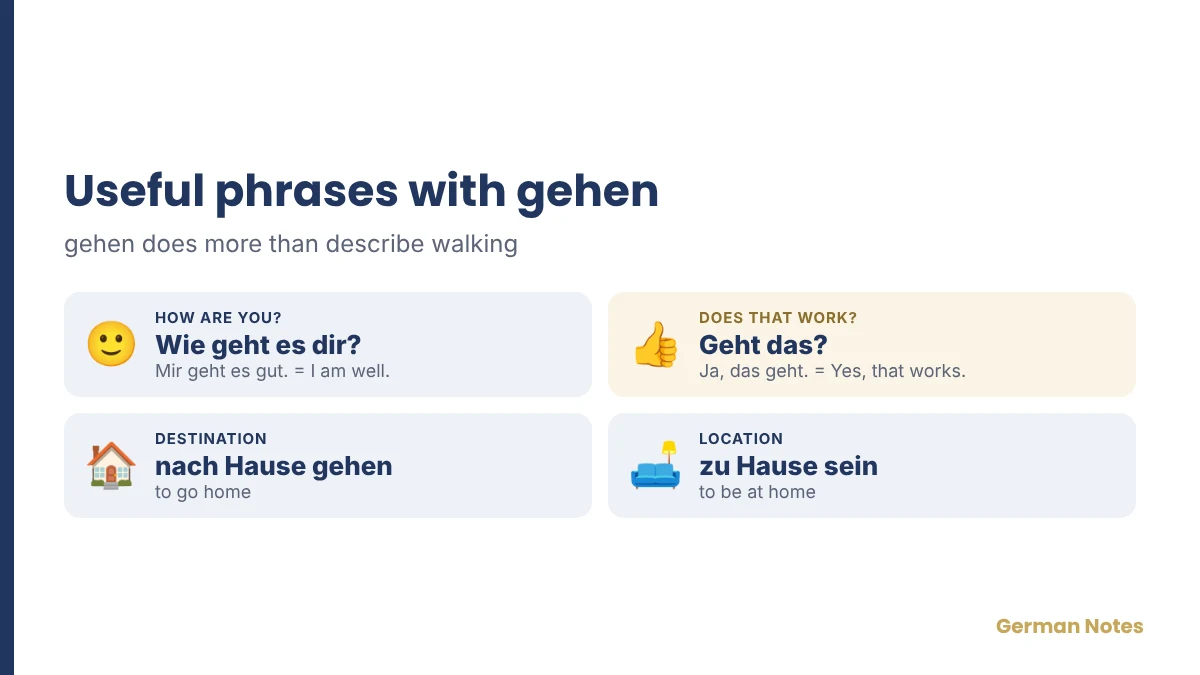
Wie geht es dir? means How are you? A common answer is Mir geht es gut, I am well. Dir and mir are dative pronouns, and geht goes with es. Don't change it to gehe just because the answer is about you.
Geht das? can mean Does that work? or Is that possible? If someone suggests a time for a meeting, Das geht means That works. In these phrases, gehen has nothing to do with moving.
Nach Hause gehen means to go home. Zu Hause is about being at home: Ich bin zu Hause. = I am at home. That one small word separates where you're going from where you are.
For instructions, say Geh bitte langsam! (Please walk slowly!) to one friend. To several friends, it's Geht bitte langsam!, and in formal speech Gehen Sie bitte langsam! You'll also see Gehe for the du form, but Geh is the one to practise.
हिंदी में समझें
Wie geht es dir? = तुम कैसे हो? जवाब: Mir geht es gut = मैं ठीक हूँ (यहाँ geht, gehe नहीं)। Geht das? = क्या यह चलेगा? nach Hause gehen = घर जाना, zu Hause sein = घर पर होना। आदेश: Geh bitte langsam!
What are the common mistakes with gehen?
| Learner error | Correction and reason |
|---|---|
| Ich bin gehe. | Ich gehe. = I am going. German doesn't use bin with a present-tense verb here. |
| Ich gehte. | Ich ging. = I went. The simple past is ging. |
| Ich habe gegangen. | Ich bin gegangen. = I went. gehen takes sein. |
| Ich bin gegeht. | Ich bin gegangen. = I went. The participle uses the stem gang-. |
| Mir gehe es gut. | Mir geht es gut. = I am well. es is the subject. |
| Ich muss gehe. | Ich muss gehen. = I have to go. After a modal, gehen stays in the infinitive. |
हिंदी में समझें
आम ग़लतियाँ: Ich bin gehe नहीं, Ich gehe। gehte नहीं, ging। habe gegangen नहीं, bin gegangen। gegeht नहीं, gegangen। Mir gehe es gut नहीं, Mir geht es gut।
Practice: fill in the form of gehen
Fill each gap with the form the subject and the tense need.
- Ich ___ heute zum Kurs. (Present.)
- Du ___ nach Hause. (Present.)
- Ihr ___ zu Fuß. (Present.)
- Gestern ___ wir in den Park. (Simple past.)
- Ich ___ früh nach Hause gegangen. (Perfekt helper.)
- Seid ihr schon ___? (Perfekt participle.)
- Wie ___ es dir? (Present.)
- Ich muss jetzt ___. (Infinitive after a modal.)
Answers
- gehe
- gehst
- geht
- gingen
- bin
- gegangen
- geht
- gehen
Now turn Ich gehe nach Hause into a question, Gehe ich nach Hause?, and then into the Perfekt, Ich bin nach Hause gegangen. Keep the helper and the participle together in your notes.
Frequently asked questions
Is gehen regular or irregular?
Gehen is irregular because its past forms are ging and gegangen. The present tense uses the usual endings: gehe, gehst, geht, gehen, geht and gehen. Learn the three main forms gehen, ging and gegangen together.
Does gehen use haben or sein in the Perfekt?
Sein: Ich bin gegangen means I went or I have gone. The helper changes with the subject, as in du bist gegangen and wir sind gegangen. The participle stays gegangen.
What is the difference between ging and gegangen?
Ging is a simple-past form used with ich and er/sie/es. Gegangen is the past participle and needs a helper to make a complete Perfekt sentence: Ich bin gegangen. Ich gegangen on its own is wrong.
Can gehen mean to leave?
Yes. Ich gehe jetzt often means I am leaving now. The meaning depends on the sentence. With a destination or zu Fuß, gehen describes going somewhere on foot.
Why is it mir geht es gut and not mir gehe es gut?
Es is the subject, so the verb takes the er/sie/es form geht. Mir shows whose condition you are talking about. Mir geht es gut means I am well.
What is the difference between gehen and fahren?
When the way you travel matters, gehen usually means going on foot and fahren means travelling by bus, train or car. Ich gehe zu Fuß zur Arbeit means I walk to work; Ich fahre mit dem Bus zur Arbeit means I go to work by bus.
Related lessons and practice
For conversation practice with feedback, check GermanNotes demo availability.
For reference: Duden's gehen conjugation table.