Quick answer
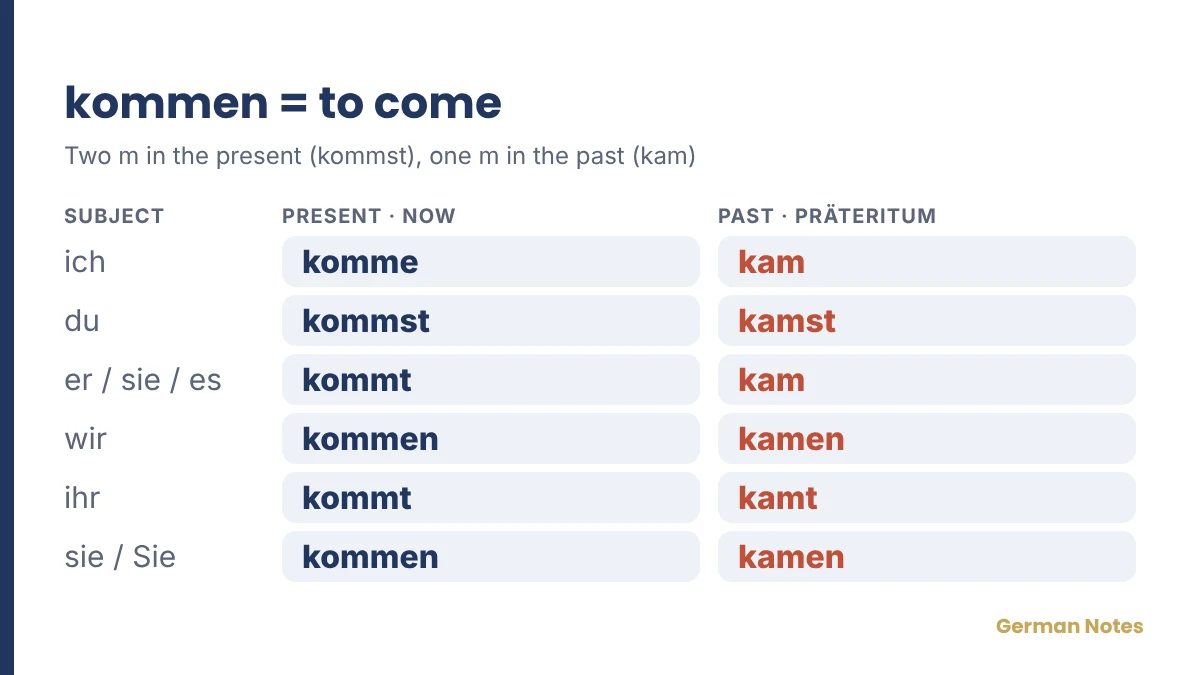
Kommen means to come. In the present you say ich komme, du kommst, er/sie/es kommt, wir kommen, ihr kommt and sie/Sie kommen. The simple past changes to kam. For the Perfekt, use sein with gekommen: Ich bin gekommen means I came or I have come.
हिंदी में समझें
kommen का मतलब है आना: Ich komme um acht = मैं आठ बजे आऊँगा/आ रहा हूँ। बीते समय में kam (आया) और bin gekommen (आया / आ चुका)। सबसे काम का सवाल: Woher kommst du? = तुम कहाँ से हो? जवाब: Ich komme aus Indien।
Contents
- Kommen conjugation chart at a glance
- Kommen conjugation in the present tense
- How do you ask where someone comes from?
- What is the simple past of kommen?
- How do you form the Perfekt of kommen?
- Where does kommen go in questions and statements?
- Kommen, gehen or ankommen?
- What are the common mistakes with kommen?
- Practice: fill in the form of kommen
- Frequently asked questions
Kommen conjugation chart at a glance
Here are all three tenses in one table. Use it for a quick check, and read on for examples.
| Subject | Present | Präteritum | Perfekt |
|---|---|---|---|
| ich | komme | kam | bin gekommen |
| du | kommst | kamst | bist gekommen |
| er / sie / es | kommt | kam | ist gekommen |
| wir | kommen | kamen | sind gekommen |
| ihr | kommt | kamt | seid gekommen |
| sie / Sie | kommen | kamen | sind gekommen |
Kommen conjugation in the present tense
Take -en off kommen and add the ending to komm-. Keep both ms: du kommst, not du komst. The vowel stays o all through the present, even though the past forms are irregular.
| Subject | Form | Example |
|---|---|---|
| ich | komme | Ich komme um acht. = I am coming at eight. |
| du | kommst | Du kommst heute. = You are coming today. |
| er / sie / es | kommt | Er kommt später. = He is coming later. |
| wir | kommen | Wir kommen zusammen. = We are coming together. |
| ihr | kommt | Ihr kommt morgen. = You are coming tomorrow. |
| sie / Sie | kommen | Sie kommen am Montag. = They are coming on Monday. / You are coming on Monday. |
The last row covers both sie (they) and formal Sie (you), and both take kommen. The ihr form is kommt, the same as for er, sie and es, so you need the subject to know who's coming.
Ich komme can mean I come or I am coming. German doesn't add bin to make a continuous form. Ich komme jeden Freitag means I come every Friday, and Ich komme gleich means I'm coming in a moment. The time word tells the listener whether you mean a habit or one particular visit.
The present can also describe a plan: Wir kommen morgen. = We are coming tomorrow. You don't need a future form just because the visit hasn't happened yet. For the pattern behind the endings, see the A1 verb conjugation lesson.
हिंदी में समझें
kommen के present में दो m रहते हैं: ich komme, du kommst, er kommt। er kommt और ihr kommt एक जैसे हैं, subject देखकर पहचानें। Ich komme morgen = मैं कल आऊँगा, यहाँ future form की ज़रूरत नहीं।
How do you ask where someone comes from?
Woher kommst du? means Where are you from? Answer with Ich komme aus plus your country or city: Ich komme aus Indien means I am from India, and Ich komme aus Mumbai means I am from Mumbai.
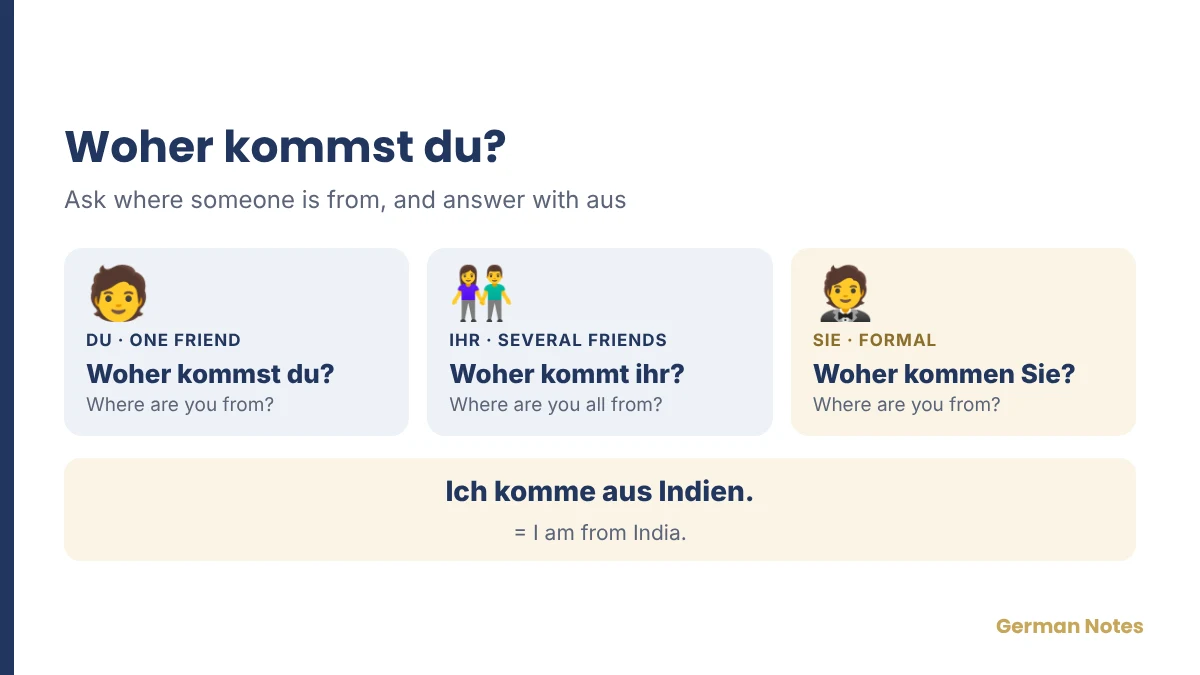
Kommst du aus Indien? is a yes-or-no question: Are you from India? You can answer Ja, ich komme aus Indien (Yes, I am from India) or Nein, ich komme aus Nepal (No, I am from Nepal). These phrases come up every time you introduce yourself, so practise them as whole sentences.
In formal situations, ask Woher kommen Sie? or Kommen Sie aus Indien? The subject and the verb change together. Woher kommt ihr? asks several friends where they're from.
Aus takes the dative. Most country names have no article, as in aus Indien or aus Deutschland. A few countries do have one and need the right form: aus der Schweiz (from Switzerland), aus den USA (from the USA). Don't add der or den to every country.
The same question can ask where someone has just come from. If a friend walks in with shopping bags, they might say Ich komme vom Markt, I'm coming from the market. The situation tells you whether woher is about someone's background or their last trip.
हिंदी में समझें
Woher kommst du? = तुम कहाँ से हो? जवाब: Ich komme aus Indien / aus Mumbai। आदर से: Woher kommen Sie? कई दोस्तों से: Woher kommt ihr? ज़्यादातर देशों के साथ article नहीं लगता (aus Indien), पर कुछ के साथ लगता है (aus der Schweiz, aus den USA)।
What is the simple past of kommen?
Kommen is a strong verb. In the simple past, the Präteritum, komm- changes to kam-. Notice there's only one m in kam, kamst and kamen.
| Subject | Präteritum | Example |
|---|---|---|
| ich | kam | Ich kam früh. = I came early. |
| du | kamst | Du kamst allein. = You came alone. |
| er / sie / es | kam | Sie kam am Abend. = She came in the evening. |
| wir | kamen | Wir kamen aus dem Garten. = We came from the garden. |
| ihr | kamt | Ihr kamt pünktlich. = You came on time. |
| sie / Sie | kamen | Sie kamen um neun. = They came at nine. / You came at nine. |
Ich and er/sie/es take kam with no ending. Du adds -st, and ihr adds -t. Avoid kommte, which applies the regular past pattern to a verb that doesn't follow it.
You'll often read kam in stories: Als der Bus kam, standen wir schon an der Haltestelle. = When the bus came, we were already standing at the stop. In conversation, people mostly use the Perfekt for past events, but kam turns up in speech too.
हिंदी में समझें
kam = आया/आई: Ich kam früh = मैं जल्दी आया। इसमें एक ही m है। kommte नहीं बनता। ich kam, er kam एक जैसे, du kamst, ihr kamt।
How do you form the Perfekt of kommen?
Use a present form of sein plus gekommen. Sein changes with the subject, and gekommen stays the same. That's true whether someone came on foot, by train or by car.
| Subject | Perfekt | English |
|---|---|---|
| ich | Ich bin gekommen. | I came / have come. |
| du | Du bist gekommen. | You came / have come. |
| er / sie / es | Er ist gekommen. | He came / has come. |
| wir | Wir sind gekommen. | We came / have come. |
| ihr | Ihr seid gekommen. | You came / have come. |
| sie / Sie | Sie sind gekommen. | They came / have come; you came / have come. |
- Ich bin gestern mit dem Zug gekommen. = I came by train yesterday.
- Meine Schwester ist etwas später gekommen. = My sister came a little later.
- Wir sind zusammen zum Kurs gekommen. = We came to the course together.
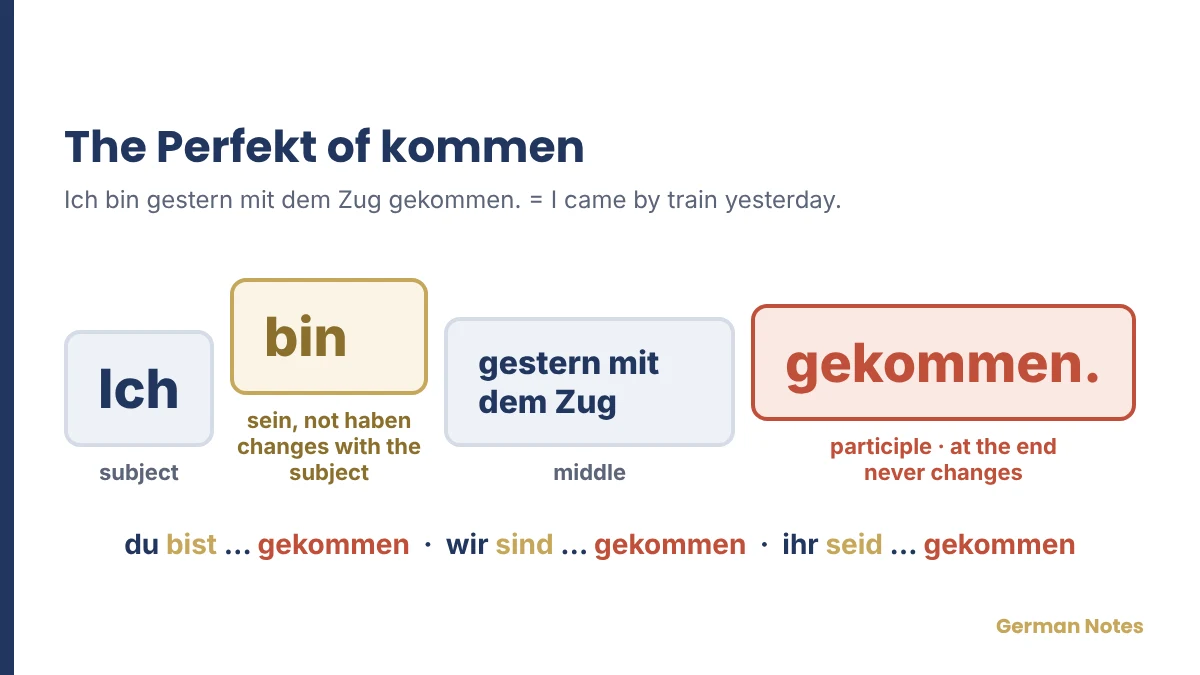
As these examples show, the German Perfekt often translates as the English simple past. Translating every sentence with have come would sound odd when a finished time like gestern is mentioned.
Write gekommen with ge- and the ending -en; gekommt is wrong. The helper is sein, so Ich habe gekommen is wrong too. Practise changing the subject while the participle stays: ich bin gekommen, du bist gekommen, ihr seid gekommen.
The sein conjugation guide explains which verbs take sein in the Perfekt, and the gehen conjugation guide covers another verb with the same pattern.
हिंदी में समझें
kommen का Perfekt sein से बनता है: Ich bin gestern mit dem Zug gekommen = मैं कल ट्रेन से आया। bin, bist, ist subject के साथ बदलते हैं, gekommen आख़िर में रहता है। Ich habe gekommen और gekommt दोनों ग़लत हैं।
Where does kommen go in questions and statements?
In a statement, the verb comes second: Ich komme heute. = I am coming today. If you start with heute, the subject follows the verb: Heute komme ich. A time phrase can take the first place, just like a subject.
For a yes-or-no question, start with the verb: Kommt ihr morgen? = Are you coming tomorrow? With a question word: Wann kommt ihr? = When are you coming? The verb comes right after wann.
The same pattern works with sein in the Perfekt: Wann seid ihr gekommen? = When did you come? Seid follows the question word, and gekommen goes to the end. In the answer, Wir sind gestern gekommen (We came yesterday), sind is in second place.
After a modal verb, use the infinitive kommen: Kannst du am Freitag kommen? = Can you come on Friday? The modal takes the du ending, so kommen doesn't change to kommst.
To ask one person you know to come in, say Komm bitte herein! (Please come in!). To several people, it's Kommt bitte herein!, and in formal speech Kommen Sie bitte herein! Bitte makes the request softer, though tone and situation still matter.
हिंदी में समझें
सवाल में verb पहले: Kommt ihr morgen? = क्या तुम लोग कल आ रहे हो? Wann kommt ihr? = तुम लोग कब आ रहे हो? modal के बाद kommen आख़िर में: Kannst du am Freitag kommen? अंदर बुलाने के लिए: Komm bitte herein! / Kommen Sie bitte herein!
Kommen, gehen or ankommen?
Kommen usually means moving towards the speaker, the listener, or the place you're visiting. If a friend calls you from home, Ich komme zu dir means I'm coming to your place. Gehen means to go and can describe leaving where you are now: Ich gehe jetzt means I'm leaving now.
The choice depends on point of view. Don't choose kommen just because a trip ends somewhere, or gehen just because it starts somewhere. Think about whose place the conversation is about.
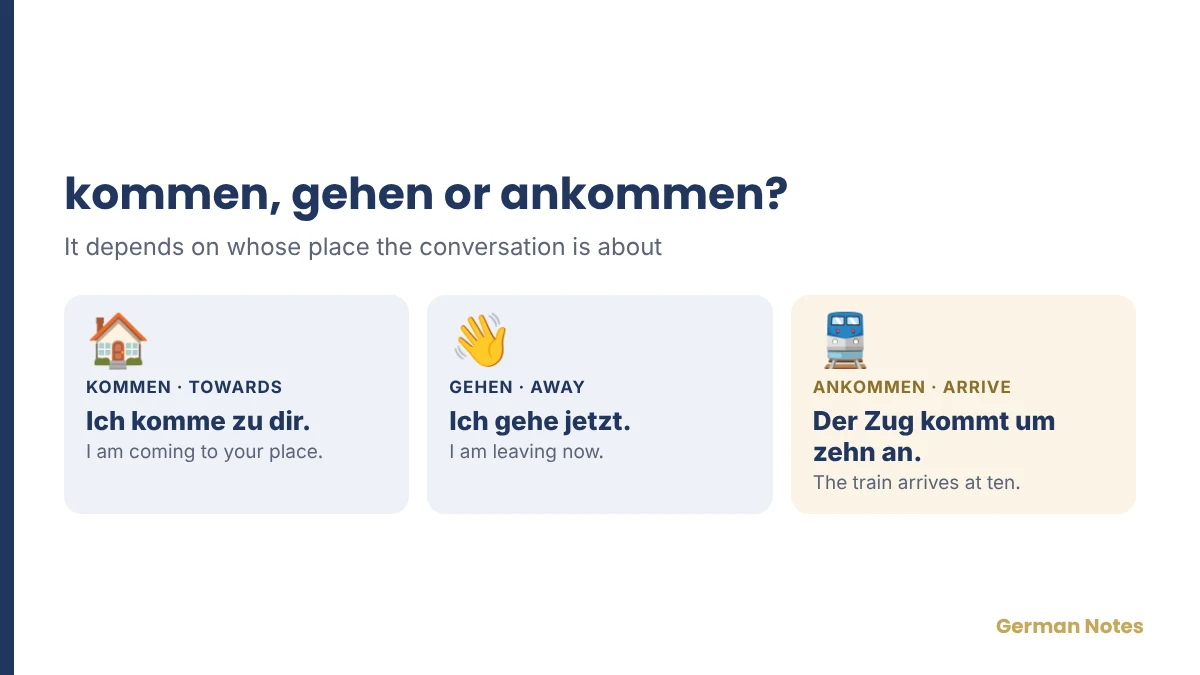
Ankommen means to arrive. Its prefix splits off in a main clause: Der Zug kommt um zehn an. = The train arrives at ten. The Perfekt is Der Zug ist angekommen (The train has arrived). Keep the prefix when you mean ankommen; gekommen is the participle of kommen.
हिंदी में समझें
kommen = पास आना: Ich komme zu dir = मैं तुम्हारे पास आ रहा हूँ। gehen = जाना / निकलना: Ich gehe jetzt = मैं अब चलता हूँ। ankommen = पहुँचना: Der Zug kommt um zehn an = ट्रेन दस बजे पहुँचती है। Perfekt: Der Zug ist angekommen।
What are the common mistakes with kommen?
| Learner error | Correction and reason |
|---|---|
| Ich bin komme. | Ich komme. = I am coming. No bin with a present-tense verb. |
| Du komst. | Du kommst. = You are coming. The present keeps two m. |
| Ich kommte. | Ich kam. = I came. The simple past is kam. |
| Ich habe gekommen. | Ich bin gekommen. = I came. kommen takes sein. |
| Woher kommt du? | Woher kommst du? = Where are you from? The du form is kommst. |
| Kannst du am Freitag kommst? | Kannst du am Freitag kommen? = Can you come on Friday? After a modal, use the infinitive. |
हिंदी में समझें
आम ग़लतियाँ: Ich bin komme नहीं, Ich komme। du komst नहीं, du kommst (दो m)। kommte नहीं, kam। habe gekommen नहीं, bin gekommen। Woher kommt du? नहीं, Woher kommst du?
Practice: fill in the form of kommen
Fill each gap with the correct form.
- Ich ___ aus Indien. (Present.)
- Woher ___ du? (Present.)
- Ihr ___ morgen. (Present.)
- Gestern ___ er spät. (Simple past.)
- Wir ___ zusammen. (Simple past.)
- Ich ___ mit dem Bus gekommen. (Perfekt helper.)
- Wann seid ihr ___? (Perfekt participle.)
- Kannst du am Samstag ___? (Infinitive.)
Answers
- komme
- kommst
- kommt
- kam
- kamen
- bin
- gekommen
- kommen
Now answer Woher kommst du? with your own city or country. Then ask a partner Wann kommst du? and answer with a day or a time.
Frequently asked questions
How do you conjugate kommen in the present tense?
ich komme, du kommst, er/sie/es kommt, wir kommen, ihr kommt and sie/Sie kommen. The stem komm- keeps its two m letters and its o in every present form.
Does kommen use haben or sein?
Kommen uses sein in the Perfekt: Ich bin gekommen. Change sein to match the subject, as in du bist gekommen and wir sind gekommen. The participle is always gekommen.
What is the difference between kam and gekommen?
Kam is a simple-past form: Er kam spät means He came late. Gekommen is a participle and needs a helper: Er ist spät gekommen also means He came late.
What does Kommst du aus Indien mean?
It means Are you from India? The informal du takes kommst. For formal address, ask Kommen Sie aus Indien? A positive answer is Ja, ich komme aus Indien.
Is kommt used with er or ihr?
Both. Er kommt means he comes or he is coming. Ihr kommt means you come or you are coming, said to several friends. The same verb form doesn't make the two subjects the same.
What is the difference between kommen and ankommen?
Kommen means to come; ankommen means to arrive. Ankommen splits in a main clause: Der Zug kommt um zehn an = The train arrives at ten. Its Perfekt is Der Zug ist angekommen.
Related lessons and practice
If you'd like feedback on your spoken sentences, check GermanNotes demo availability.
For reference: Duden's kommen conjugation table.